
Domestic Violence Attorneys in Fort Worth Texas: Helping Families Find Safety, Stability, and a Path Forward

It started with something so small it almost didn’t seem important. A mother sat in her car outside her home for nearly twenty minutes because she didn’t know what would happen when she walked through the front door. She wasn’t thinking about court dates or legal paperwork. She was wondering whether tonight would be peaceful or whether another argument would begin before dinner. Domestic Violence Attorneys in Fort Worth Texas help families facing moments exactly like these—moments when uncertainty, fear, and concern for loved ones make even ordinary routines feel overwhelming. The good news is that Texas law provides meaningful protections, and taking the first step toward understanding your options can begin restoring both safety and peace of mind.
At The Law Office of Bryan Fagan, PLLC, we believe no family should have to navigate these challenges alone. Founded by Bryan Joseph Fagan, a graduate of South Texas College of Law and a recognized authority on Texas divorce and child custody law, our firm has spent years helping families move through some of life’s most difficult transitions with compassion, practical guidance, and trusted legal counsel. We understand that when family violence becomes part of a divorce or custody dispute, clients are searching for more than legal answers—they are looking for stability, clarity, and confidence about what comes next. That commitment to educating families and protecting their futures is at the heart of everything we do.
Texas law reflects many of these same priorities. Under Texas Family Code §153.002, courts must make custody decisions based on the best interest of the child, carefully considering each family’s unique circumstances. When domestic violence is present, judges also evaluate how a child’s safety, emotional well-being, and daily stability may affect future custody arrangements. These decisions can influence where a child lives, how parenting time is structured, and the environment in which they can heal and thrive.
In this article, you’ll learn how family violence can influence divorce, child custody, protective orders, and parenting plans under Texas law. We’ll also explore the often-overlooked connection between domestic violence, family stability, and a child’s overall well-being, while offering practical guidance that can help parents protect their children and move forward with greater confidence. Our goal is simple: to provide the knowledge and support you need to make informed decisions and begin building a safer, more secure future for your family.
Quick Answer
In Texas, a person experiencing family violence can ask a court for a protective order that legally requires the other person to stay away and stop the abuse. There is no fee to file, an emergency or temporary order can be issued quickly, and a final order can last up to two years. Domestic violence can also affect divorce and custody decisions.
Key Takeaways
- A protective order legally requires an abuser to stay away and stop the violence.
- There are three main types: emergency, temporary ex parte, and final protective orders.
- There is no fee to apply for a protective order in Texas (§81.002).
- A court must find that family violence occurred and is likely to occur again (§85.001).
- A final protective order generally lasts up to two years.
- Family violence can affect divorce and custody outcomes.

Your Family’s Future Starts Here
Don’t navigate your legal journey alone. Schedule a consultation now and get the clarity and support you deserve.
Our office is available 24/7. Do not hesitate to schedule your free case evaluation by calling 817-406-7230 or contacting us online today.
What Counts as Family Violence in Texas

Domestic Violence Attorneys in Fort Worth Texas often explain that family violence includes far more than physical assault. Under Texas Family Code §71.004, family violence generally includes acts intended to cause physical harm, bodily injury, assault, or sexual assault, as well as threats that reasonably place someone in fear of imminent harm. The law is designed to help protect individuals and families before a situation becomes even more dangerous.
Texas applies this broad definition to many different relationships, including spouses, former spouses, dating partners, parents, children, co-parents, roommates, and other household members. Family violence may involve physical abuse, stalking, harassment, coercive control, emotional abuse, financial abuse, or credible threats. These situations can also affect divorce, child custody, visitation, and conservatorship decisions because courts focus on protecting the best interests of children and vulnerable family members.
Many people hesitate to seek help because they believe they need visible injuries or a police report before they have legal options. In many cases, that is not true. A person may be able to seek a protective order without an arrest if the available evidence—such as text messages, emails, photographs, medical records, witness statements, or other documentation—shows that family violence has occurred or that there is a reasonable fear of future harm. Every case depends on its own facts, but understanding your rights early can make a meaningful difference.
For families relocating to Tarrant County or beginning a new chapter after leaving an abusive relationship, understanding both your legal protections and your new community can help you move forward with greater confidence. Our guide to moving to Fort Worth offers practical information about living in the area while you focus on rebuilding stability and peace of mind.
At The Law Office of Bryan Fagan, PLLC, we believe that education empowers families to make informed decisions during life’s most difficult transitions. Whether your situation involves a protective order, divorce, child custody, or multiple related legal issues, understanding what Texas law considers family violence is the first step toward protecting yourself, your children, and your future.
The Three Types of Protective Orders
Texas offers different protective orders for different moments, from the immediate aftermath of an arrest to long-term protection after a hearing. Understanding which is which helps you know what to ask for.
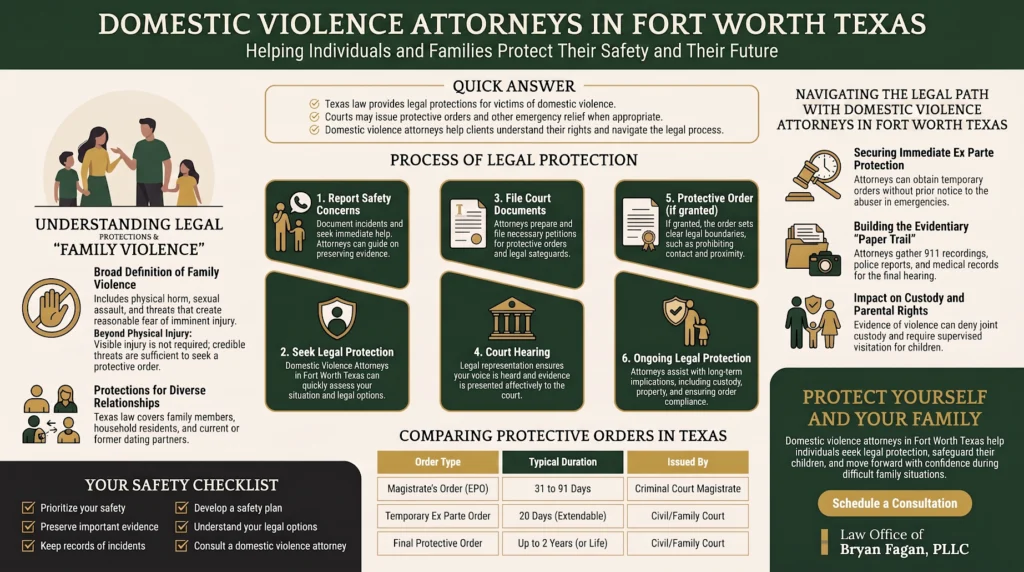
An emergency protective order (formally a Magistrate’s Order for Emergency Protection) is issued by a criminal court after an abuser is arrested for family violence. A temporary ex parte order, under §83.001, can be granted without the other person present when a judge sees a clear and present danger — important protection in the gap before a full hearing. A final protective order, under Chapter 85, follows notice and a hearing and provides the longest-lasting protection.
How to Get a Protective Order in Texas
The process starts with an application filed with the court. Under §82.002, an adult member of the family or household can file — for themselves or another member — and a prosecutor or the Department of Family and Protective Services can also file on a survivor’s behalf. Importantly, under §81.002 there is no fee to apply.
For a final protective order, the court must make two findings under §85.001: that family violence occurred, and that it is likely to occur again. The standard of proof for a final order is a preponderance of the evidence. If the court makes those findings, it can order the abuser to stay away, cut off contact, leave a shared home, surrender firearms, and more. Because these cases move quickly and the details matter, having an attorney or a domestic-violence advocate help prepare the application can make a real difference — though no one can promise how a court will rule.
It helps to know what to expect along the way. You generally file in a county where the violence occurred or where either party lives. Evidence can include your own account of what happened, any photos, messages, or medical records, and the accounts of witnesses. If there is an immediate danger, the court can put a temporary ex parte order in place before the other person is even notified, so you are not left unprotected while the case is pending. Then, at the hearing for a final order, both sides have a chance to be heard before the court decides. A lawyer or advocate can help you gather what you need and prepare for that hearing, which often makes the process feel far less daunting.
What a Protective Order Can Do

Domestic Violence Attorneys in Fort Worth Texas help families understand that a protective order is a legally enforceable court order designed to increase safety, reduce contact with an abusive person, and provide immediate legal protections. Depending on the facts of the case, a protective order may prohibit contact, require the respondent to stay away from your home, workplace, or your child’s school, remove someone from a shared residence, address temporary child custody issues, and, in some situations, require the surrender of firearms. Under Texas Family Code Chapter 85, these orders are intended to help prevent future family violence—not simply respond after additional harm occurs.
A protective order is only effective if it is enforced. Violating a protective order can result in arrest, criminal charges, or contempt of court, making it much stronger than a typical civil restraining order used during a divorce. If you believe an order has been violated, keep a copy of the order available, contact law enforcement immediately, and document what occurred. In straightforward protective order cases, enforcement may resolve the issue quickly. If there are repeated violations, pending criminal charges, or ongoing child custody disputes, additional legal action may be necessary to protect you and your family.
Protective orders can also play an important role in divorce and conservatorship proceedings. Texas courts consider a child’s safety and best interests under Texas Family Code §153.002, and evidence of family violence may influence decisions involving visitation, parenting plans, and temporary custody. If children witnessed the abuse, if CPS is involved, or if emergency custody becomes necessary, the family law issues often become more complex and require a coordinated legal strategy.
Many families are also concerned about what happens after they decide to seek protection. Planning your visit ahead of time can help reduce stress during an already difficult period. Before coming to meet with our team, you can review our Plan Your Visit to Our Fort Worth Office guide for information about our location, parking, and what to expect during your consultation.
At The Law Office of Bryan Fagan, PLLC, we believe that understanding your legal options is the first step toward restoring safety and peace of mind. Whether your situation involves obtaining a protective order, coordinating it with a divorce, or protecting your children through custody proceedings, our goal is to educate families, provide practical guidance, and help you make informed decisions with confidence.
Which protective order might fit?
↓
↓
↓
If you are in immediate danger, call 911 first. To understand your options, speak with a Fort Worth attorney or a domestic-violence advocate.
How Family Violence Affects Divorce and Custody
Family violence does not stay in its own lane — it can shape a custody case and a divorce. Texas courts decide custody based on the best interest of the child, and a history of family violence is a serious factor a court weighs, potentially affecting who is named as the primary conservator and whether visitation is limited or supervised.
In a divorce, family violence can also be relevant to how a court views fault and, in some cases, the division of property. If you are dealing with both safety concerns and a family-law case, it helps to work with attorneys who handle them together, so your protection and your case strategy are aligned rather than at odds. For defense of a criminal family-violence charge — a separate matter from the family-law protections described here — a criminal defense attorney is the right resource.
There is also a practical timing point. Bringing safety concerns forward early in a divorce or custody case, rather than after arrangements are already set, lets the court build protections into its temporary orders from the start — for example, structuring how the children are exchanged, or who remains in the family home while the case is pending. Family violence does not automatically decide a custody case, but it is a serious factor the court must weigh, and raising it properly and early is part of protecting both you and your children as the case moves forward.
Common Misconceptions
Fear and misinformation keep many survivors from seeking help, and the myths tend to be the very things that make people hesitate. A few common ones are worth correcting directly.
“It costs money to file for a protective order.” It does not — Texas law prohibits charging a fee to apply. “I have to wait until I’m physically hurt.” No; a credible threat that places you in fear of imminent harm can qualify as family violence. “The abuser has to be arrested first.” Not for a family-law protective order — an arrest is required only for the criminal-court emergency order, while you can pursue a temporary or final order without one. “A protective order and a restraining order are the same thing.” They are different tools; a protective order specifically addresses family violence and carries criminal enforcement for violations. Knowing the truth can make reaching out feel possible.
Situations We Help With

Domestic Violence Attorneys in Fort Worth Texas help people facing many different family violence situations, whether they involve an immediate safety concern, a pending divorce, or ongoing child custody issues. Every case is unique, and Texas law provides different legal options depending on the circumstances. The examples below reflect common situations families experience—not guaranteed outcomes—and are intended to help you recognize when legal protections may be available.
A parent may need a temporary or final protective order after an incident involving family violence while also seeking emergency custody to protect a child. Another person may be preparing to file for divorce and want temporary orders that address safety, visitation, child support, and use of the family home from the beginning of the case. In other situations, someone may face repeated threats, stalking, or harassment from a current or former dating partner even though no arrest has occurred, raising important questions about whether a protective order is appropriate under Texas law.
In straightforward protective order matters, the primary goal may be stopping unwanted contact and creating immediate legal protection. In more complex cases involving divorce, conservatorship, CPS investigations, relocation, or repeated violations of existing court orders, multiple legal issues often need to be addressed together to create a long-term plan for safety and stability. Every decision should be guided by the specific facts of the case and the court’s responsibility to protect the child’s best interests.
One concern many survivors share is whether their situation is “serious enough” to seek help. The answer often depends on the facts, but family violence is not limited to physical injuries. Threats, coercive control, emotional abuse, and other conduct recognized under Texas Family Code §71.004 may also support legal action. Understanding your options early can help you preserve evidence, develop a family safety plan, and avoid unnecessary delays that could affect your legal rights.
Whether you are seeking protection close to home or traveling to meet with an attorney, planning ahead can reduce additional stress during an already difficult time. If you’re preparing to visit our office, our guide to Transportation in Fort Worth offers helpful information about getting around the city. You can also learn more about our Protective Orders and Child Custody services to better understand how The Law Office of Bryan Fagan, PLLC helps families throughout Fort Worth and Tarrant County move forward with clarity, confidence, and compassion.
What Happens Next? The General Process
Every situation differs, but seeking protection generally follows a recognizable path. This is the shape of the process, not a promise of timing or outcome — and step one is always safety.
1. Get safe — if you are in danger, call 911 or the hotline first.
2. Talk to an attorney or advocate — understand your options and gather what you need.
3. File the application — with the court, at no fee.
4. Temporary order if there is danger — a court may issue one before the hearing.
5. Hearing — the court considers the evidence for a final order.
6. Final order and enforcement — if granted, the order is enforceable by law.
Protective Orders in Fort Worth & Tarrant County
Protective-order applications for Fort Worth families are filed and heard in the Tarrant County courts, and knowing how those courts handle these cases helps a survivor move forward with less uncertainty. Our Fort Worth office can help you prepare an application, seek temporary protection where there is danger, and pursue a final order after a hearing.
Because safety often intersects with a divorce or custody matter, we handle protective orders alongside the broader family-law case when needed, so your protection and your case work together. And because reaching out can be the hardest step, we aim to make that first conversation calm, confidential, and focused on what you need — starting with your safety.
Fort Worth and Tarrant County also have community resources that work alongside the legal process — shelters, advocates, and counseling services that support survivors and their children. A good legal team does not operate in a vacuum; part of helping is connecting you with the right support and coordinating the legal protection with the safety plan those advocates help you build. You do not have to assemble all of that yourself, and you do not have to do it alone.
Listen to Our Texas Family Law Podcast
Prefer listening? In this episode, we discuss domestic violence attorneys in Fort Worth, Texas, including how legal representation can help protect your rights, obtain protective orders, and navigate family law matters involving domestic violence.
When to Get Help Immediately
· You are in immediate danger — call 911.
· You have been threatened or hurt and need support — the hotline is available 24/7 at 800-799-7233.
· An abuser has been arrested and you want to understand emergency protection.
· You are planning to leave and want protection in place first.
· A protective order has been violated — report it to law enforcement.
How Our Firm Helps Fort Worth Survivors

Domestic Violence Attorneys in Fort Worth Texas provide more than legal representation—they help families understand their options, develop a plan for safety, and navigate the legal process with confidence. At The Law Office of Bryan Fagan, PLLC, our team has served Texas families since 2012 and includes more than 170 legal professionals across the state. Whether your situation involves a protective order, divorce, child custody, or multiple related family law matters, our goal is to help you make informed decisions while keeping your safety and your children’s well-being at the center of every strategy.
In straightforward protective order cases, we help clients prepare the necessary court filings, organize supporting evidence, and understand what to expect during the hearing process. In more complex situations involving divorce, conservatorship, CPS investigations, relocation, or emergency custody, we develop a coordinated legal approach that addresses each issue together rather than treating them as separate matters. Because every family is different, we tailor our guidance to the specific facts of your case and the protections available under Texas law.
Your first meeting is designed to provide clarity, not confusion. During a confidential Legal Strategy Session, one of our attorneys listens to your concerns, explains the legal process in plain English, and discusses practical options based on your circumstances. If you need information about local public offices, courts, or other official services before your appointment, our guide to governmental resources in Fort Worth can help you become familiar with important community resources.
If you are in immediate danger, call 911 or seek assistance from emergency services before taking any legal action. Once you are safe, our team is here to help you understand protective orders, family violence proceedings, divorce, and child custody issues with the compassion, education, and practical guidance that have made The Law Office of Bryan Fagan, PLLC a trusted resource for families throughout Fort Worth, Tarrant County, and across Texas.
Our Fort Worth Office
The Law Office of Bryan Fagan, PLLC
204 W Central Ave, Fort Worth, TX 76164 · Tarrant County
Open 24 hours
Call 817-406-7230How Domestic Violence Protective Orders Work in Texas
Tap each stage to see how protective orders work in Texas and which part of the law applies. This is a general overview, not legal advice about any particular case. If you are in immediate danger, call 911 or the National Domestic Violence Hotline at 800-799-7233 before anything else. The steps below can wait until you are safe.
1 · Recognize family violence — §71.004
Family violence includes an act by a family or household member, or dating partner, intended to cause harm or injury, and threats that place a person in fear of imminent harm. It does not include reasonable self-defense.
You do not have to be physically injured — a credible threat can qualify.
2 · Choose the right order — emergency, temporary, or final
An emergency order (MOEP) can follow an arrest. A temporary ex parte order can be issued before a hearing when there is a clear and present danger. A final order follows notice and a hearing and lasts longest.
An attorney or advocate can help you decide which fits your situation. In many cases these work together — a temporary order provides protection right away while a final order is pending.
3 · File the application — §82.002, §81.002
An adult family or household member can file, and a prosecutor or DFPS can file on a survivor’s behalf. There is no fee to apply.
You file in a county where the violence occurred or where either party lives.
4 · The hearing and findings — §85.001
For a final order, the court must find that family violence occurred and is likely to occur again, by a preponderance of the evidence.
If the court makes those findings, it can order no contact, stay-away conditions, and more.
5 · Enforcement
A protective order carries the force of law. Violating it is a crime that can lead to arrest and charges, which is part of what makes the order protective.
Keep a copy accessible, and report any violation to law enforcement. An order can also require the person to surrender firearms, adding another layer of protection.
Every situation is different, and this overview is not legal advice about a specific case. If you are in danger, call 911 or the hotline at 800-799-7233. To understand your options, speak with a Fort Worth attorney or a domestic-violence advocate.
Ready to talk about protection?
When you are safe and ready, a Legal Strategy Session is a confidential place to understand your options.
Schedule a Legal Strategy Sessionor call 281-810-9760
What I Tell Every Client Facing Family Violence
Domestic Violence Attorneys in Fort Worth Texas begin every conversation with the same priority: your immediate safety comes first. If you or your children are in danger, contact 911 or emergency services before taking any legal action. Protective orders, temporary ex parte orders, and other legal remedies under Texas law are powerful tools, but they work best as part of a broader safety plan designed to protect you both now and in the future.
The second thing I want every client to know is that you do not have to decide on your own whether your situation is “serious enough.” Many people worry they lack enough evidence because there are no visible injuries or no police report was filed. Family violence under Texas Family Code §71.004 can include threats, stalking, coercive control, and other abusive behavior, and understanding how those facts apply to your circumstances is an important part of developing the right legal strategy. In straightforward cases, a protective order may address the immediate concern. If divorce, child custody, CPS involvement, or multiple court proceedings are also part of your situation, a more comprehensive approach may be appropriate.
Finally, I tell every client that while no attorney can honestly promise a particular outcome, every client deserves to be treated with dignity, respect, and compassion. Our role is to educate you about your options, explain the legal process in plain English, and help you make informed decisions that protect what matters most. When you are safe and ready to take the next step, you can schedule a confidential Legal Strategy Session with our Fort Worth office to discuss your circumstances and begin building a plan tailored to your family’s needs.
Your Fort Worth Attorney
Bryan Bubis — Associate Attorney, Fort Worth
13 Years of Legal Experience · Tarrant, Johnson & Parker County Courts
Bryan Bubis regularly helps Tarrant County families with protective orders and family-violence issues in divorce and custody cases, bringing 13 years of legal experience across family law, criminal defense, and probate. He approaches these sensitive matters with discretion and care, keeping a client’s safety and children at the center of the plan. He earned his Bachelor’s in Business Management from Texas A&M University and his Juris Doctor from Texas A&M School of Law.
Bryan works with clients in the Tarrant, Johnson, and Parker county courts, and he can meet with you at the firm’s Fort Worth office. Read Bryan Bubis’s full profile.
Conclusion
Domestic violence can change nearly every aspect of a family’s life, but it does not have to define your future. Understanding your legal rights, protecting your children, and creating a stable path forward are all achievable with the right information and thoughtful planning. Whether you are seeking a protective order, navigating divorce, or working to preserve your child’s emotional and academic stability, Domestic Violence Attorneys in Fort Worth Texas can help you understand the legal options available under Texas law and develop a strategy that reflects your family’s unique circumstances. In straightforward situations, parents may simply need guidance on the legal process and a well-crafted parenting plan. In more complex cases involving family violence, contested custody, protective orders, relocation, or concerns about a child’s safety, having an attorney with experience handling high-conflict family law matters can make a meaningful difference.
At The Law Office of Bryan Fagan, PLLC, we believe families make stronger decisions when they have clear information and trusted guidance. Our goal is not simply to resolve a legal dispute, but to help you regain confidence, restore stability, and protect what matters most. If your case involves domestic violence, complex custody issues, or questions about your family’s future, a Legal Strategy Session can help you better understand your options and determine the approach that best fits your situation. Every family’s story is different, and every legal strategy should be, too.
About the Author
Bryan Fagan
Founder & Managing Attorney · Serving Texas families since 2012
I am Bryan Fagan, founder and managing attorney of The Law Office of Bryan Fagan, PLLC, one of the largest family law firms in Texas. I earned my Juris Doctor from South Texas College of Law, I am an elected member of the College of the State Bar of Texas, and I lead a team of more than 170 legal professionals with offices across the state.
I am also the author of The Texas Divorce Handbook, because I believe families make better decisions when they understand the law that affects them. Family violence is one of the most serious situations a family can face, and safety and clarity come first. Out of our Fort Worth office, our team helps survivors across Tarrant County find protection and a path forward. Read more about Bryan Fagan.
Frequently Asked Questions
A protective order is a court order that legally restricts an abuser’s contact and conduct to protect a survivor of family violence. It can require the person to stay away, stop all contact, leave a shared home, and surrender firearms, and violating it is a crime.
You file an application with the court — there is no fee (§81.002). An adult family or household member can file, and a prosecutor or DFPS can file on a survivor’s behalf. For a final order, the court must find that family violence occurred and is likely to occur again (§85.001).
No. Under Texas Family Code §81.002, an applicant may not be charged a fee to apply for a protective order. Cost should never be a barrier to seeking protection.
It depends on the type. An emergency protective order after an arrest typically lasts about 31 to 91 days, a temporary ex parte order is short-term until a hearing, and a final protective order generally lasts up to two years.
Yes. Under §83.001, a court can issue a temporary ex parte order without the other person present when there is a clear and present danger of family violence. A final order, however, follows notice and a hearing.
Yes. Family violence is a serious factor in custody decisions, which are based on the best interest of the child, and can affect conservatorship and visitation. It can also be relevant to fault and, in some cases, property division in a divorce.
They are different tools. A protective order specifically addresses family violence and is enforceable by criminal penalties if violated. A restraining order is typically a civil order used in other contexts, such as within a divorce, and does not carry the same criminal enforcement.
An adult member of the family or household can file, for themselves or another member. A prosecuting attorney or the Department of Family and Protective Services can also file on behalf of a survivor (§82.002).
Violating a protective order is a crime in Texas and can lead to arrest and criminal charges. If an order against you is violated, report it to law enforcement right away, and keep a copy of the order accessible.
Your safety comes first
In an emergency call 911 or the hotline at 800-799-7233. When you are ready, our Fort Worth team is here to help.
Schedule a Legal Strategy Sessionor call 281-810-9760
