
Child Protective Services Defense Attorneys in Fort Worth Texas

A knock at the door. A call from your child’s school. A caseworker’s card left on the kitchen counter. For many Texas parents, that is how everything changes in an afternoon — and in the hours after, the hardest part is not knowing what happens next or what you are still allowed to do. If that is where you are, the Child Protective Services Defense Attorneys in Fort Worth, Texas at The Law Office of Bryan Fagan, PLLC help parents across Tarrant County understand their rights and stand with them at every stage.
Take a breath. You have more rights than you may realize, and the process ahead follows rules and deadlines set by law — not by any single caseworker’s opinion of your family. Our team has guided Texas families through these cases for years, and we know how much clarity matters in the early days. Here is the one thing worth knowing first: if a child has been removed, Texas Family Code §262.201 requires a full adversary hearing within 14 days — so the sooner you understand your options, the more prepared you can be when it counts.
That single deadline is why families reach out to us early, and it is also why we built this guide. Our purpose has always been to help people reclaim peace of mind during life’s hardest moments, and with a CPS case that starts with clarity: knowing how the process works, what the State has to prove, and where your voice fits in. In the sections below, we walk through each stage of a Texas CPS case in plain language — the investigation, the adversary hearing, the service plan, and the timeline that governs it all — so that whatever brought you here, you leave understanding your next step.
A CPS defense attorney in Fort Worth represents parents during a Texas Department of Family and Protective Services (DFPS) investigation and any resulting court case — protecting your legal rights from the initial investigation through the full adversary hearing, service plan, and permanency proceedings in Tarrant County courts.
Key Takeaways
- · A CPS case in Texas is a civil child-welfare matter run by DFPS under the Texas Family Code — separate from any criminal case, though the two can overlap.
- · You have the right to consult an attorney at any stage, including before answering questions or signing anything.
- · If a child is removed, a full adversary hearing must be held by the 14th day under §262.201 — the first chance to contest the removal before a judge.
- · DFPS carries the burden of proof; it must persuade the court, on evidence, before a child stays in its care.
- · Cases seeking conservatorship or termination generally run about a year under the §263.401 dismissal timeline, giving families time to work toward reunification.
- · Fort Worth cases are heard in the Tarrant County courts; a local attorney can meet with you and guide you through them.

Your Family’s Future Starts Here
Don’t navigate your legal journey alone. Schedule a consultation now and get the clarity and support you deserve.
Our office is available 24/7. Do not hesitate to schedule your free case evaluation by calling 817-406-7230 or contacting us online today.
What Child Protective Services Does in Texas

Family owned businesses and farms in Houston Heights Texas can face unexpected challenges when a DFPS or CPS investigation overlaps with divorce, child custody, or estate planning. Although the Texas Department of Family and Protective Services focuses on child safety under Chapter 261 of the Texas Family Code, the investigation can temporarily affect who manages daily operations, makes financial decisions, or oversees a family enterprise. For multigenerational businesses, planning ahead helps protect both the family and the business during periods of uncertainty.
A CPS investigation is a civil child-welfare matter, not automatically a criminal case or a dispute over business ownership. However, when it coincides with a divorce or custody case, it can influence parenting schedules, conservatorship, and the availability of an owner or key decision-maker. Understanding your legal rights early—and knowing how to respond appropriately—can reduce unnecessary disruption to both your family and your business. For additional guidance, read our article on How to Cooperate with DFPS Without Compromising Your Divorce Proceedings.
In straightforward succession plans, documents such as powers of attorney, trusts, and operating agreements often provide a clear path for business continuity if an owner becomes temporarily unavailable. In more complex family businesses—including LLCs, partnerships, farms, ranches, and closely held companies—those governing documents become even more important. Texas Business Organizations Code §101.052 allows an LLC company agreement to establish how the business will be managed, helping prevent uncertainty during a family crisis.
The same planning principles apply to family farms, commercial real estate, and other generational assets throughout Houston Heights, Harris County, and Texas. Buy-sell agreements, trust planning, probate avoidance strategies, and clearly defined succession plans can reduce conflict, preserve operations, and protect the legacy a family has spent decades building.
The goal is not simply to navigate a legal challenge—it is to preserve stability for both your loved ones and your livelihood. Through thoughtful estate planning, probate planning, business succession strategies, and asset protection, The Law Office of Bryan Fagan, PLLC helps Texas business owners create practical plans that protect what matters most while providing greater clarity and peace of mind for the future.
You have the right to consult an attorney. At every stage of a CPS matter, you may seek legal advice. If a case reaches court and you cannot afford a lawyer, the court must inform you of your right to be represented, and indigent parents who oppose the suit may qualify for a court-appointed attorney under Texas law.
The Texas CPS Case Process, Step by Step
Texas CPS cases follow a statutory sequence with firm deadlines. The interactive explorer below walks through each stage; here is the overview.
Investigation (Chapter 261)
DFPS reviews the report, may interview the child, parents, and others, and assesses whether the child is safe. An investigation can close with no finding, close with a finding but no court case, or escalate to a request for court intervention. During this stage the agency may ask to enter your home, speak privately with your children, request drug testing, or ask you to agree to a safety plan. How you respond to these requests can shape the direction of the case, and it is a stage where early legal advice is often most useful, because decisions made here are made before any judge is involved.
Removal (Chapter 262)
If DFPS believes a child is in immediate danger, it can seek a court order to remove the child, or in an emergency remove first and go to court shortly after. Removal is not the end of the story — it triggers a fast court timeline built to put the decision in front of a judge quickly. The law treats removal as a serious step, and it requires the agency to justify that step to a court within days rather than weeks. That short window is why having counsel early can matter so much: the first hearing comes fast.
The Full Adversary Hearing (§262.201)
When a child is removed, Texas Family Code §262.201 requires a full adversary hearing no later than the 14th day after the child is taken into possession. This is the first real chance to contest the removal before a judge. If you appear in opposition and need time to hire or prepare a lawyer, the court may, for good cause, postpone the hearing for up to seven additional days. At the hearing, DFPS carries the burden of showing why the child should stay in its care; if it cannot meet that burden, the statute directs the court to return the child.
This hearing often sets the tone for everything that follows. The court decides whether the child stays in DFPS care and enters temporary orders that can govern where the child lives, what contact you have, and what you are asked to do in the near term. Because so much can be decided at this early stage, and because it arrives on a compressed timeline, it is the point at which many families most want experienced counsel at their side.
Service Plan & Permanency (Chapter 263)
If the child remains in DFPS care, the agency prepares a service plan under Chapter 263 — the specific steps a parent is asked to complete. The court reviews progress at status and permanency hearings. These stages are where much of the work of a case happens.
A service plan may include tasks such as classes, evaluations, counseling, or other requirements the agency ties to the concerns it raised. At status and permanency hearings, the court checks on progress toward the plan’s goals and toward a permanent outcome for the child — ideally reunification. You have the right to understand what the plan requires and to raise concerns with the court if the terms seem unclear, unrealistic, or disconnected from the actual issues in your case. This is a phase measured in months, and steady, well-advised engagement with it is often what moves a case forward.
The one-year clock. Under §263.401, a DFPS case seeking conservatorship or termination is automatically dismissed on the first Monday after the first anniversary of the temporary order naming DFPS as managing conservator — unless trial has begun or the court grants a one-time extension of up to 180 days for extraordinary circumstances. In practice this gives families roughly a year to work toward reunification.
Your Rights as a Parent in a CPS Case

Family owned businesses and farms in Houston Heights Texas are often built on years of hard work, careful planning, and shared family responsibility. When a CPS investigation arises during a divorce or custody dispute, it is important to remember that parents retain significant legal rights throughout the process. Texas law requires courts—not individual caseworkers—to decide the outcome based on the evidence, giving families an opportunity to be heard while protecting both their children and the long-term stability of their business or family enterprise.
Understanding those rights early can make a meaningful difference. Parents have the right to consult an attorney before answering questions or signing documents, to understand the allegations being made, and to participate fully in every court hearing. If the case proceeds to court, Texas Family Code §262.201 provides important protections, including notice of the right to counsel and, in some circumstances, the appointment of an attorney for eligible parents. For a deeper discussion of how custody decisions intersect with DFPS investigations, see our guide on Understanding Custody in the Context of DFPS Evaluations.
In straightforward situations, knowing your rights may help resolve the matter before it significantly disrupts your family or business operations. In more complex cases involving family-owned companies, farms, ranches, LLCs, or closely held businesses, early preparation becomes even more valuable. A parent responsible for managing employees, overseeing agricultural property, or making financial decisions should have a plan that addresses both the legal proceedings and the continued operation of the business.
Just as a succession plan protects a company during retirement, incapacity, or death, understanding your legal rights helps protect your family during unexpected challenges. Through thoughtful estate planning, business succession planning, trusts, and asset protection strategies, The Law Office of Bryan Fagan, PLLC helps families throughout Houston Heights, Harris County, and Texas preserve what generations have worked to build while creating greater clarity and peace of mind for the future.
If a caseworker contacts you
Stay calm and courteous. You are allowed to tell a caseworker that you want to speak with an attorney before answering questions or signing documents — asking for a lawyer is your right, not an admission of anything. Getting legal advice early helps you respond accurately and understand what is being asked of you.
What DFPS Has to Prove — and Why It Matters
One of the most important things for a parent to understand is that CPS does not get to decide the outcome on its own. When the agency asks a court to keep a child in its care, it carries the burden of proof. It must persuade the judge, on evidence, that the legal standard is met. If it cannot, the statute favors returning the child. That framework — the agency proves its case to a neutral judge — is the backbone of your defense.
At the full adversary hearing under §262.201, the court is required to return the child unless it finds sufficient evidence to satisfy a person of ordinary prudence and caution on specific points the statute lays out, including that there was a danger to the child, that removal was urgently needed, and that reasonable efforts were made. A defense attorney holds the agency to that standard: testing its evidence, presenting the facts that tell your side, and keeping the court’s decision anchored to what the law requires.
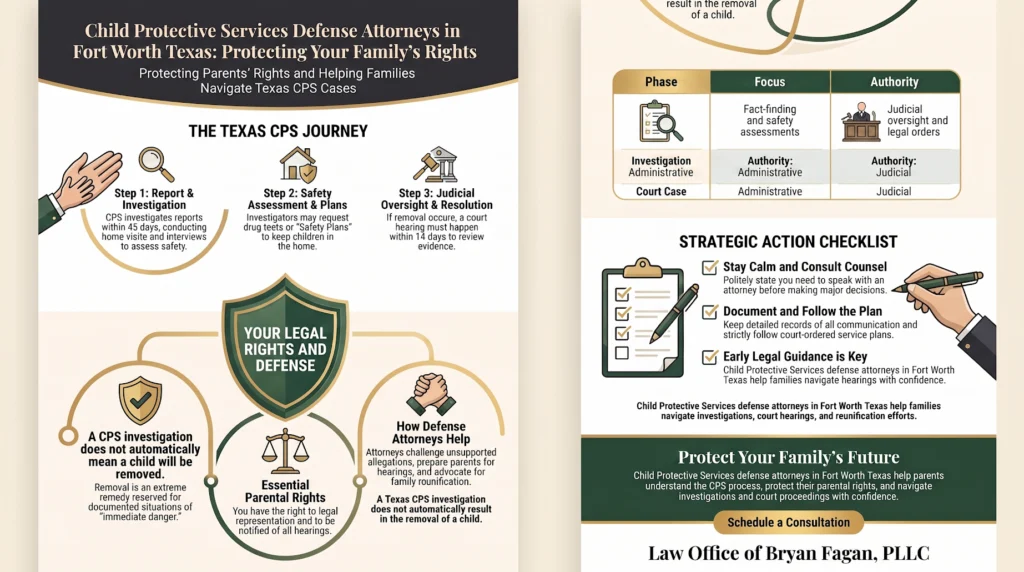
Common Situations That Lead to CPS Involvement
CPS cases start in many ways, and understanding the common paths can help you make sense of your own situation. None of these situations is a verdict — a report or an investigation is a starting point, not a finding, and the law requires the agency to prove its case before a court can act.
Reports from professionals
Teachers, doctors, nurses, and counselors are among the people Texas law requires to report suspected abuse or neglect. Many investigations begin with a report from a school or a medical provider. A report of this kind is a legal duty on the reporter’s part; it is not a conclusion about your family, and it begins a process in which you have the right to respond.
Allegations that overlap with a divorce or custody dispute
CPS sometimes becomes involved in the middle of a contentious separation or custody fight, when one parent reports concerns about the other. These situations can be especially tangled, because a family law case and a CPS case may be proceeding at the same time. Coordinating the two matters carefully is important, and it is one reason families often want a firm that handles both.
Neglect and living-condition allegations
A significant share of CPS matters involve allegations of neglect rather than intentional harm — concerns about supervision, housing, medical care, or a parent’s own circumstances. The legal standards that apply to these cases are specific, and what the agency must show to a court is not the same as what a caseworker may initially believe. Poverty and hardship are not the same as neglect under the law, and understanding that gap is often central to a defense.
Substance use and related concerns
Cases involving allegations of substance use often come with service-plan requirements such as testing or treatment. Texas law specifically directs courts, when weighing whether to extend a case, to consider a parent’s good-faith effort to complete a substance abuse treatment program. Genuine engagement with a plan can matter, and a lawyer can help you understand what the plan asks and how the court will view your progress.
Listen to Our Texas Family Law Podcast
Prefer listening? In this episode, we explain the five phases of a Texas CPS investigation for Fort Worth families, including what happens during each stage, your rights throughout the process, and how to respond if Child Protective Services contacts your family.
CPS Cases in Fort Worth & Tarrant County

Family owned businesses and farms in Houston Heights Texas often depend on steady leadership, clear decision-making, and long-term planning. When a CPS investigation overlaps with a divorce or custody dispute, understanding how local courts handle these cases can help families protect both their children and the business they have spent years building. Although Texas Family Code procedures apply statewide, each county has its own court schedules, practices, and expectations that can influence how a case progresses.
For families in Houston Heights and throughout Harris County, preparation is far more valuable than familiarity alone. Knowing the statutory deadlines under the Texas Family Code, understanding what the court expects at each hearing, and coordinating a legal strategy early can reduce uncertainty during an already stressful time. For more insight into how these cases move through the local system, read our guide on Navigating DFPS Investigations in Houston.
In straightforward situations, a CPS investigation may have little long-term impact on a family business when proper estate planning and business continuity documents are already in place. In more complex family enterprises involving LLCs, partnerships, commercial real estate, agricultural property, or multiple heirs, a temporary disruption can expose weaknesses in succession planning. Operating agreements, buy-sell agreements, trusts, and powers of attorney help ensure that important decisions continue to be made even when an owner is focused on resolving a family law matter.
Business succession planning and family law planning often work together because both are designed to protect stability during life’s unexpected transitions. By combining thoughtful estate planning, probate strategies, asset protection, and business continuity planning, The Law Office of Bryan Fagan, PLLC helps families throughout Houston Heights, Harris County, and Texas preserve their legacy, protect generational wealth, and move forward with greater confidence and peace of mind.
How CPS Cases Work in Texas
Tap each stage to see what happens and which part of the Texas Family Code governs it. This is a general overview, not a prediction about any particular case. Throughout the process, one principle holds steady: when DFPS asks a court to keep a child in its care, the agency carries the burden of proving its case to a judge on the evidence — the decision is not the caseworker’s to make alone.
1 · Investigation — Chapter 261
A report of suspected abuse or neglect prompts DFPS to open an investigation under Chapter 261. The agency may interview the child, the parents, and others, and evaluates whether the child is safe. An investigation can close with no finding, close with a finding but no court case, or move toward a request for court intervention.
During this stage a caseworker may ask to come into your home, to speak with your children, to have you take a drug test, or to agree to a voluntary safety plan. These requests are significant, and how you respond can shape where the case goes next. Because everything here happens before a judge is involved, it is often the point where early legal advice is most valuable.
2 · Removal — Chapter 262
If DFPS believes a child faces immediate danger, it can ask a court for an order to remove the child, or in an emergency remove first and go to court shortly after. Removal starts a fast statutory clock designed to bring the decision before a judge quickly.
Removal is a serious step, and the law does not let it stand unexamined. The agency must justify it to a court within days, not weeks — which is exactly why the next stage, the full adversary hearing, arrives so fast. For a parent, the days right after a removal are the time to get organized and, if at all possible, to have a lawyer.
3 · Full Adversary Hearing — §262.201
Held no later than the 14th day after a child is taken into possession, this hearing is the first real chance to contest a removal. The court may postpone it for up to seven more days, for good cause, so a parent can hire or prepare an attorney. DFPS must show why the child should remain in its care; if it cannot, the statute directs the court to return the child. Unrepresented parents must be told of their right to counsel.
The court also enters temporary orders at this stage that can govern where the child lives and what contact and services apply in the near term. Because so much can be decided here, and on such a short timeline, this is the point at which many families most want experienced counsel beside them.
4 · Service Plan & Hearings — Chapter 263
If the child remains in DFPS care, the agency prepares a service plan — the steps a parent is asked to complete. The court checks progress at status and permanency hearings. Much of the day-to-day work of a case happens during this phase, and a parent has the right to understand the plan and raise concerns with the court.
A plan may include classes, evaluations, counseling, or other tasks tied to the concerns the agency raised. This is a phase measured in months, and steady, well-advised engagement with it — along with clear communication with the court about your progress — is often what moves a case toward reunification.
5 · Dismissal Deadline & Final Trial — §263.401
A DFPS case seeking conservatorship or termination is automatically dismissed on the first Monday after the first anniversary of the temporary order naming DFPS as managing conservator — unless trial has begun or the court grants a one-time extension of up to 180 days for extraordinary circumstances. This effectively gives families about a year to work toward reunification. When a court weighs whether to extend a case in which a parent was ordered to complete a substance abuse treatment program, the law directs it to consider the parent’s good-faith effort to finish that program.
Your rights at every stage
These protections run through the whole process, not just one hearing:
· You may consult and retain an attorney at any point, including before answering questions or signing anything.
· If a case reaches court, the judge must inform unrepresented parents of the right to counsel, and indigent parents who oppose the suit may qualify for a court-appointed attorney under §262.201.
· You have the right to appear at hearings, present evidence, and challenge the agency’s case.
· You have the right to understand any service plan and to raise concerns about its terms with the court.
Exercising these rights is not an admission of anything — it is how a fair process is meant to work. Asking for a lawyer, asking to understand the allegations, and asking the court to hold the agency to its burden are all steps the law provides for precisely because what is at stake is so important.
Every case is different, and this overview does not predict how any particular case will turn out. To understand how these stages apply to your situation, speak with an attorney. A Fort Worth CPS defense lawyer can walk you through where your case sits in this timeline and what your options are at each step.
Our Fort Worth Office
The Law Office of Bryan Fagan, PLLC
204 W Central Ave, Fort Worth, TX 76164 · Tarrant County
Open 24 hours
Call 817-406-7230Talk with a Fort Worth CPS defense attorney
Schedule a Legal Strategy Session to understand your rights and your options.
Schedule a Legal Strategy Sessionor call 281-810-9760
How Our Firm Helps Fort Worth Families
Family owned businesses and farms in Houston Heights Texas benefit from more than legal documents—they benefit from having a clear strategy when unexpected family challenges arise. Since 2012, The Law Office of Bryan Fagan, PLLC has helped Texas families understand complex legal issues, protect their rights, and make informed decisions that preserve both their family relationships and the businesses they have worked hard to build. Whether the issue involves a CPS investigation, divorce, estate planning, or business succession, our focus is on providing practical guidance that reduces uncertainty.
Getting started begins with understanding your unique circumstances. Our intake team gathers the information needed to connect you with the attorney best suited for your situation, while your Legal Strategy Session focuses on the legal issues that matter most to your family, business, and long-term goals. If DFPS contacts you during a divorce or another family law matter, our article on What to Do If DFPS Contacts You During a Divorce provides additional guidance on protecting your rights while making thoughtful decisions.
In straightforward succession plans, reviewing existing estate planning documents, operating agreements, trusts, and powers of attorney may be enough to keep a family business moving forward during a temporary disruption. In more complex family enterprises involving LLCs, partnerships, commercial real estate, family farms, ranches, or multiple generations of owners, a coordinated strategy often becomes essential to maintain business continuity and avoid unnecessary disputes.
Our mission has always been to educate families first because informed decisions create stronger futures. Through business succession planning, probate guidance, estate planning, trust administration, and asset protection, The Law Office of Bryan Fagan, PLLC helps families throughout Houston Heights, Harris County, and Texas protect generational wealth, preserve family enterprises, and move forward with clarity, confidence, and peace of mind.
If CPS has contacted you, consider doing this early:
· Write down dates, names, and what was said at each contact.
· Keep copies of any documents CPS gives you or asks you to sign.
· Note any court dates and deadlines you are given.
· Speak with an attorney before the full adversary hearing if a child has been removed.
What I Tell Every Parent Facing CPS

Family owned businesses and farms in Houston Heights Texas are better protected when families understand both the legal process and the value of planning ahead. A CPS investigation follows a structured timeline under the Texas Family Code, with specific hearings, deadlines, and procedures designed to protect parents’ rights and children’s well-being. Knowing what comes next helps reduce uncertainty, allowing families to focus on protecting both their loved ones and the business they have worked hard to build.
Preparation matters because the same principles that strengthen a business succession plan also strengthen a family’s response to unexpected legal challenges. Parents have the right to consult an attorney before answering questions or signing documents, to participate in court proceedings, and to understand the evidence being presented. If your family is relocating or establishing roots in another Texas community while planning for the future, our guide to moving to Fort Worth offers additional information about one of the state’s fastest-growing regions.
In straightforward succession plans, existing trusts, operating agreements, powers of attorney, and buy-sell agreements often allow a business to continue operating with minimal disruption. In more complex family enterprises involving LLCs, partnerships, ranches, commercial real estate, or multiple heirs, early planning becomes even more important. A well-designed succession strategy helps ensure that temporary family challenges do not become long-term business problems.
The goal is not simply to respond when a crisis occurs, but to create a framework that protects your family, your company, and your legacy for generations to come. Through estate planning, business succession planning, probate guidance, trust planning, and asset protection, The Law Office of Bryan Fagan, PLLC helps families throughout Houston Heights, Harris County, and Texas move forward with clarity, confidence, and peace of mind.
Your Fort Worth Attorney
Bryan Bubis — Senior Attorney, Fort Worth
15+ Years Family Law · Tarrant, Johnson & Parker County Courts
Bryan Bubis brings more than 15 years of family law experience to CPS matters, from the first investigation through removal, the full adversary hearing, and the service-plan stage. Because his practice spans family law, criminal law, and probate, he is well suited to the kind of case that sits where family and criminal issues meet — helping parents understand the process, know their rights at each hearing, and see clearly where their case stands.
Bryan represents parents in the Tarrant, Johnson, and Parker county family courts, and he can meet with you at the firm’s Fort Worth office. He works these cases the way we do across the firm: understand the allegations fully, protect the parent’s rights at every stage, hold the agency to what the law requires, and prepare thoroughly for each hearing. Read Bryan Bubis’s full profile.
Conclusion
No two CPS cases look alike. In straightforward situations — an investigation that is winding down, or a single conversation with a caseworker — what you may need most is clear information and a bit of guidance to feel steady. In more complex cases, where a child has already been removed or a hearing is on the calendar, having an attorney beside you early can change how prepared you are when it matters. The point is not to guess which describes you; it is to get a clear read on where your case actually stands.
That is exactly what a conversation with our team is for. If your case involves an active investigation, a removal, or a court date, the sooner you understand the process and your rights under the Texas Family Code, the more confident your next decision can be. Our role is not to add pressure — it is to bring clarity, so you can make informed choices about your family rather than react to a situation that feels out of your hands.
The experienced Child Protective Services defense attorneys in Fort Worth, Texas at The Law Office of Bryan Fagan, PLLC are here to help you understand your options and protect what matters most. When you are ready, reach out for a Legal Strategy Session — and take the first step toward regaining a sense of control.
About the Author
Bryan Fagan
Founder & Managing Attorney · Serving Texas families since 2012
I am Bryan Fagan, founder and managing attorney of The Law Office of Bryan Fagan, PLLC, one of the largest family law firms in Texas. I hold a Juris Doctor from South Texas College of Law and a bachelor’s degree from the University of Houston, and I lead a team of more than 170 legal professionals with offices across the state.
I am also the author of several family law guides, including The Texas Divorce Handbook. Out of our Fort Worth office, our team helps parents across Tarrant County understand CPS investigations, protect their rights at each hearing, and move through the process with less fear and more clarity. If you have a question about a CPS matter, we would like to help. Read more about Bryan Fagan.
Frequently Asked Questions
In an emergency, Texas law allows DFPS to take a child into possession without a prior court order if there is an immediate danger to the child’s safety. When that happens, the law requires the case to go before a judge quickly — a full adversary hearing must be held no later than the 14th day after the child is taken into possession under §262.201.
It is the first major court hearing after a child is removed. Held by day 14 under §262.201, it is where DFPS must show the court why the child should remain in its care and where parents can contest the removal, present evidence, and be represented by an attorney.
This depends on the circumstances, and it is exactly the kind of question to put to an attorney. Whether a caseworker can enter, and on what basis, turns on the specific facts and on whether there is a court order. You have the right to seek legal advice before making decisions during an investigation, and speaking with a lawyer early can help you understand your rights and respond appropriately rather than guessing under pressure.
Stay calm and be courteous, write down what happened and when, keep any documents you are given, note any deadlines or court dates, and get legal advice as early as you can — especially if a child has been removed and an adversary hearing is coming. Early guidance helps you understand what is being asked of you and respond accurately.
Yes. You may retain an attorney at any point. If a case reaches court, the judge must inform unrepresented parents of the right to counsel, and indigent parents who oppose the suit may qualify for a court-appointed attorney under §262.201.
Many cases are governed by the §263.401 timeline: a DFPS case seeking conservatorship or termination is automatically dismissed on the first Monday after the first anniversary of the temporary order naming DFPS as managing conservator, unless trial has begun or the court grants a one-time extension of up to 180 days. Every case is different, and timing can vary.
CPS cases involving Fort Worth families are heard in the Tarrant County courts. Our Fort Worth office serves families throughout Tarrant County and the surrounding area.
Facing a CPS investigation in Fort Worth?
Understanding your rights early can make a real difference. Talk with our team about your situation.
Schedule a Legal Strategy Sessionor call 281-810-9760
