
Alimony and Spousal Support Attorneys in Fort Worth, Texas

Two very different people arrive on this page. One is worried they will walk away from their marriage without enough money to support themselves. The other is worried they may be ordered to pay spousal support they simply cannot afford. If you see yourself in either situation, you’re not alone—and if you’re looking for Alimony and Spousal Support Attorneys in Fort Worth Texas, you’re in the right place. The first thing we want to do is clear up the confusion that surrounds almost every question about alimony in Texas.
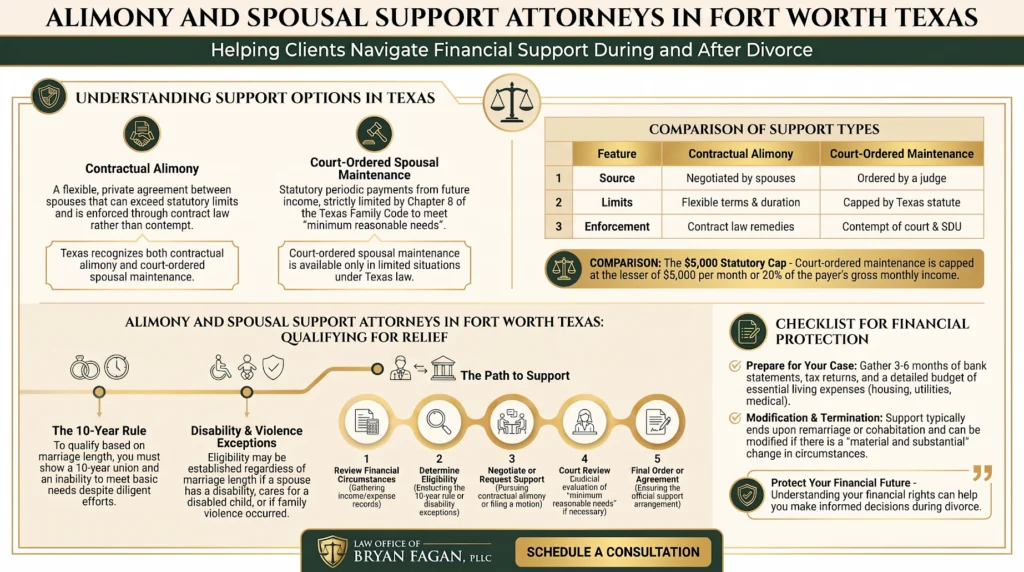
Here’s the honest starting point: Texas does not have “alimony” the way many other states do. Instead, Texas law recognizes two very different types of post-divorce financial support. The first is court-ordered spousal maintenance, which is available only in limited circumstances and is subject to strict statutory eligibility requirements, caps, and time limits under Chapter 8 of the Texas Family Code. The second is contractual alimony, which spouses voluntarily negotiate as part of a divorce settlement. Because contractual alimony is based on an agreement rather than a court order, it offers much more flexibility. Understanding which type of support applies to your case can influence nearly every financial decision you make during your divorce.
At the Law Office of Bryan Fagan, PLLC, we represent both spouses seeking financial support and those who may be asked to provide it. We understand that every divorce brings unique financial concerns, and our mission is to help families move through those challenges with clarity, confidence, and a practical plan for the future. Led by Bryan Joseph Fagan, a South Texas College of Law graduate and founder of one of Texas’s largest family law firms, our team has guided thousands of clients through divorce and complex spousal support issues across Texas, including in the Tarrant County courts.
This guide explains how spousal support actually works in Texas—from who qualifies for court-ordered maintenance and how judges determine the amount, to how long payments may last, when they can be modified, and what happens if circumstances change after your divorce. You’ll also learn the difference between spousal maintenance and contractual alimony, how temporary support works during a pending divorce, and the practical strategies that can help protect your financial future.
Whether you’re trying to secure the support you need or protect yourself from an unfair financial obligation, understanding Texas law is the first step toward making informed decisions. Let’s begin by separating common myths from reality and examining how spousal support really works in Fort Worth and throughout Texas.
The Short Answer
Texas has two kinds of spousal support. Court-ordered spousal maintenance (Family Code Chapter 8) requires you to meet strict eligibility rules, and it is capped in amount — the lesser of $5,000 per month or 20% of the payer’s average monthly gross income — and in duration, based on how long you were married. Contractual alimony is agreed in a divorce settlement, is not subject to those caps, and is enforced as a contract. A long marriage may open the door to maintenance, but nothing about it is automatic.
Key things to know about spousal support in Fort Worth
- Texas has spousal maintenance (court-ordered, capped) and contractual alimony (negotiated, uncapped) — not “alimony” as most states use the word.
- To get court-ordered maintenance you must first lack enough property to meet your minimum reasonable needs and meet one statutory ground (§8.051).
- There is a rebuttable presumption against maintenance — you must show diligence in trying to support yourself (§8.053).
- The amount is capped at the lesser of $5,000/month or 20% of the payer’s average monthly gross income (§8.055).
- Duration is tied to how long you were married — generally up to 5, 7, or 10 years (§8.054).
- Maintenance ends on death, the recipient’s remarriage, or cohabitation (§8.056), and can be modified on a material and substantial change (§8.057).
- A long marriage does not guarantee support — eligibility is a real gate, and Texas is one of the strictest states.
Our office is available 24/7. Do not hesitate to schedule your free case evaluation by calling 817-406-7230 or contacting us online today.
Does Texas have alimony?

Short answer: Not in the way most people think. Texas does not use the term “alimony” for court-ordered support. Instead, Chapter 8 of the Texas Family Code authorizes spousal maintenance, a limited form of financial support available only when specific legal requirements are met. Texas also recognizes contractual alimony, which spouses voluntarily negotiate as part of a divorce settlement.
Understanding the difference between these two forms of support is one of the most important financial decisions you’ll make during a divorce. Court-ordered spousal maintenance is available only if a spouse qualifies under Texas law, and any award is subject to strict limits on both the amount and duration. Contractual alimony, by contrast, is created through a negotiated settlement, giving spouses considerably more flexibility than a judge could order under Chapter 8.
Many people relocating to North Texas assume divorce laws work the same everywhere, especially if they’ve recently moved from another state. If you’re new to the area, our guide to moving to Fort Worth explains what families should know about establishing themselves in the community, including practical considerations that often arise during life transitions. One of the biggest surprises for newcomers is learning that Texas starts with a presumption against long-term spousal maintenance. The Legislature intentionally designed Chapter 8 to encourage financial independence whenever reasonably possible, making court-ordered maintenance one of the most limited forms of post-divorce support in the country.
A common misconception is that a long marriage automatically guarantees spousal support or that a higher-earning spouse will face unlimited financial obligations after divorce. Neither is true. In straightforward cases, understanding these legal limits can help both spouses negotiate more effectively. In more complex divorces involving closely held businesses, significant assets, or customized settlement agreements, contractual alimony may provide a more flexible solution than court-ordered maintenance.
At the Law Office of Bryan Fagan, PLLC, we begin every spousal support discussion by determining which type of support may apply before evaluating eligibility, financial circumstances, and long-term goals. Once you understand the distinction between court-ordered spousal maintenance and contractual alimony, you can move beyond common misconceptions and make informed decisions that protect your financial future.
The biggest myth we correct: that a long marriage guarantees “alimony.” It does not — even a marriage of 10 or more years only opens the door, and Texas law starts from a presumption against ordering maintenance at all.
Not sure whether maintenance or contractual alimony fits your divorce? Let’s talk it through.
Call 281-810-9760Who qualifies for spousal maintenance?
Court-ordered maintenance has a two-part gate, and you have to clear both. First, under §8.051, the spouse asking for support must lack sufficient property — including their share of what’s divided in the divorce — to provide for their minimum reasonable needs. That phrase is about basic living costs, not maintaining the lifestyle of the marriage. If the property division leaves you able to cover your basics, a court may deny maintenance no matter how large the income gap.
Second, you must meet at least one statutory ground: the marriage lasted 10 years or longer and you cannot earn enough to meet your minimum reasonable needs; the paying spouse was convicted of or received deferred adjudication for family violence within two years before filing or during the case; you have an incapacitating disability; or you are the custodian of a child of the marriage with a disability requiring substantial care. On top of that, §8.053 creates a rebuttable presumption against maintenance unless you show you exercised diligence in earning income or developing skills. This is why Texas is considered one of the strictest states — qualifying takes real evidence.
A quick example shows how the property threshold actually bites. Suppose a couple divorces after a 14-year marriage and the lower-earning spouse receives a substantial share of the community estate — enough investable assets and a paid-off home to cover basic living costs. Even though the marriage easily clears the 10-year mark and there is a real income gap, a court may still deny maintenance, because the spouse can meet their minimum reasonable needs from the property they were awarded. Flip the facts — a long marriage but few liquid assets and a spouse who left the workforce to raise children — and the same 10-year threshold now leads toward eligibility. The marriage length opens the door; the property-and-needs analysis decides whether you walk through it. That is why the property division and the maintenance question have to be planned together, not separately.
How much is spousal maintenance in Texas?
Court-ordered maintenance is capped by statute at the lesser of $5,000 per month or 20% of the paying spouse’s average monthly gross income (§8.055). The word “lesser” matters: if 20% of gross income comes to less than $5,000, that lower number is the ceiling. For a spouse earning $15,000 a month gross, 20% is $3,000 — so $3,000 is the cap, not $5,000. Gross income is defined broadly (wages, bonuses, commissions, rental income, retirement benefits) and excludes things like means-tested public assistance.
People often search for an “alimony calculator,” but there isn’t a formula that spits out a number the way child support guidelines do. The cap sets the ceiling; within it, the court weighs the §8.052 factors — each spouse’s finances and earning ability, education and job skills, the time needed to gain training, the length of the marriage, age and health, contributions to the other’s earning power, and more — to decide the actual amount, always aiming at the shortest reasonable period. Rather than trust an online calculator, the useful step is to have us analyze your income figures against the cap and the factors.
One point that trips people up on the amount: the cap runs on gross income, and “gross income” for this purpose is broader than a paycheck. It includes wages, salary, bonuses, commissions, self-employment income, rental income, and retirement benefits, which is why the calculation gets complicated fast when a spouse is self-employed or owns a business. Courts often look at multiple years of tax returns to smooth out swings, and where a business is involved they will scrutinize whether personal spending is being routed through the company to depress apparent income. This is exactly the kind of analysis where getting the income figure right — on either side — changes the cap, and it is a large part of what we do in a support case.
Where cases are won: whether you are seeking or resisting maintenance, the outcome turns on evidence, not argument. If you need support, that means a documented minimum-reasonable-needs budget and a record of your diligence in trying to become self-supporting. If you may have to pay, it means clean income records so the 20%-of-gross cap is calculated on the right number. Walk in organized and the analysis is far sharper.
How long does spousal maintenance last?
Duration is capped by how long you were married (§8.054), and Texas courts are directed to order the shortest reasonable period that lets the receiving spouse become self-supporting. These are ceilings, not guarantees — a judge who sees a path to employment in two years will not award five just because the statute allows it.
Note the two separate limits: the duration depends on marriage length, while the amount cap ($5,000 or 20% of gross) is the same across every tier.
Can spousal maintenance be changed or end early?

Short answer: Yes. Texas law allows court-ordered spousal maintenance to be modified when there has been a material and substantial change in circumstances since the original order was entered. Under Texas Family Code §8.057, either former spouse may ask the court to review the support order if events such as involuntary job loss, a significant change in income, or a serious medical condition affect the need for support or the ability to pay. The key is acting promptly, because any modification generally applies only to future payments—not amounts that were already due.
Court-ordered spousal maintenance can also end automatically. Under Texas Family Code §8.056, future payments generally stop upon the death of either former spouse, the recipient’s remarriage, or the recipient’s cohabitation with a romantic partner on a continuing basis. Although those events terminate future obligations, unpaid maintenance that accrued before the termination may still be collected through enforcement proceedings.
One issue we frequently see is people assuming they can simply stop making payments after losing a job or experiencing another major life change. Unfortunately, that can create additional legal problems. Until a court signs a modified order, the existing obligation usually remains in effect, and missed payments may lead to arrears, income withholding, or contempt proceedings. Filing for a modification is almost always a better option than allowing unpaid support to accumulate.
Every case is different. In straightforward situations, a modification may involve documenting a single change in financial circumstances. In more complex cases—such as those involving self-employment, fluctuating business income, disability, or disputed financial records—the court may require more detailed evidence before deciding whether a modification is appropriate. If your questions involve changes to child custody, parenting time, or child support rather than spousal maintenance, our guide to Divorce Modifications Attorneys in Fort Worth, Texas explains how those post-divorce issues are handled under Texas law.
Understanding when spousal maintenance can be modified—or when it ends automatically—can help you protect your financial interests and avoid unnecessary disputes. Addressing changes early, gathering the right documentation, and understanding how Texas courts evaluate modification requests can make the process more predictable and help you move forward with greater confidence.
Contractual alimony: the negotiated alternative
When spouses want more flexibility than Chapter 8 allows, they can agree to contractual alimony as part of the divorce settlement. Because it is a contract rather than a court’s maintenance order, it is not bound by the $5,000/20% amount cap or the duration tiers — the parties can agree to a larger amount, a longer term, or terms a court could not impose. It is often used in higher-asset divorces, or when both sides simply prefer to negotiate certainty rather than leave support to a judge’s discretion.
The trade-off is that contractual alimony is generally harder to change later — courts treat it as a contract, so if you agree to pay a set amount for a set number of years, you are usually bound by that even if your income drops. That flexibility going in, and rigidity later, is exactly why the terms deserve careful drafting. In higher-asset cases, contractual alimony is frequently negotiated alongside the property division; our Fort Worth high-net-worth divorce page covers that landscape.
Spousal support vs. child support
These are two different obligations, and people sometimes blur them. Child support is money for the children’s needs, calculated under its own guidelines. Spousal support — maintenance or contractual alimony — is for a former spouse’s own minimum reasonable needs. A single divorce can involve both, and courts are increasingly careful to separate the children’s costs from a spouse’s personal needs when both are on the table. If child support is part of your case, our Fort Worth child support page explains how that side is calculated.
Enforcing a maintenance order

Short answer: If court-ordered spousal maintenance is not being paid, Texas law provides several ways to enforce the order. Under Texas Family Code §8.059, a court may issue an income withholding order, requiring the paying spouse’s employer to send payments directly from their paycheck. In cases of willful noncompliance, the court may also hold the paying spouse in contempt, which can result in fines or jail time.
A common mistake is assuming that a change in financial circumstances automatically ends the obligation to pay. It does not. Until a court modifies the order, missed payments may continue to accumulate as arrears, making it important to seek legal relief rather than simply stop paying. Likewise, if you are owed maintenance and payments have stopped, acting promptly often gives you more options for enforcement.
Whether you’re pursuing unpaid maintenance or responding to an enforcement action, understanding your rights is essential. If you’re planning to meet with our team, our Plan Your Visit to Our Fort Worth Office guide explains what to expect before your consultation and how to prepare for a productive discussion about your case.
Listen to Our Texas Family Law Podcast
Prefer listening? In this episode, we dispel common myths about alimony in Texas for Fort Worth families, including how spousal maintenance works, who may qualify, and what factors courts may consider when determining support.
How the Analysis Works, Stage by Stage
How Spousal Support Works in Texas
Tap any stage to see what the court weighs and what to do. This walks through the analysis — it is not a calculator and does not predict whether or how much support a court will order, which is fact-specific and discretionary.
1. Identify which type applies
What happens: We determine whether you are looking at court-ordered spousal maintenance (Chapter 8, capped) or contractual alimony (negotiated in settlement, uncapped). The two follow completely different rules, so this comes first.
What the court weighs: Nothing yet — this is a planning step between you and your attorney.
What to do: Come ready to describe your goals and whether settlement is realistic.
2. Test eligibility
What happens: For court-ordered maintenance, you must lack sufficient property to meet your minimum reasonable needs (§8.051) and meet one ground — a 10+ year marriage, family violence, disability, or caring for a disabled child. A rebuttable presumption against maintenance also applies (§8.053).
What the court weighs: Your property after division, your minimum-needs budget, and your diligence in trying to support yourself.
What to do: Build the minimum-reasonable-needs budget and document your efforts to earn or retrain.
3. Analyze the amount
What happens: Court-ordered maintenance is capped at the lesser of $5,000 per month or 20% of the payer’s average monthly gross income (§8.055). Within that ceiling, the court weighs the §8.052 factors to set the actual amount.
What the court weighs: Earning ability, education and skills, time needed to retrain, marriage length, age and health, and contributions to the other spouse’s earning power.
What to do: Gather clean income records so the 20%-of-gross figure is calculated correctly.
4. Analyze the duration
What happens: Duration is capped by marriage length (§8.054) — generally up to 5 years for 10 to 20 years of marriage, up to 7 years for 20 to 30, and up to 10 years for 30 or more. Disability or caring for a disabled child can extend it while the condition lasts.
What the court weighs: The shortest reasonable period for the receiving spouse to become self-supporting.
What to do: Be realistic about a path to self-sufficiency — courts favor shorter awards.
5. Order, enforcement, and modification
What happens: Once ordered, maintenance can be enforced through income withholding or contempt (§8.059), modified on a material and substantial change (§8.057), and it ends on death, remarriage, or cohabitation (§8.056).
What the court weighs: For a modification, whether circumstances have materially and substantially changed since the order.
What to do: Keep following the current order; if your situation changes, file to modify rather than stopping payment.
Wherever you are in this analysis, we can tell you what it means for your situation — on either side.
Schedule a ConsultationWarning: do not assume a long marriage guarantees you support — eligibility is a real gate with a presumption against it. And if you are the one paying, do not simply stop when money gets tight. Until a court modifies the order, the obligation stands; unpaid maintenance becomes arrears and can expose you to contempt (§8.059). If your circumstances have changed, the right move is to file for a modification, not to stop paying.
Our Fort Worth Office
The Law Office of Bryan Fagan, PLLC
204 W Central Ave, Fort Worth, TX 76164
Serving Fort Worth, Tarrant County, and clients across Texas.
Hours: Mon–Fri 8am–8pm
Call 281-810-9760Ready to understand your real position on support? Let’s run your numbers against the law.
Schedule a ConsultationBryan Bubis — Senior Attorney, Fort Worth
15+ Years Family Law · Texas Wesleyan Law · Texas A&M Business · Tarrant, Johnson & Parker County Courts
Bryan Bubis is the Senior Attorney who leads our Fort Worth office, and spousal-support cases play to his strengths. With more than fifteen years of family law experience, a law degree from Texas Wesleyan University, and a business background from Texas A&M University, he is especially effective where the numbers matter — analyzing income for the 20%-of-gross cap, handling cases with significant assets or business income, and negotiating contractual alimony as part of a larger settlement.
Bryan represents both spouses seeking maintenance and spouses being asked to pay it, in the Tarrant, Johnson, and Parker county courts, and focuses on getting to a result that holds up. Read Bryan Bubis’s full profile.
Why Fort Worth families choose our team for spousal support
Spousal support cases often involve more than simply applying the law—they require a careful understanding of income, assets, and each family’s financial future. Our Fort Worth attorneys represent both spouses seeking maintenance and those defending against support claims, giving us insight into the issues that commonly shape negotiations and courtroom decisions. Whether the case involves straightforward employment income or more complex compensation, we focus on building a strategy based on accurate financial analysis and practical solutions.
Many clients are surprised to learn how much timing matters. Addressing spousal support early in the divorce process often creates more opportunities for productive negotiation and helps avoid unnecessary disputes later. If you’re preparing for your consultation, our guide to Transportation in Fort Worth, TX can help you plan your visit so you can focus on discussing your legal options rather than navigating the trip.
At the Law Office of Bryan Fagan, PLLC, our goal is to help you understand where you stand under Texas law before major financial decisions are made. By combining experienced legal guidance with a practical evaluation of your unique circumstances, we help clients move through divorce with greater clarity, confidence, and a strategy designed to protect their financial future.
Both sides, clearly: if you qualify, Texas gives you a real — if limited — path to support while you get back on your feet. And if you are the one who may pay, the statutory caps exist to protect you from an open-ended obligation. Either way, knowing exactly where the law puts you is the thing that turns a frightening question into a manageable one.
Tarrant County spousal-support practice
Spousal-support matters for Fort Worth residents are decided in the Tarrant County family district courts. The Chapter 8 framework is statewide, but how a particular court weighs the §8.052 factors and evaluates a minimum-reasonable-needs budget is where local familiarity helps. Our Fort Worth office handles maintenance and contractual-alimony matters — on both sides — throughout Tarrant County, and we serve the surrounding communities: Arlington, Grapevine, Mansfield, Keller, North Richland Hills, and Bedford, as well as neighboring Dallas, Denton, Parker, and Johnson counties.
For the firm-wide view of Texas alimony beyond Fort Worth, see our statewide alimony and spousal support page, or start from the Fort Worth family law hub.
What I tell clients on both sides of a support question

The first thing I tell clients is that the uncertainty surrounding spousal support is often greater than the reality. Texas law places strict limits on court-ordered maintenance, which can provide reassurance if you may be asked to pay support while also highlighting the importance of careful planning if you believe you may qualify to receive it. Once we determine which type of support applies and evaluate the financial facts of your case, what initially feels overwhelming usually becomes a much clearer legal and financial roadmap.
The second thing I emphasize is that preparation matters. Courts make decisions based on evidence—not assumptions—so accurate financial records, a well-documented budget, and a clear understanding of your circumstances can significantly affect the outcome. If your situation changes after a support order is entered, seeking a modification is almost always the better approach than allowing unpaid obligations to accumulate. For information about local agencies and public services that may also be helpful during or after your case, visit our guide to Governmental Resources in Fort Worth, TX.
Whether you’re seeking maintenance or responding to a request for support, our goal is to help you understand where you stand under Texas law and what options are available. With clear guidance, practical planning, and experienced representation, you can make informed decisions that protect your financial future and move forward with greater confidence.
What to do about spousal support in Fort Worth
- Determine which type is in play — court-ordered maintenance or contractual alimony.
- Test the §8.051 eligibility gate: do you lack enough property for your minimum reasonable needs?
- Confirm you meet a ground (10+ year marriage, family violence, disability, or disabled child).
- Build a documented minimum-reasonable-needs budget.
- Gather income records so the $5,000/20%-of-gross cap is figured on the right number.
- Document your diligence in trying to become self-supporting (to meet the presumption).
- If you may pay, model the cap against your gross income; consider contractual alimony in settlement.
- If modifying, pinpoint the material and substantial change and keep paying until the court changes the order.
- If enforcing, document the missed payments for a withholding or contempt motion.
- Book a Legal Strategy Session with our Fort Worth office.
Know Where You Stand
Spousal support in Texas is limited, capped, and specific to your facts. Let’s find your real position — on either side.
Call 281-810-9760 TodayConclusion:
Whether you expect to receive spousal maintenance or believe you may be asked to pay it, understanding how Texas law applies to your unique circumstances is one of the best investments you can make in your future. Every divorce presents different financial realities, and the right strategy depends on factors such as your income, assets, employment history, and long-term goals. In straightforward situations, understanding your legal rights may be enough to reach a fair settlement. In more complex cases—such as those involving business ownership, significant assets, self-employment, disability, or requests to modify an existing support order—a thoughtful legal strategy can make a meaningful difference in both the outcome and your financial security.
At the Law Office of Bryan Fagan, PLLC, we believe informed clients make confident decisions. Our role is to provide clear answers, practical guidance, and a strategy tailored to your circumstances so you can move forward with greater clarity and peace of mind. If you’re ready to discuss your situation with an experienced Fort Worth family law attorney, you can schedule a consultation with our Fort Worth office. Together, we’ll evaluate your options, answer your questions, and develop a plan designed to protect what matters most to you and your family’s future.
About the Author
Bryan Fagan
Founder & Managing Attorney · Serving Texas families since 2012
I am Bryan Fagan, founder and managing attorney of The Law Office of Bryan Fagan, PLLC, one of the largest family law firms in Texas. I hold a Juris Doctor from South Texas College of Law and an undergraduate degree in business and finance, and I lead a team of more than 170 legal professionals with offices across the state. In spousal-support cases, my goal is to cut through the fear on both sides and show clients exactly where Texas law puts them.
I am also the author of several family law guides, including The Texas Divorce Handbook. Out of our Fort Worth office, our team represents both spouses seeking maintenance and spouses being asked to pay it, in the Tarrant County courts. If you have a support question, I would like to help. Read more about Bryan Fagan.
Questions Fort Worth clients ask about spousal support
Texas does not use “alimony” in its statutes the way many states do. It has court-ordered spousal maintenance (Chapter 8 of the Family Code), which has strict eligibility rules and caps on amount and duration, and contractual alimony, which spouses agree to in a divorce settlement and which is not subject to those caps. What most people call “alimony” is one of these two.
You must lack sufficient property after the divorce to meet your minimum reasonable needs (§8.051), and meet one ground: a marriage of 10 or more years, the paying spouse’s family-violence conviction within two years, your own incapacitating disability, or caring for a disabled child of the marriage. Even then, Texas law presumes against maintenance unless you show diligence in trying to support yourself.
Court-ordered maintenance is capped at the lesser of $5,000 per month or 20% of the paying spouse’s average monthly gross income (§8.055). If 20% of gross is below $5,000, that lower figure is the ceiling. Within the cap, the court weighs statutory factors like earning ability, marriage length, and health to set the actual amount. Contractual alimony is not subject to this cap.
Duration depends on marriage length (§8.054): generally up to 5 years for marriages of 10 to 20 years, up to 7 years for 20 to 30 years, and up to 10 years for 30 years or more. Maintenance based on a disability or caring for a disabled child can last as long as the condition does. Courts order the shortest reasonable period, so these are maximums, not guarantees.
Spousal maintenance is ordered by a court under Chapter 8 and is limited by strict eligibility rules and caps on amount and duration. Contractual alimony is agreed to by the spouses in a divorce settlement, is not subject to those caps, and is enforced as a contract. The trade-off is that contractual alimony is usually harder to modify later, because courts treat it as a binding agreement.
Yes. Court-ordered maintenance can be modified when there has been a material and substantial change in circumstances since the order (§8.057) — for example, the recipient getting a well-paying job or the payer involuntarily losing income. A modification affects payments that come due after you file, not past ones. Contractual alimony, by contrast, is generally fixed by the agreement and much harder to change.
Court-ordered maintenance ends automatically on the death of either spouse, the recipient’s remarriage, or the recipient’s cohabitation with a romantic partner on a continuing basis (§8.056). No new court order is needed for those events to stop future payments, though any arrears already owed remain collectible. It also ends when the statutory duration period runs out.
No. Unlike child support, there is no formula that produces a maintenance number. The statute sets a ceiling — the lesser of $5,000 per month or 20% of the payer’s gross income — and within that the court weighs factors like earning ability, marriage length, education, and health. Online “alimony calculators” can’t account for those factors or the eligibility gate, so they are unreliable for Texas.
No. A marriage of 10 or more years opens the door to eligibility, but it does not guarantee an award. You still must show you lack sufficient property to meet your minimum reasonable needs, and Texas law starts from a rebuttable presumption against maintenance unless you show diligence in trying to earn enough or gain skills to support yourself. Texas is one of the strictest states on this.
Child support is money for the children’s needs, calculated under separate guidelines. Spousal support — maintenance or contractual alimony — is for a former spouse’s own minimum reasonable needs. A divorce can involve both, and courts separate the children’s costs from a spouse’s personal needs. If child support is part of your case, our Fort Worth child support page explains how it is calculated.
You can enforce the order. Courts can collect through an income withholding order, where the employer sends payment directly, and a spouse who refuses to pay or falls into arrears can be held in contempt under §8.059, which may carry fines or jail. If maintenance you are owed has stopped, that is a specific enforcement problem we can act on quickly — the sooner the better.
Bring your questions to a Legal Strategy Session and we’ll map your support position from both sides.
Schedule Your Consultation