
Annulment Attorneys in Fort Worth, Texas

A man walked into our Fort Worth office just a month after getting married, convinced he needed a divorce. During their honeymoon, he discovered his new wife had never legally finalized her previous marriage. He was frustrated, confused, and unsure what to do next. Annulment Attorneys in Fort Worth Texas regularly meet people facing situations like this, where the first question is not how to end a marriage, but whether there was ever a legally valid marriage to begin with. In his case, the law pointed toward a suit to declare the marriage void rather than a divorce. But his situation was the exception—not the rule.
If you’re researching whether you qualify for an annulment, the most important thing you should know is that Texas law makes annulments available only in limited circumstances. A short marriage, a painful mistake, or a change of heart does not automatically qualify. An annulment is not simply a quicker or easier divorce. Instead, it is a court’s determination that a marriage was never legally valid because one of the specific grounds recognized by the Texas Family Code existed at the time of the wedding, such as fraud, duress, intoxication, mental incapacity, or an undisclosed existing marriage.
At The Law Office of Bryan Fagan, PLLC, we believe that helping families starts with giving them honest answers. Founded by Bryan Joseph Fagan, a graduate of South Texas College of Law, our firm is committed to educating clients so they understand their legal options before making important decisions. Sometimes an annulment is the right solution. More often, the law requires a divorce instead. Knowing which path applies to your circumstances can save time, reduce unnecessary expense, and help you move forward with confidence.
In this guide, we’ll explain what actually qualifies for an annulment in Texas, how void marriages differ from voidable marriages, what evidence courts require, the deadlines that can affect your rights, and what happens if your case involves children, property, military service, immigration issues, or other complex circumstances. By the end, you’ll have a clearer understanding of whether an annulment is a realistic option and what steps to consider next.
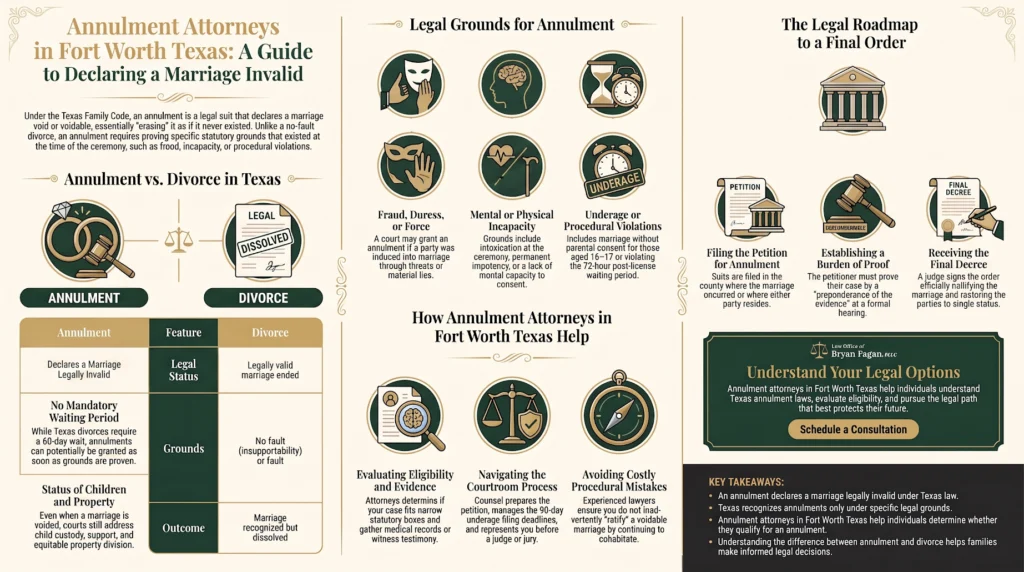
An annulment in Texas is a court declaration that a marriage was never legally valid, not a faster divorce. It is available only on narrow statutory grounds, such as fraud, duress, intoxication, impotency, or an undisclosed prior marriage (Texas Family Code §§6.102–6.111). Most marriages do not qualify and must end by divorce instead. Several grounds are lost if you keep living together after discovering the problem, so acting quickly matters.
Key Takeaways
- Most marriages cannot be annulled. Annulment requires a specific legal ground under Texas Family Code §§6.102–6.111; a short or regretted marriage does not qualify on its own, and most people end up needing a divorce.
- Annulment is not divorce. A divorce ends a valid marriage; an annulment declares the marriage never legally existed. Because there was no valid marriage, there is generally no community estate to divide the way there is in divorce.
- Voidable and void are different. Voidable marriages are annulled on a ground (§§6.102–6.111); void marriages, like bigamy or incest, were never valid and are ended by a suit to declare the marriage void (§§6.201–6.206).
- Living together can destroy your ground. Several grounds, including fraud (§6.107) and impotency (§6.106), are lost if you keep cohabiting after you learn of the problem.
- Deadlines are short for some grounds. The underage ground (§6.102) and the 72-hour rule (§6.110) both carry tight filing windows, so waiting can cost you the option.
- Children are still legitimate. An annulment does not make children of the marriage illegitimate, and custody and child support are still decided.
- If you don’t qualify, divorce is the path. Many people who ask about annulment proceed by an uncontested divorce instead, which is often faster and simpler than a contested annulment.

Your Family’s Future Starts Here
Don’t navigate your legal journey alone. Schedule a consultation now and get the clarity and support you deserve.
Our office is available 24/7. Do not hesitate to schedule your free case evaluation by calling 817-406-7230 or contacting us online today.
What an Annulment Is in Texas

An annulment is a court order declaring that a marriage was never legally valid under Texas law. Annulment Attorneys in Fort Worth Texas help people determine whether their marriage qualifies for an annulment, a suit to declare the marriage void, or whether a divorce is the appropriate legal path. Unlike a divorce, which ends a valid marriage, an annulment applies only when one of the limited legal grounds in Texas Family Code Chapter 6 exists.
Texas does not grant annulments simply because a marriage was brief or one spouse regrets the decision to marry. Instead, the court must find a recognized legal ground, such as fraud, duress, intoxication, mental incapacity, or an undisclosed existing marriage. In some cases, the marriage may actually be void—for example, if one spouse was already legally married to someone else—requiring a different legal proceeding known as a suit to declare the marriage void.
For example, someone who discovers after the wedding that their spouse never finalized a previous divorce may have grounds to challenge whether the marriage was legally valid from the beginning. On the other hand, someone who simply realizes they made a mistake after a few weeks generally will not qualify for an annulment. The legal outcome depends on the facts that existed when the marriage began, not on how quickly the relationship ended.
Understanding that distinction early can save time, expense, and frustration. If you’d like to see how these same Texas laws apply in another community, visit our guide to Annulment Attorneys in Houston Heights, Texas. You may also find our Fort Worth Divorce Attorneys and Family Law resources helpful if your circumstances ultimately point toward divorce rather than annulment.
Who Qualifies: The Grounds for Annulment
Texas allows an annulment only on specific statutory grounds, listed in Family Code §§6.102 through 6.110. A short or regretted marriage does not qualify for annulment by itself; you must prove one of these grounds, such as fraud, and most marriages end by divorce instead. These grounds cover a voidable marriage, meaning one that is valid until a court sets it aside because something was wrong at the time of the wedding.
The recognized grounds are narrow and fact-specific. They include an underage spouse who married at 16 or 17 without proper consent (§6.102), being under the influence of alcohol or narcotics at the ceremony so that you could not consent (§6.105), a spouse’s permanent impotency you did not know about (§6.106), fraud, duress, or force used to induce the marriage (§6.107, the ground behind many green-card and deception cases), mental incapacity to consent (§6.108), a spouse who concealed a divorce finalized within the 30 days before your wedding (§6.109), and a marriage that took place less than 72 hours after the license was issued (§6.110). Fraud under §6.107 is the ground people ask about most, and Texas courts have granted annulments where a spouse married solely to obtain an immigration benefit while never intending a real marriage; but the fraud must go to the essence of the marriage, and an ordinary lie or disappointment is not enough. Each ground has its own specific requirements, and several must be proven with real evidence, not just your account. The table below lays them out with the key limit on each.
What I can tell you from experience: the single most useful thing an honest family lawyer does in an annulment consultation is tell you the truth about whether you qualify. Annulments are one of the least common family law cases we see, and pushing a case that does not fit the grounds wastes your money. If you qualify, we pursue it; if you do not, I will point you to the faster path.
The Cohabitation Trap That Defeats Most Annulments

Continuing to live with your spouse after discovering the legal problem that supports an annulment can cause you to lose the right to seek one. Annulment Attorneys in Fort Worth Texas often explain that several grounds for annulment—including fraud, intoxication, mental incapacity, impotency, and a concealed recent divorce—can be defeated if the spouses voluntarily continue cohabiting after the truth is known. Under Texas Family Code §§6.105–6.109, the court may view that decision as accepting, or “ratifying,” the marriage despite the earlier defect.
The reasoning is straightforward. Texas law assumes that if you discover the issue and knowingly continue living together as spouses, you have chosen to continue the marriage rather than challenge its validity. For example, if you learn your spouse misrepresented an important fact to induce the marriage but you remain together for several months afterward, the court may conclude that the fraud no longer supports an annulment. The same principle can apply after discovering permanent impotency, recovering from intoxication, or learning about a recently concealed divorce.
Timing often determines whether an otherwise valid annulment claim succeeds. In straightforward cases, acting promptly after discovering the legal issue may preserve your rights. In more complex situations—particularly if your spouse disputes the facts or questions whether cohabitation continued—the court may need to evaluate witness testimony, documents, and other evidence before deciding whether the marriage was effectively ratified. This is one reason why gathering evidence early can be just as important as identifying the legal ground itself.
If you believe your marriage may qualify for an annulment, delaying your decision can have significant legal consequences. Understanding how Texas law treats cohabitation allows you to make informed choices before an important legal right is lost. For additional guidance on how these rules apply elsewhere in Texas, you can also read our guide to Annulment in Fort Bend, or explore our Legal Strategy Session and Fort Worth Divorce Attorneys resources to better understand which legal path fits your circumstances.
Warning: if you have discovered something that might be a ground for annulment, such as fraud, a concealed divorce, or impotency, continuing to live together as a couple can permanently destroy your annulment ground under §§6.105–6.109. Do not wait weeks to decide. Stop cohabiting and get advice quickly, because some grounds also carry short filing deadlines that do not pause while you think it over.
Void Marriages Are Different
Some marriages are not merely voidable but void, meaning they were never legally valid from the very start. These are ended not by an annulment but by a related proceeding called a suit to declare the marriage void, governed by Family Code §§6.201 through 6.206.
A marriage is void, no matter how much the couple wanted it, if it falls into a prohibited category. The most common is bigamy: under §6.202, a marriage is void if either spouse was still legally married to someone else at the time. A marriage is also void for consanguinity, meaning the parties are too closely related by blood or adoption (§6.201), if a party was younger than 18 without the narrow court-order exception (§6.205), or if the parties are current or former stepchild and stepparent (§6.206). The practical difference matters: with a voidable marriage you must prove a ground and act before defenses like cohabitation kick in, while a void marriage was never valid and can be declared void without those same ground-and-timing hurdles. The young woman I described at the start, whose husband was still married, had a void marriage under §6.202, which is one of the clearest cases there is.
Listen to Our Texas Family Law Podcast
Prefer listening? In this episode, we discuss annulment in Texas, including when a marriage may be legally voided, the legal grounds that may apply, and how annulment differs from divorce.
Annulment vs Divorce: Property and Consequences
The biggest practical difference between an annulment and a divorce is what happens to property. In a divorce, the court divides the community estate in a manner that is “just and right” under §7.001; in an annulment, because there was never a valid marriage, there generally is no community estate to divide that way.
That does not mean money and property simply disappear. A court can still sort out who owns what, return separate property, and address debts, but it does not apply the community-property framework the way a divorce does, because the legal premise is that no marriage existed to create community property. This is one reason annulment is not automatically “better” than divorce; for a couple who genuinely built a life and assets together, the divorce framework may actually protect a financially dependent spouse more than an annulment would. Two consequences surprise people: children of an annulled or void marriage are still legitimate under Texas law, and custody and child support are still decided through the appropriate proceeding, often a Suit Affecting the Parent-Child Relationship filed alongside the annulment. The table below compares the three paths side by side.
Strategy note: if you think you have a ground, act fast on two fronts at once. Stop cohabiting so a defense doesn’t erase your ground, and note the deadline that applies to your specific ground, because the 72-hour rule (§6.110) and the underage ground (§6.102) both have tight filing windows. The single biggest mistake in annulment cases is treating them like a divorce you can file whenever you’re ready.
Deadlines and Proof

Missing a legal deadline or failing to gather the right evidence can prevent an otherwise valid annulment from being granted. Annulment Attorneys in Fort Worth Texas regularly explain that annulments are governed by strict statutory requirements under Texas Family Code Chapter 6, and unlike a no-fault divorce, you must prove that a specific legal ground existed when the marriage began. Courts do not grant an annulment simply because both spouses agree the marriage should end.
Some annulment grounds have particularly short filing deadlines. For example, under Texas Family Code §6.110, if a marriage ceremony takes place within 72 hours of obtaining the marriage license without a qualifying exception, the petition generally must be filed within 30 days of the wedding. Likewise, the underage marriage provisions in §6.102 have limited timeframes, while other grounds can effectively expire if the spouses continue living together after discovering the problem. If you’d like a broader explanation of these statutory requirements, our guide to Annulment in Texas Requirements provides additional detail.
Evidence is equally important because the burden of proof rests with the person seeking the annulment. Depending on the legal ground, that evidence may include a prior marriage certificate, divorce records, the marriage license, medical documentation, text messages, emails, financial records, or witness testimony establishing fraud, duress, intoxication, or another qualifying circumstance. In straightforward annulment cases, gathering these records early can strengthen your claim. If your spouse disputes the facts or the evidence is incomplete, additional investigation and documentation may be necessary before the court can determine whether the marriage was voidable or legally valid.
The practical lesson is simple: time works against many annulment claims. Waiting too long can result in missed filing deadlines, lost evidence, or legal defenses that may no longer allow the court to grant an annulment. Understanding both the deadlines and the proof required helps you evaluate your options early and make informed decisions about whether an annulment, a suit to declare the marriage void, or a divorce is the most appropriate path forward.
The Law Office of Bryan Fagan, PLLC
204 W Central Ave, Fort Worth, TX 76164
Serving Fort Worth, Tarrant County, and clients across Texas.
Call 281-810-9760The Annulment Process, Stage by Stage
Here is what pursuing an annulment actually looks like, from spotting a possible ground to the final decree, or the divorce alternative if you don’t qualify. Tap any stage to see what happens, how long it takes, and what to do.
From a Possible Ground to the Final Decree, Stage by Stage
Tap any stage to expand what happens, how long it takes, and what to do.
Stage 1 — Identify a Possible Ground
Annulment starts with matching your facts to a specific statutory ground: underage (§6.102), intoxication (§6.105), impotency (§6.106), fraud, duress, or force (§6.107), mental incapacity (§6.108), concealed divorce (§6.109), or the 72-hour rule (§6.110). If your situation is bigamy, incest, a minor, or a steprelation, it may be a void marriage instead (§§6.201–6.206).
Typical timing: immediately, before any filing.
What to do: be honest about whether a ground truly fits; most marriages do not qualify.
Stage 2 — Confirm Eligibility & Deadlines
This is where most annulments are won or lost. Several grounds are destroyed by cohabitation after you learn of the problem (§6.105–§6.109), and some carry hard deadlines: 30 days for the 72-hour rule (§6.110) and tight limits for the underage ground (§6.102). An attorney confirms whether your ground still survives.
Typical timing: as early as possible; the clock is often already running.
What to do: stop cohabiting if you’ve discovered a problem, and note your deadline.
Stage 3 — File the Suit to Annul (or Declare Void)
A petition is filed in the proper court. Under §6.306 a Texas court can annul a marriage if the parties married here or a party lives here; under §6.307 either party can sue to declare a void marriage void. For a Fort Worth resident this is the Tarrant County family district courts, generally in the county where a spouse lived at the marriage. If children are involved, a SAPCR is filed alongside.
Typical timing: once eligibility is confirmed and proof is gathered.
What to do: file in the right county promptly; serve the other spouse.
Stage 4 — Prove the Ground in Court
Unlike a no-fault divorce, an annulment requires you to prove the specific ground with evidence, such as a marriage license showing the date, documentation of a spouse’s prior marriage, or proof of fraud. For the underage ground, §6.104 makes the annulment discretionary with the judge. The other spouse may contest, which is why proof matters.
Typical timing: weeks to months, depending on the court and whether it’s contested.
What to do: organize your evidence early; be ready to establish the ground, not just assert it.
Stage 5 — Decree of Annulment (or the Divorce Alternative)
If the court is satisfied, it enters a decree of annulment, and in the eyes of the law the marriage never existed; a prior name can be restored under §6.706. If the ground can’t be proven, the marriage is valid and ends by divorce instead, often a straightforward uncontested divorce. Either way, you end up single and free to remarry.
Typical timing: at the conclusion of the case.
What to do: if annulment doesn’t fit, move to the divorce path without losing more time.
Wherever you are in this process, the next step is finding out whether you qualify.
Call 281-810-9760Where You File in Tarrant County
The court where you file your annulment matters because Texas law requires both proper jurisdiction and the correct venue before a judge can hear your case. Annulment Attorneys in Fort Worth Texas regularly help clients determine where to file under Texas Family Code §§6.306–6.307, which generally allow a Texas court to hear an annulment if the marriage took place in Texas or one of the spouses lives in Texas. These same jurisdictional rules also apply when filing a suit to declare a marriage void.
For most Fort Worth residents, an annulment petition is filed with the Tarrant County District Clerk and assigned to one of the Tarrant County Family Courts. If children were born or adopted during the marriage, the court will usually address conservatorship, visitation, and child support through a Suit Affecting the Parent-Child Relationship (SAPCR) filed alongside the annulment, ensuring that the children’s best interests remain protected while the court determines the legal status of the marriage.
In straightforward annulment cases, filing in the correct court helps avoid unnecessary delays. In more complex situations—such as when spouses live in different counties, military service affects residency, or venue is disputed—the filing requirements may require closer analysis before the petition is submitted. Local court procedures, including standing orders and scheduling practices, can also vary, making it important to understand the specific rules that apply to your case.
If you’re preparing to begin the process, our guide on How to File for Annulment in Texas: Step-by-Step Guide explains what to expect after determining the proper court. Whether your case proceeds as an annulment, a suit to declare a marriage void, or another family law matter, filing in the correct venue from the outset helps protect your rights and keeps your case moving in the right direction.
What Happens If You Don’t Qualify

If your marriage does not meet one of the legal grounds for an annulment, Texas law generally requires the marriage to end through divorce instead. Annulment Attorneys in Fort Worth Texas regularly help people understand this distinction because many marriages, even very short ones, do not qualify for annulment under Texas Family Code Chapter 6. While that may feel disappointing at first, it often leads to a simpler and more predictable legal process.
Texas is a no-fault divorce state, meaning you do not have to prove fraud, duress, or any other statutory ground to legally end a valid marriage. In straightforward cases where both spouses agree on property, debts, and any issues involving children, an uncontested divorce is often the quickest and most cost-effective solution. If your spouse disputes those issues or significant assets are involved, a contested divorce may provide the court with the opportunity to resolve those disagreements through the legal process.
A common example is a couple who married after a brief courtship but later realized they were simply incompatible. Even though the marriage lasted only a few months, the absence of a qualifying legal ground means an annulment is unlikely. In contrast, a no-fault divorce allows both spouses to move forward without the burden of proving that the marriage was legally invalid from the beginning. If you’d like to better understand the legal requirements for annulment in another Texas community, you can also explore our guide to Annulment Attorneys in Houston Heights, Texas.
The most important step is identifying the legal path that fits your circumstances rather than pursuing one that Texas law does not support. In straightforward situations, that may mean moving directly toward an uncontested divorce. If your case involves disputed facts, children, significant property, or uncertainty about whether the marriage may actually be void, a more detailed legal analysis can help you make informed decisions and protect your future.
Nearby Counties Where Practice Differs
Where you file an annulment matters just as much as whether you qualify for one. Annulment Attorneys in Fort Worth Texas regularly help clients determine the proper venue because, although the legal grounds for annulment are the same throughout Texas, filing in the correct county helps avoid unnecessary delays and procedural complications. Texas Family Code §§6.306–6.307 establishes when Texas courts have jurisdiction to hear annulment and void marriage cases, while local court procedures can vary from county to county.
For most Fort Worth residents, an annulment is filed in the Tarrant County Family Courts through the Tarrant County District Clerk. However, the proper venue may be different if one or both spouses live in another county or if the marriage has stronger legal ties to Dallas, Denton, Parker, Johnson, or another Texas county. Although every county applies the same Texas Family Code, each court manages its own docket, scheduling procedures, local rules, and standing orders, making it important to understand where your case belongs before filing.
In straightforward annulment cases, selecting the correct venue at the outset can help keep the process moving efficiently. In more complex situations—such as when residency is disputed, the marriage may actually be void, or multiple counties could have jurisdiction—the venue question itself may require careful legal analysis before the petition is filed. If your case involves these issues, resolving them early can help prevent unnecessary delays while preserving important filing deadlines and evidence.
If you’d like a broader overview of the filing process, our guide on How to File for Annulment in Texas: Step-by-Step Guide explains what to expect after determining the proper court. Whether your case belongs in Tarrant County or another Texas jurisdiction, understanding the filing requirements from the beginning helps ensure you pursue the right legal path with confidence.
Your Fort Worth Attorney
Annulment questions out of our Fort Worth office are handled by Senior Attorney Bryan Bubis, whose long family-law experience makes him well suited to the first and most important task in any annulment case: telling you honestly whether you qualify. When you call about an annulment in Tarrant County, Bryan Bubis and our Fort Worth team are who you will work with.
Bryan Bubis — Senior Attorney, Fort Worth
15+ Years Family Law · Tarrant, Johnson & Parker County Courts
Bryan Bubis brings more than 15 years of family law experience to annulment and divorce matters. Because annulment turns first on eligibility, his experience assessing whether a set of facts actually fits a statutory ground, and how strong the proof is, is exactly what these cases need before anyone files. He gives clients a straight answer about their options rather than pushing a case that will not succeed.
Bryan represents clients in the Tarrant, Johnson, and Parker county family courts. He works these cases the way I do: assess the grounds honestly, act fast when a deadline or cohabitation defense is in play, and move to a divorce when that is the client’s real path. Read Bryan Bubis’s full profile.
What I Tell Every Person Who Asks About an Annulment

The first thing I tell people is to keep an open mind about their legal options. Annulment Attorneys in Fort Worth Texas regularly meet individuals who believe an annulment is the obvious answer, only to discover that Texas law allows annulments only in very limited circumstances. An annulment can be the right solution when the facts fit one of the statutory grounds in Texas Family Code Chapter 6, but most marriages—even those that lasted only a short time—must legally end through divorce. An honest evaluation at the beginning often saves clients time, money, and unnecessary frustration.
The second thing I emphasize is that timing matters. Several annulment grounds can be lost if you continue living with your spouse after discovering the issue, and some have strict statutory filing deadlines. In straightforward annulment cases, acting quickly may preserve your legal rights. If your case involves disputed facts, fraud, a concealed prior marriage, military service, or other complex circumstances, gathering evidence early can make a significant difference. For a closer look at how timing affects these cases, you can also read our guide on Understanding the Timeline of an Annulment in Texas.
Finally, I remind people that not qualifying for an annulment is not a setback—it simply means Texas law points toward a different legal path. A no-fault divorce often allows couples to resolve matters efficiently without proving that the marriage was invalid from the beginning. Our role at The Law Office of Bryan Fagan, PLLC is to help you understand which option fits your circumstances, explain the legal consequences in plain English, and give you the confidence to move forward with a strategy that protects your future and the people who matter most.
Get an Honest Answer
Annulment or divorce? Find out which path actually fits your situation.
Call 281-810-9760 TodayWhat to Do If You’re Considering an Annulment in Fort Worth
- Identify which specific ground might apply to your marriage, using the grounds list above, before assuming you qualify.
- If you have discovered a problem like fraud or a concealed divorce, stop living together as a couple so a cohabitation defense doesn’t erase your ground.
- Note the deadline for your ground, especially the 30-day window for the 72-hour rule (§6.110) and the underage limits (§6.102).
- Gather proof: a marriage license showing the date, evidence of a spouse’s prior marriage, or documentation of fraud.
- Determine whether your situation is actually a void marriage (bigamy, incest, minor, steprelation), which is a different proceeding.
- If children were born or adopted during the marriage, be ready to address custody and support through a SAPCR.
- Be prepared for the likely outcome that you don’t qualify and will proceed by divorce instead.
- Avoid delay; almost every annulment ground is time-sensitive, either by statute or by the cohabitation defenses.
- Do not rely on an online quiz or article to decide eligibility; the facts are specific and easy to get wrong.
- Book a Legal Strategy Session with our Fort Worth office to get an honest read on your options.
Still not sure whether it’s an annulment or a divorce? Bring your facts to a Legal Strategy Session.
Schedule Your ConsultationConclusion:
An annulment is not a shortcut to divorce—it is a specific legal remedy available only when the facts satisfy the requirements of Texas Family Code Chapter 6. Annulment Attorneys in Fort Worth Texas help people determine whether their marriage qualifies for an annulment, whether a suit to declare the marriage void is the better option, or whether a no-fault divorce is the appropriate path. In straightforward cases, the answer may become clear after reviewing the circumstances. If your case involves disputed evidence, fraud, children, military service, immigration concerns, or significant property issues, a more detailed legal analysis can help ensure you pursue the right strategy from the outset.
At The Law Office of Bryan Fagan, PLLC, we believe that informed decisions create better outcomes. Our commitment is to educate you about your legal options, explain the law in plain English, and help you move forward with confidence and peace of mind. If you’d like to learn more about how timing can affect an annulment case, we invite you to read our guide on Understanding the Timeline of an Annulment in Texas. Whether your circumstances point toward an annulment, a void marriage action, or a divorce, the right first step is understanding which legal path best protects your future and the people who matter most.
About the Author
Founder & Managing Attorney · Serving Texas families since 2012
I am Bryan Fagan, founder and managing attorney of The Law Office of Bryan Fagan, PLLC, one of the largest family law firms in Texas. I hold a Juris Doctor from South Texas College of Law and a bachelor’s degree in business finance from the University of Phoenix, and I lead a team of more than 170 legal professionals with offices across the state. In custody cases, my aim is always to keep the focus where the law puts it: on what is genuinely best for the child.
I am also the author of several family law guides, including The Texas Divorce Handbook, because I believe parents make better decisions when they understand the process. Out of our Fort Worth office, our team helps parents with conservatorship, possession, modification, and enforcement matters in the Tarrant County family courts. If you are facing a custody case, I would like to help. Read more about Bryan Fagan.
Questions Families Ask About Annulment in Fort Worth
An annulment is a court order declaring that a marriage was never legally valid, treating it as if it never happened. It is different from a divorce, which ends a marriage everyone agrees was valid. Annulment is available only on narrow statutory grounds under Texas Family Code §§6.102–6.111, such as fraud, intoxication, or impotency. Most marriages do not qualify and must end by divorce instead.
Texas recognizes specific grounds: an underage spouse (§6.102), intoxication at the ceremony (§6.105), permanent impotency you didn’t know about (§6.106), fraud, duress, or force (§6.107), mental incapacity (§6.108), a spouse’s concealed recent divorce (§6.109), and marrying less than 72 hours after the license was issued (§6.110). Each has specific requirements, and several are lost if you keep living together after learning of the problem.
A divorce ends a valid marriage; an annulment declares the marriage was never legally valid. The practical consequence is property: a divorce divides the community estate “just and right” under §7.001, while an annulment generally has no community estate to divide because no valid marriage existed. Divorce is available to anyone on a no-fault basis; annulment requires proving a narrow statutory ground, which most marriages cannot do.
Not by itself. A short marriage does not qualify for annulment unless it also fits a statutory ground, such as fraud, intoxication, or a concealed prior divorce. This is one of the most common misunderstandings about annulment. If your short marriage doesn’t fit a ground, the path to ending it is divorce, and an uncontested divorce is often quick and simple for a brief marriage with few shared assets.
Yes, for several grounds. If you married less than 72 hours after the license was issued (§6.110), you must file within 30 days of the marriage. The underage ground (§6.102) must generally be pursued before the person turns 18. Other grounds are effectively time-limited because continuing to live together after learning of the problem usually destroys them. Acting quickly is essential in almost every annulment case.
A voidable marriage is valid until a court annuls it on a ground under §§6.102–6.111, and defenses like cohabitation can bar it. A void marriage was never valid from the start and is ended by a suit to declare it void under §§6.201–6.206, covering bigamy, incest, marriage to a minor, and stepchild/stepparent marriages. A void marriage does not require proving a ground the way a voidable one does.
If a valid informal (common law) marriage exists, the same annulment grounds and the same divorce alternative apply as with a formal marriage. Often, though, the real dispute is whether an informal marriage was ever created at all, which is a separate question of proof about agreement, living together, and holding yourselves out as married. If no informal marriage was formed, there may be nothing to annul or divorce. The facts decide it.
Possibly, under the fraud ground in §6.107, but not for every lie. The fraud must have been serious enough to induce you into the marriage, such as concealing an intent never to truly be married, and Texas courts have granted annulments in cases like a spouse marrying only for immigration benefits. Crucially, you must not have kept living together after discovering the fraud, or the ground is lost. The specific facts decide it.
Court filing fees for an annulment generally run a few hundred dollars and vary by county, with attorney fees on top depending on whether the case is contested and how much proof is required. A contested annulment where you must prove a ground can cost more than a simple uncontested divorce, which is one reason to weigh both paths. I give you a realistic estimate at your consultation once I know which ground, if any, applies.
Because an annulment declares that no valid marriage existed, there is generally no community estate to divide the way a divorce divides property under §7.001. A court can still address ownership of specific property, return separate property, and sort out debts, but it does not apply the full community-property framework. For couples who built substantial shared assets, this can make a divorce more protective than an annulment, which is worth discussing before choosing a path.
Then your marriage ends by divorce, which is the outcome for most people who ask about annulment. Texas is a no-fault state, so you don’t have to prove wrongdoing, and an uncontested divorce is often faster and cheaper than a contested annulment. This is not a worse result; for many short marriages with few assets, an uncontested divorce is the clean, direct path to being single again and free to remarry.
Yes. An annulment or a declaration that a marriage is void does not make children of that marriage illegitimate under Texas law. Custody, visitation, and child support are still decided, typically through a Suit Affecting the Parent-Child Relationship filed alongside the annulment. The end of the marriage, whether by annulment or divorce, does not change a parent’s rights and obligations toward their children.
The fastest way to know whether you qualify is to ask. Let’s talk through your facts today.
Call 281-810-9760