
Collaborative Divorce Attorneys in Fort Worth, TX | Bryan Fagan

A couple sat in our Fort Worth office last year after making the painful decision that their marriage was ending. They had already accepted that divorce was inevitable, but they were determined not to let conflict define the next chapter of their family’s life. As we talked, they asked the question I hear from caring parents time and again: “Is there a better way to do this?” Like many families searching for Collaborative Divorce Attorneys in Fort Worth Texas, they wanted to protect their privacy, preserve their ability to co-parent, and create as much stability as possible for their children. They weren’t looking for a courtroom battle—they were looking for a practical, respectful solution that would help their family move forward.
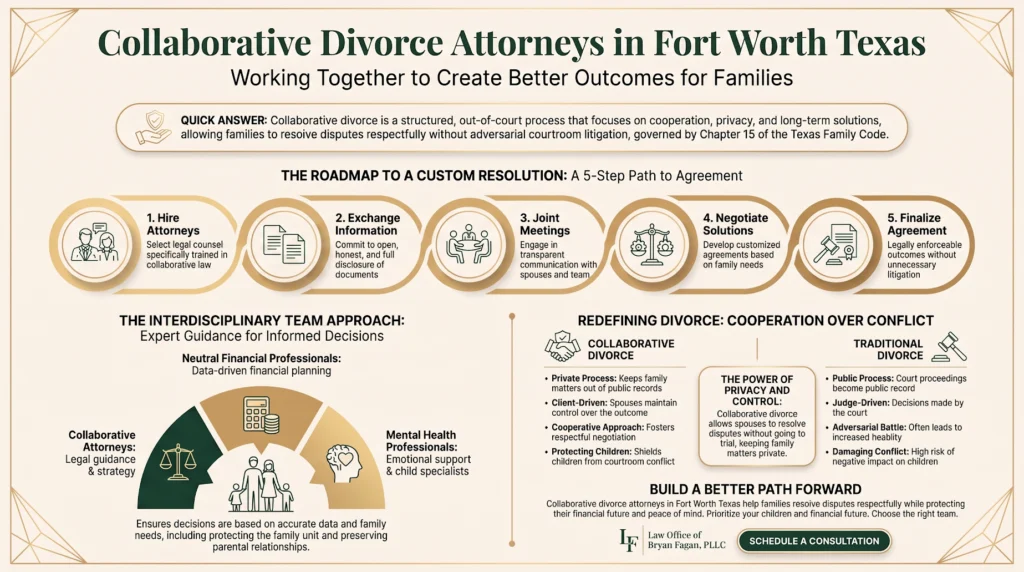
Collaborative divorce offers exactly that for many Texas families. Rather than placing every decision in the hands of a judge, this process allows both spouses to work with their own attorneys and, when appropriate, neutral professionals such as financial specialists, child specialists, or mental health professionals to negotiate a resolution outside the courtroom. Governed by the Texas Collaborative Family Law Act, the process emphasizes transparency, cooperation, and thoughtful problem-solving while helping families avoid much of the stress, expense, and uncertainty that often accompany traditional litigation. It is not the right choice for every situation, but for parents who remain committed to working together in good faith, it can create a healthier path through divorce.
One of the greatest advantages of this approach is that it gives parents the opportunity to focus on what matters most before positions harden and conflict escalates. Texas law reflects that priority. Under Texas Family Code §153.002, every decision involving children must be guided by the child’s best interest. That often includes preserving consistency, encouraging meaningful relationships with both parents, and creating an environment where children can continue to thrive despite the changes taking place around them.
In this article, you’ll learn how the collaborative divorce process works in Texas, how it differs from mediation and traditional litigation, and why many parents believe it provides the best opportunity to reduce conflict while protecting their children’s emotional well-being and long-term success. Understanding your options today can help your family move forward with greater confidence, clarity, and peace of mind tomorrow.
Collaborative divorce in Texas is a private, team-based process, governed by the Collaborative Family Law Act (Family Code Chapter 15), where both spouses and their own attorneys sign a participation agreement committing to settle without court. Its defining feature is §15.106: if the process fails and either spouse litigates, both attorneys must withdraw. That rule keeps everyone focused on resolution, but you must understand it before you sign.
Key Takeaways
- It starts with a participation agreement. Under Family Code §15.101, both spouses and their collaborative lawyers sign a written contract committing to resolve the divorce outside court, and under §15.102 the process begins when they sign.
- The withdrawal rule is the heart of it. Under §15.106, if the process breaks down and either spouse goes to court, both collaborative attorneys, and their firms, must withdraw. That shared commitment is what keeps everyone working toward settlement.
- It is a team, not a single mediator. Each spouse has their own attorney, and the couple can jointly retain neutral financial and mental-health professionals, unlike mediation’s single neutral.
- Disclosure is informal but complete. Under §15.109, the process replaces formal discovery with timely, full, and candid voluntary disclosure, which is faster and less combative but depends on honesty.
- Court activity pauses while it’s active. Under §15.103, litigation deadlines, hearings, and trial settings are paused during the collaborative process, though §15.104 preserves the ability to seek an emergency order.
- It is private and binding. Collaborative communications are confidential and privileged (§15.113, §15.114), and a compliant settlement agreement entitles a party to judgment (§15.105).
- It is not for every case. Where a spouse won’t disclose honestly, wants to punish the other, or there is family violence, collaborative divorce is usually the wrong tool.

Your Family’s Future Starts Here
Don’t navigate your legal journey alone. Schedule a consultation now and get the clarity and support you deserve.
Our office is available 24/7. Do not hesitate to schedule your free case evaluation by calling 817-406-7230 or contacting us online today.
What Collaborative Divorce Is in Texas

Collaborative divorce is a legally recognized process under Texas Family Code Chapter 15 that allows spouses to resolve divorce, property division, child custody, and support outside the courtroom while each remains represented by their own collaborative attorney. Unlike informal negotiations, collaborative divorce follows a structured legal framework that emphasizes cooperation, transparency, and practical problem-solving instead of litigation. If you’re looking for a broader overview of the process, explore our Collaborative Divorce in Texas guide.
Texas adopted the Collaborative Family Law Act in 2011 to provide families with a formal alternative to courtroom disputes. Under Texas Family Code §§15.052 and 15.053, collaborative law applies to both divorce and parent-child matters, allowing spouses to resolve issues involving property division, conservatorship, parenting time, and child support through confidential settlement meetings rather than contested hearings. Because the process is governed by statute—not simply by agreement—it includes established procedures, confidentiality protections, and clear responsibilities for everyone involved.
From my experience representing Texas families, collaborative divorce works best when both spouses genuinely want to resolve disagreements rather than prolong conflict. Couples who communicate openly and voluntarily exchange financial information often reach thoughtful agreements that protect their children, preserve their privacy, and give them more control over the outcome than they would have in a courtroom. That cooperative approach frequently reduces emotional stress while helping families move forward with greater certainty.
Collaborative divorce is not the right fit for every situation, which is why evaluating your family’s goals before signing a participation agreement is so important. Whether your case involves children, a family business, significant assets, or simply a shared commitment to avoiding unnecessary litigation, understanding how collaborative divorce works under Texas law helps you make informed decisions about the path that best protects your family’s future.
How It Begins: The Participation Agreement
A collaborative divorce begins when both spouses and their collaborative lawyers sign a participation agreement, the written contract required by Family Code §15.101. Under §15.102, the process officially starts on signing, and that document sets the rules everyone agrees to follow.
The participation agreement is more than a formality. It identifies each spouse’s collaborative lawyer and any neutral professionals joining the team, and it commits everyone to transparency, good-faith negotiation, and resolving the case outside the courtroom rather than preparing for trial. Signing it is a deliberate choice to change how the divorce will be conducted, so I make sure clients understand every commitment in it before they sign, especially the withdrawal rule that comes with it. Reviewing that agreement carefully with your own attorney is the single most important step at the front of a collaborative case.
What I can tell you from experience: couples who enter the collaborative process genuinely committed to it tend to reach durable, thoughtful agreements that hold up over time, because they built the terms themselves around what actually matters to their family. The structure rewards honesty and cooperation, and for the right couple it produces a far better outcome than a courtroom ever could.
The Withdrawal Rule — the Heart of the Process

The defining feature of collaborative divorce is the withdrawal rule found in Texas Family Code §15.106. Simply put, if the collaborative process ends without a settlement and either spouse chooses litigation, both collaborative attorneys—and their law firms—must withdraw from the case. That means you cannot continue into court with the same collaborative lawyer. While this may seem like a disadvantage at first, it is actually the foundation of the collaborative process because it encourages everyone to stay focused on finding practical solutions instead of preparing for trial. For a broader look at how this process works, visit our Houston Heights Collaborative Divorce page.
From my experience, this shared commitment changes the tone of negotiations. Because neither attorney benefits from the case becoming a lawsuit, everyone at the table is aligned toward reaching a fair, lasting agreement rather than escalating conflict. There is a limited exception under Texas Family Code §15.107 for certain low-income legal services, but in most cases the withdrawal requirement is mandatory. Before signing a collaborative participation agreement, I make sure every client understands this trade-off so they can confidently decide whether collaborative divorce is the right fit for their family’s goals, communication style, and commitment to resolving issues outside the courtroom.
Warning: before you sign the participation agreement, understand §15.106. If the collaborative process fails and the case goes to court, your collaborative attorney and everyone in their firm must withdraw, and you must hire new litigation counsel and largely start over. That is the price of the process’s commitment to settlement. Enter it only if you and your spouse truly intend to stay out of court.
The Collaborative Team and How Information Is Shared
Collaborative divorce is a team process, not a single mediator. Each spouse has their own collaborative attorney, and the couple can jointly retain neutral professionals, such as a financial specialist and a mental-health or child specialist, who work for the process rather than for either side.
That team model is the heart of the collaborative approach. A neutral financial professional can value a business or untangle retirement and tax questions once for both spouses, instead of each side hiring dueling experts. A mental-health professional or child specialist can keep the conversation productive and keep the children’s needs at the center. And instead of the formal discovery that drives litigation, §15.109 has the process run on timely, full, and candid informal disclosure, where each side voluntarily shares all relevant information even without a formal request. That is faster, cheaper, and less adversarial, but it depends entirely on both spouses being honest, which is why the process suits couples who are willing to cooperate and is a poor fit for those who are not. I help assemble the right team for each family’s situation.
A collaborative divorce is only as strong as the team behind it. Let’s build yours the right way.
Schedule a Confidential ConsultationWhat the Process Pauses
While a collaborative divorce is active, court litigation activity is paused. Under Family Code §15.103, the parties are not running toward hearings, discovery deadlines, or trial settings, which lets everyone focus on reaching agreement instead of preparing for battle.
This pause is part of what makes the collaborative environment feel different from litigation. There is no looming trial date forcing decisions or driving up cost, and no contested motions being filed while the team works. Instead, the parties provide status updates as required and keep the momentum on resolution. Importantly, the process does not strip away protection in a genuine emergency: §15.104 preserves the ability to seek an emergency order from a court if urgent circumstances demand it, so pausing litigation does not mean giving up safety. For couples who want to lower the temperature and work deliberately, that paused, deadline-free space is a real advantage.
Reaching and Enforcing the Settlement

A successful collaborative divorce ends with a legally enforceable settlement agreement that becomes the foundation for the final divorce decree. Under Texas Family Code §15.105, a collaborative settlement is binding when it contains the required non-revocation language and is signed by both spouses and their collaborative attorneys. Once those requirements are met, the agreement can be presented to the court for entry of the final judgment. To learn more about resolving divorce through cooperation rather than litigation, visit our Collaborative Divorce Attorneys in Houston Heights page.
That legal enforceability is one of collaborative divorce’s greatest advantages. Instead of leaving major decisions to a judge, spouses work together to create customized solutions that fit their family’s circumstances while still complying with Texas law. Property division remains subject to the “just and right” standard under Texas Family Code §7.001, but collaborative negotiations provide significantly more flexibility than a courtroom trial to address parenting arrangements, financial issues, and long-term planning.
Every Texas divorce is also subject to the state’s mandatory 60-day waiting period under Texas Family Code §6.702, so even collaborative cases cannot be finalized immediately after filing. During that time, the parties can continue refining their settlement, preparing the final decree, and resolving any remaining details. Once the waiting period expires and the court approves the agreement, the negotiated terms become an enforceable court order, giving both spouses the certainty and stability they worked together to achieve.
Listen to Our Texas Family Law Podcast
Prefer listening? In this episode, we discuss collaborative divorce in Texas for Fort Worth families, including how the collaborative process works, how it differs from traditional litigation, and why it may be an effective way to resolve divorce outside of court.
“The withdrawal rule sounds like a risk, but it is really a promise: everyone in the room is committed to solving this, because no one on the team profits from a fight.”
Confidentiality and Privilege
Collaborative divorce is private. Under Family Code §15.113, collaborative communications are confidential, and under §15.114 they are privileged, meaning what is said in the collaborative process generally cannot be used against you later if the case does not settle and moves to litigation.
This protection is what allows both spouses to speak candidly during joint meetings. You can explore options, share concerns, and float compromises without fear that your words will resurface as evidence in a courtroom. It also keeps sensitive personal, financial, and family details out of the public court record, which for many couples, especially those with a business or a public profile, is one of the strongest reasons to choose the collaborative path. There are limits, as the underlying duty to report abuse or neglect always applies, but within those bounds the privacy of the process is genuine and is protected by statute, not just by courtesy.
Collaborative Divorce vs Mediation vs Litigation
Collaborative divorce, mediation, and litigation all provide different paths to resolving a divorce, and the best option depends on your family’s circumstances, communication, and willingness to work together. Collaborative divorce combines legal representation with cooperative problem-solving, mediation relies on a neutral facilitator to help spouses negotiate, and litigation places the dispute before a judge who ultimately decides unresolved issues. If you’d like to explore the collaborative approach in more detail, visit our Collaborative Divorce Lawyer in The Woodlands resource.
The biggest difference is the level of support each process provides. In mediation, one neutral mediator helps guide negotiations, and each spouse may choose whether to have an attorney involved. Collaborative divorce gives each spouse their own collaborative attorney while allowing the family to work with neutral professionals, such as financial specialists or child specialists, through a series of structured meetings. Under Texas Family Code §15.106, collaborative divorce also includes the withdrawal rule, meaning both collaborative attorneys must withdraw if the process ends and the case proceeds to litigation—a feature designed to keep everyone focused on reaching a settlement.
Litigation follows a very different path. Discovery, court hearings, and trial preparation occur under a judge’s supervision, and unresolved issues are ultimately decided by the court. In straightforward cases where spouses already agree on most issues, mediation may provide an efficient resolution. In more complex cases involving children, significant assets, family-owned businesses, or high-conflict disputes, collaborative divorce often offers a balanced middle ground by combining experienced legal guidance with a structured commitment to resolving issues outside the courtroom whenever possible.
Strategy note: enter the collaborative process only if both spouses genuinely commit to candor and to staying out of court. The process rewards couples who want to problem-solve and punishes gamesmanship, because the withdrawal rule means a bad-faith participant blows up the whole thing. Be honest with yourself about which kind of divorce you’re really having before you sign.
When Collaborative Divorce Is Not Appropriate

Collaborative divorce works best when both spouses are willing to communicate honestly, exchange information voluntarily, and work toward a shared resolution. It is generally not the right approach when there is family violence, a significant imbalance of power, hidden assets, or a spouse who is determined to avoid cooperation. Understanding these limitations early helps families choose the process most likely to produce a fair and lasting outcome. For a more detailed explanation of the collaborative process, read our What Is Collaborative Divorce? guide.
Texas law recognizes that collaborative divorce is appropriate only when participation is informed and voluntary. Texas Family Code §15.111 requires each party to give informed consent before entering the collaborative process, while §15.112 requires attorneys to consider whether family violence or coercion could prevent meaningful participation. These safeguards exist because collaborative negotiations depend on both spouses having the ability to make informed decisions without intimidation or unfair pressure.
From my experience, the most successful collaborative cases involve spouses who may disagree but still share a genuine commitment to resolving issues outside the courtroom. When one spouse refuses to provide complete financial information, is attempting to conceal assets, or views the divorce as an opportunity for retaliation, the process often breaks down before meaningful progress can be made. In those situations, mediation or traditional litigation may provide stronger legal tools for protecting your rights and obtaining the information needed to reach a fair resolution.
Choosing the right process is just as important as choosing the right attorney. Before recommending collaborative divorce, I help clients honestly evaluate their circumstances, communication dynamics, and goals for the future. If safety concerns, financial complexity, or a lack of cooperation make collaborative divorce impractical, recognizing that early can save significant time, expense, and frustration while positioning your family for a more effective path forward.
The Law Office of Bryan Fagan, PLLC
204 W Central Ave, Fort Worth, TX 76164
Serving Fort Worth, Tarrant County, and clients across Texas.
Call 281-810-9760The Collaborative Divorce Process, Stage by Stage
Here is what a collaborative divorce actually looks like from the participation agreement to the final decree. Tap any stage to see what happens, how long it takes, and what to do.
From Participation Agreement to Final Decree, Stage by Stage
Tap any stage to expand what happens, how long it takes, and what to do.
Stage 1 — Sign the Participation Agreement
Both spouses and their collaborative lawyers sign the participation agreement required by Family Code §15.101, and under §15.102 the process begins on signing. The agreement commits everyone to transparency, good-faith negotiation, and staying out of court, and it includes the §15.106 withdrawal rule.
Typical timing: at the start, once both spouses choose the collaborative path.
What to do: review every term with your attorney, especially the withdrawal rule, before you sign.
Stage 2 — Assemble the Team
Each spouse has their own collaborative lawyer, and the couple can jointly retain neutral professionals, such as a financial specialist to value a business or untangle retirement, and a mental-health or child specialist to keep the process productive and child-focused. The team works toward one shared goal: a resolution.
Typical timing: the opening phase, right after the agreement is signed.
What to do: identify which neutral experts your case needs and choose professionals experienced in collaborative work.
Stage 3 — Joint Meetings & Candid Disclosure
The couple, their lawyers, and the neutrals meet in a series of joint sessions. Instead of formal discovery, §15.109 has the process run on timely, full, and candid voluntary disclosure. Court activity is paused while the process is active under §15.103, and communications are confidential and privileged under §15.113 and §15.114.
Typical timing: the core of the process, over weeks to a few months.
What to do: disclose fully, negotiate in good faith, and focus on interests rather than fixed positions.
Stage 4 — Reach the Settlement Agreement
When the couple resolves every issue, the terms are written into a settlement agreement. Under §15.105, a party is entitled to judgment on it if it carries a prominently displayed non-revocation statement and is signed by each spouse and their collaborative lawyer. Property is still divided “just and right” under §7.001.
Typical timing: once the joint meetings produce full agreement.
What to do: confirm the agreement reflects everything you negotiated before signing.
Stage 5 — Judgment & Final Decree
The signed settlement becomes the basis for the final decree, which the attorneys draft and submit for the judge to sign. No Texas divorce can be finalized before the 60-day minimum waiting period under §6.702. If the process had instead broken down, §15.106 would require both collaborative lawyers to withdraw and the spouses to retain new litigation counsel.
Typical timing: after signing, plus the mandatory waiting period.
What to do: review the final decree against your settlement to confirm it matches before it is entered.
Wherever you are in weighing this process, the next step is a conversation.
Call 281-810-9760Collaborative Practice in Tarrant County

Fort Worth and Tarrant County have an active collaborative-law community, and collaborative divorce is a well-established option here. The Tarrant County family district courts handle the resulting decrees, and the local collaborative practice group supports the process with trained professionals.
Because the collaborative process is designed to stay out of court while it is active, most of the work happens in joint meetings at the attorneys’ offices rather than at the courthouse, with the Tarrant County family district courts entering the final decree once the settlement is signed and the waiting period passes. Fort Worth has a local collaborative-divorce community, and choosing attorneys and neutral professionals who regularly work together collaboratively can make the process smoother. One procedural point worth confirming for your specific case is whether an automatic standing order applies on filing, because county practice on standing orders varies and can change; I confirm the current requirement for your court when we file. For the statewide picture on the collaborative process, see my collaborative divorce overview.
Nearby Counties Where Practice Differs
The Collaborative Family Law Act is the same statewide, but the local collaborative-law community, the available neutral professionals, and court scheduling for the final decree differ between metroplex counties. Where your case is filed follows residency.
For Fort Worth families, a collaborative divorce sometimes touches Dallas, Denton, Parker, or Johnson counties where a spouse lives or owns property, and each county has its own family courts and its own pool of trained collaborative professionals. Because so much of the collaborative process happens outside the courthouse, the local differences matter less than in litigation, but knowing the collaborative community in the county where your decree will be entered is still an advantage. Our attorney Bryan Bubis practices in the Tarrant, Johnson, and Parker county courts, and we help families pursue the collaborative path across the metroplex and statewide.
Your Fort Worth Attorney
Collaborative divorce out of our Fort Worth office is handled by Senior Attorney Bryan Bubis, who has built his career resolving family cases cooperatively rather than through unnecessary courtroom fights. When you call about a collaborative divorce in Tarrant County, Bryan Bubis and our Fort Worth team are who you will work with.
Bryan Bubis — Senior Attorney, Fort Worth
15+ Years Family Law · Tarrant, Johnson & Parker County Courts
Bryan Bubis brings more than 15 years of family law experience to the collaborative process, representing clients through divorce, custody, and support matters with a focus on resolving them efficiently and cooperatively rather than dragging families through avoidable litigation. He prepares each client to enter the collaborative process with a clear understanding of the commitment involved and a realistic view of what it can achieve.
Bryan represents clients in the Tarrant, Johnson, and Parker county family courts. He works these cases the way I do: understand what the family truly needs, pursue a cooperative resolution when both spouses are committed to it, and be candid when another path would serve the client better. Read Bryan Bubis’s full profile.
What to Do If You’re Considering a Collaborative Divorce in Fort Worth
- Understand the withdrawal rule under §15.106 before anything else; if the process fails and you litigate, you start over with a new lawyer.
- Have an honest conversation about whether both spouses genuinely want a non-adversarial, out-of-court resolution.
- Gather your financial records so you can participate in the full, candid disclosure the process requires.
- Consider whether a business, shared children, or a desire for privacy make the team model especially valuable for you.
- Choose an attorney who works cooperatively and understands the collaborative process, and ask about the neutral professionals available.
- Think about which neutral experts your case may need, such as a financial specialist or a child specialist.
- Read the participation agreement carefully with your attorney before signing, since it governs the whole process.
- Raise any history of family violence or safety concern with your attorney early, as it may make the process inappropriate.
- Be prepared to negotiate in good faith and focus on interests, not fixed positions, across the joint meetings.
- Book a Legal Strategy Session with our Fort Worth office to decide whether collaborative divorce fits your situation.
End It With Dignity
A private, respectful, out-of-court divorce is possible. Let’s see if the collaborative path fits your family.
Call 281-810-9760 TodayWhat I Tell Every Couple Considering a Collaborative Divorce

The first thing I tell them is what the process offers: a private, structured, dignified way to end a marriage with a team of professionals helping you build the outcome, instead of a public courtroom fight where a judge decides. For couples who still respect each other, who share children or a business, or who simply want to protect their privacy, it can be a far better experience than litigation.
The second thing I tell them is the honest trade-off. The withdrawal rule under §15.106 means that if the process fails and you go to court, your collaborative attorney must step aside and you start over. That rule is what keeps everyone committed to settlement, but it is a real cost if the process collapses, so collaborative divorce is right only when both spouses genuinely intend to resolve things out of court. The threshold is simple: if you and your spouse can be honest with each other and want to avoid a fight, the collaborative path deserves a serious look; if one of you wants to hide assets or wage war, it does not.
You do not have to choose between an ugly court battle and simply giving in. Collaborative divorce is a structured middle path, and for the right couple it protects your privacy, your finances, and your family’s future. Call 281-810-9760 or book a Legal Strategy Session with our Fort Worth office, and let’s figure out honestly whether it is the right path for you.
Conclusion:
Divorce does not have to become a battle that defines your family’s future. For many parents, choosing the right process is just as important as choosing the right outcome. Collaborative Divorce Attorneys in Fort Worth Texas help families resolve difficult issues with greater privacy, respect, and long-term stability, allowing parents to focus on building a healthy future instead of reliving past conflicts. In straightforward situations where both spouses are committed to honest communication and cooperative problem-solving, collaborative divorce can provide an efficient and constructive path forward. In more complex cases—particularly those involving substantial assets, business ownership, complicated parenting arrangements, or concerns about transparency—the right legal strategy may require additional guidance and experience. Every family’s circumstances are different, and the best approach is the one that protects your goals while keeping your children’s well-being at the center of every decision.
At The Law Office of Bryan Fagan, PLLC, we believe informed decisions create stronger futures. Our role is not simply to help clients complete a divorce but to educate, guide, and empower families through one of life’s most significant transitions with clarity, compassion, and strategic legal counsel. If your case involves questions about whether collaborative divorce is the right fit, a Legal Strategy Session can help you understand your options, evaluate the complexity of your situation, and develop a plan designed to protect what matters most—your family, your future, and your peace of mind.
About the Author
Founder & Managing Attorney · Serving Texas families since 2012
I am Bryan Fagan, founder and managing attorney of The Law Office of Bryan Fagan, PLLC, one of the largest family law firms in Texas. I hold a Juris Doctor from South Texas College of Law and a bachelor’s degree in business finance from the University of Phoenix, and I lead a team of more than 170 legal professionals with offices across the state. In custody cases, my aim is always to keep the focus where the law puts it: on what is genuinely best for the child.
I am also the author of several family law guides, including The Texas Divorce Handbook, because I believe parents make better decisions when they understand the process. Out of our Fort Worth office, our team helps parents with conservatorship, possession, modification, and enforcement matters in the Tarrant County family courts. If you are facing a custody case, I would like to help. Read more about Bryan Fagan.
Questions Families Ask About Collaborative Divorce in Fort Worth
Collaborative divorce is a private, team-based process governed by the Collaborative Family Law Act, Chapter 15 of the Texas Family Code. Both spouses and their own attorneys sign a participation agreement committing to resolve the divorce without court, and the couple can add neutral financial and mental-health professionals. The process relies on cooperation and candid disclosure, and its defining rule is that both attorneys must withdraw if the case goes to litigation.
Mediation uses one neutral third party who facilitates a settlement, and you keep your lawyer whether or not it settles. Collaborative divorce gives each spouse their own attorney plus a shared team of neutral experts, and it carries the §15.106 withdrawal rule that mediation does not: if collaborative fails, both attorneys must withdraw. Collaborative offers more support and a stronger commitment to staying out of court, with that trade-off.
It is the written contract, required by Family Code §15.101, that both spouses and their collaborative lawyers sign to start the process. Under §15.102 the collaborative divorce begins on signing. The agreement identifies each spouse’s lawyer and any neutral professionals, and commits everyone to transparency, good-faith negotiation, and resolving the case outside court. Review it carefully with your attorney, because it includes the withdrawal rule.
Under Family Code §15.106, if the process ends and either spouse takes the case to litigation, both collaborative attorneys and every lawyer in their firms must withdraw. You cannot keep your collaborative lawyer for the court fight; you hire new litigation counsel and largely start over. This is the process’s key trade-off, and it is why you should enter it only if both spouses genuinely intend to settle out of court.
Yes. Collaborative divorce requires each spouse to be represented by their own collaborative lawyer; that is a defining feature of the process under the Collaborative Family Law Act. This differs from mediation, where a single neutral works with both sides. Having your own attorney ensures your interests are protected and advised on throughout the joint meetings, while the whole team stays committed to reaching a settlement out of court.
It varies with the complexity of your estate and how many neutral professionals you use, but collaborative divorce is usually less expensive than a contested trial because it avoids formal discovery and courtroom litigation. You pay your own attorney and share the cost of jointly retained neutrals. The main financial risk is the withdrawal rule: if the process fails, hiring new litigation counsel adds cost. I give you a realistic estimate at your consultation.
It depends on the issues and how well the spouses cooperate, but collaborative divorce often moves faster than litigation because there is no crowded court docket driving the schedule and litigation is paused under §15.103. Many couples resolve everything in a series of joint meetings over a few months. No Texas divorce, however, can be finalized before the 60-day minimum waiting period under §6.702.
Yes. Under Family Code §15.105, a party is entitled to judgment on a collaborative settlement agreement if it contains a prominently displayed statement that it is not subject to revocation and is signed by each spouse and their collaborative lawyer. That agreement becomes the basis for the final decree. Property is still divided under Texas community-property law, and the divorce is finalized after the 60-day waiting period.
Yes. Under Family Code §15.113 collaborative communications are confidential, and under §15.114 they are privileged, so what is said in the process generally cannot be used against you later if the case moves to litigation. It also keeps sensitive financial and family details out of the public court record. The underlying duty to report abuse or neglect still applies, but within that limit the process’s privacy is protected by statute.
Often, yes. For couples who will keep co-parenting, collaborative divorce is designed to preserve a working relationship rather than damage it in a courtroom fight. The team can include a child specialist, and the focus on problem-solving keeps the children’s needs central. Because you build the parenting plan together rather than having a judge impose one, the result is usually more workable and more durable for the whole family.
It is a poor fit when a spouse won’t disclose honestly, wants to punish the other, or where there is a history of family violence or a serious power imbalance. Texas law requires informed consent (§15.111) and family-violence screening (§15.112) for this reason. Because the process depends on cooperation and full voluntary disclosure, and the withdrawal rule makes failure costly, high-conflict or dishonest situations usually need mediation or litigation instead.
Still have a question I didn’t cover? Bring it to a Legal Strategy Session and we’ll work through it together.
Schedule Your Consultation