
Parental Visitation Attorneys in Fort Worth Texas

When someone contacts me looking for Parental Visitation Attorneys in Fort Worth Texas, they are usually describing one of a few situations. A father who has noticed his child becoming quieter every time they return from the other parent’s house. A mother who has been called by the school because her child’s grades have started slipping since the separation. A parent whose co-parent is moving across town and is worried about changing schools, longer commutes, and whether the current visitation schedule still makes sense. Or a parent who simply wants to know how to create a custody arrangement that gives their child the best chance to succeed despite everything their family is going through. If any of those situations sound familiar, you’re in the right place, and I want to begin with one of the most important things every Texas parent should understand.
In Texas, what many people call “visitation” is legally known as possession and access, and it is governed by Chapter 153 of the Texas Family Code. While most parents focus on when their child will be with each parent, Texas courts focus on something much bigger: what arrangement serves the child’s best interests. Under Texas Family Code §153.002, every conservatorship and possession decision is made with that guiding principle in mind. That includes creating routines that provide consistency, reduce unnecessary conflict, and support a child’s emotional well-being and overall development—including their ability to thrive in school.
I am Bryan Fagan, founder of The Law Office of Bryan Fagan, PLLC and a graduate of South Texas College of Law. Through our Fort Worth office, my team helps parents throughout Tarrant County establish, modify, and enforce possession orders while developing parenting plans that fit their family’s unique circumstances. Over the years, I have learned that successful custody cases are rarely just about calendars or weekends. They are about giving children the stability they need to feel secure, maintain healthy relationships with both parents, and continue moving forward during one of the biggest transitions of their lives.
This guide explains how Texas visitation laws intersect with a child’s educational stability, how judges evaluate parenting arrangements when making custody decisions, and what practical steps parents can take to support both their child’s emotional well-being and academic success. My goal is to help you better understand the law so you can make informed decisions that protect your child today while building a stronger future for tomorrow.
The Short Answer
In Texas, “visitation” is legally called possession and access, and the default schedule is the Standard Possession Order under Family Code §153.252. It generally gives the non-primary parent the 1st, 3rd, and 5th weekends, a weekday period during the school year, alternating holidays, and extended summer time. Parents can always agree to a different schedule; the Standard Possession Order is what a court applies when they cannot.
Key things to know about visitation in Fort Worth
- The Standard Possession Order (SPO) is the default schedule. Under Texas Family Code §153.252, the SPO is generally presumed to be in the best interest of children three years of age or older, although parents may agree to a different schedule or the court may order one that better fits the child’s needs. The Expanded Standard Possession Order often provides more parenting time. For parents living within 50 miles of one another, Texas law generally favors the Expanded Standard Possession Order, which typically uses school pickup and drop-off times instead of fixed evening exchanges. Learn more in our guide to the Texas Standard Possession Order. Distance between parents changes the possession schedule. When parents live more than 100 miles apart, Texas law generally provides longer periods of possession with fewer exchanges to better accommodate travel. Children under three usually need a customized schedule. Instead of automatically applying the Standard Possession Order, courts create age-appropriate parenting plans that support a young child’s developmental needs before transitioning to a more traditional schedule. Possession and access is different from conservatorship. Possession determines when your child is with each parent, while conservatorship determines who makes important decisions about education, healthcare, and other major aspects of the child’s life. Court orders should be enforced through the legal system. If the other parent refuses to follow a possession order, the appropriate remedy is typically a motion to enforce—not withholding the child or stopping child support payments. Possession orders can be modified when circumstances change. A relocation, significant change in a parent’s work schedule, changes in the child’s needs, or other material changes may justify seeking a visitation or custody modification under Texas law.

Your Family’s Future Starts Here
Don’t navigate your legal journey alone. Schedule a consultation now and get the clarity and support you deserve.
Our office is available 24/7. Do not hesitate to schedule your free case evaluation by calling 817-406-7230 or contacting us online today.
What “visitation” means in Texas

Texas does not legally use the term “visitation.” Instead, Chapter 153 of the Texas Family Code uses the term possession and access to describe when a child is physically with each parent and how parents communicate through phone calls, video chats, or other approved methods. The guiding principle behind every possession order is the best interest of the child under Texas Family Code §153.002, while §153.001 encourages children to maintain frequent and continuing contact with both parents whenever it is safe and appropriate. If you want a deeper explanation of how parenting schedules are structured, explore our guide to the Texas Standard Possession Order.
For parents searching for Parental Visitation Attorneys in Fort Worth Texas, understanding this distinction is important because courts enforce the language of your possession order—not what either parent believes the schedule should be. Whether your family follows the Standard Possession Order, an Expanded Standard Possession Order, or a customized parenting plan, every provision regarding exchanges, holidays, summer possession, and electronic communication can affect your parenting time. A clear order reduces misunderstandings and provides a predictable framework for successful co-parenting.
When I meet with parents in our Fort Worth office, one of the first things we do is review their order carefully, often line by line. In straightforward visitation cases, that review frequently answers questions about parenting schedules and resolves confusion before it turns into conflict. In more complex situations involving relocation, visitation enforcement, custody modification, or long-distance possession, the exact wording of the order often determines what legal remedies are available through the Tarrant County family courts.
If you do not yet have a possession order, creating one is one of the best ways to protect both your parental rights and your child’s stability. A thoughtfully drafted parenting plan establishes clear expectations, reduces conflict, and creates an enforceable schedule that supports healthy co-parenting. That clarity helps families move forward with greater confidence, consistency, and peace of mind.
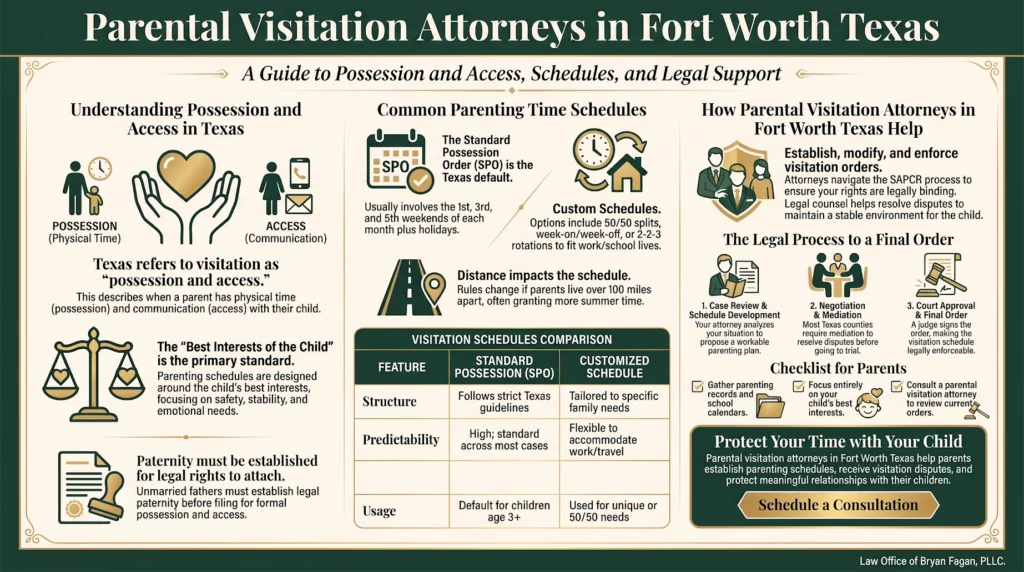
The Standard Possession Order explained
The Standard Possession Order (SPO) is the default parenting schedule Texas courts use when parents cannot agree on a visitation arrangement. Under Texas Family Code §153.252, the law generally presumes that the SPO is in the best interest of a child who is three years of age or older. For parents living relatively close to one another, the schedule typically includes the first, third, and fifth weekends of each month, a weekday parenting period during the school year, alternating holidays, and an extended period of summer possession. Many families today also qualify for the Expanded Standard Possession Order, which often provides additional parenting time through school-based pickup and drop-off schedules.
For parents researching Parental Visitation Attorneys in Fort Worth Texas, one of the most common misconceptions is that the Standard Possession Order means “every other weekend.” It does not. The schedule follows the first, third, and fifth weekends of each month, meaning some months include three visitation weekends while others include only two because a fifth weekend occurs only when the month contains five Fridays. Understanding this distinction can help prevent unnecessary disputes and confusion.
Just as important, the Standard Possession Order is a starting point—not a one-size-fits-all solution. Texas courts encourage parents to create parenting plans that fit their family’s unique circumstances, provided the arrangement serves the child’s best interests under Texas Family Code §153.002. In straightforward visitation cases, parents often agree to customized schedules such as week-on/week-off, 2-2-3, or 2-2-5-5 rotations. In more complex custody disputes involving relocation, demanding work schedules, or children with unique educational or medical needs, a tailored possession order may better support long-term stability for both the child and the family.
The Standard Possession Order is the default; parents may agree to a different schedule, and the over-100-mile schedule differs (see below).
Want to know which version of the schedule you qualify for? Bring your order to a confidential consultation.
Schedule a Confidential ConsultationStandard vs. Expanded possession
The biggest difference between the Standard Possession Order and the Expanded Standard Possession Order is simple: the expanded schedule gives many parents more time with their children. Under Texas Family Code §§153.317 and 153.3171, weekend possession generally begins when school is dismissed on Friday and continues until school resumes on Monday, rather than ending Sunday evening. The Thursday visit also becomes an overnight, allowing the child to go directly to school Friday morning. If you’d like a detailed breakdown of these changes, read our guide to the Expanded Standard Possession Order in Texas.
For parents searching for Parental Visitation Attorneys in Fort Worth Texas, one of the most important changes to understand is that, for many cases filed on or after September 1, 2021, the Expanded Standard Possession Order is now the default when parents live within 50 miles of one another, unless a parent elects otherwise or the court finds a different schedule is in the child’s best interest. For many families in Fort Worth, Arlington, Mansfield, Keller, Grapevine, North Richland Hills, and Bedford, this means more consistent parenting time without requiring additional court hearings.
In straightforward visitation cases, the expanded schedule creates longer weekends and additional overnight parenting time while maintaining a predictable routine for children. In more complex custody disputes, such as when a parent is moving to Fort Worth, relocating elsewhere in Texas, or requesting a custody modification, determining whether the Expanded Standard Possession Order still applies requires a careful review of the existing possession order, the distance between the parents’ homes, and the child’s best interests. Even a relatively short move can affect transportation, school attendance, and the overall parenting schedule, making it important to understand how Texas law applies to your family’s specific circumstances.
The reassuring part: because the possession schedule is codified, it is knowable in advance. Once you tell me how far apart you and the other parent live and how old your child is, I can usually tell you early what your schedule most likely looks like and whether the expanded times apply to you. You are not walking into a mystery — you are working from a default the whole state uses.
Holiday and summer possession

Holiday possession takes priority over the regular visitation schedule. Under Texas Family Code §153.314, holiday parenting time overrides the normal weekend and weekday possession schedule, ensuring parents know in advance who will have the child during major holidays. Instead of creating yearly uncertainty, the law generally alternates holidays between parents so that, over time, each parent has meaningful opportunities to celebrate special occasions with their child.
Summer possession gives the non-primary parent an extended period of uninterrupted parenting time, but important deadlines apply. For parents who live within 100 miles of each other, Texas law generally provides 30 days of summer possession, while parents living more than 100 miles apart may receive up to 42 days. To choose specific summer dates, written notice generally must be provided by April 1. Missing that deadline may mean the default schedule applies instead. If you’re planning exchanges across the city or throughout North Texas, our guide to Transportation in Fort Worth offers helpful information about navigating the area efficiently.
For parents searching for Parental Visitation Attorneys in Fort Worth Texas, holiday and summer possession often become some of the most important parts of a parenting plan because they involve vacations, family traditions, and extended time together. In straightforward visitation cases, following the written schedule and meeting required notice deadlines helps prevent misunderstandings. In more complex custody disputes involving relocation, long-distance possession, or visitation modifications, careful planning becomes even more important to ensure travel arrangements, transportation responsibilities, and holiday schedules continue to serve the child’s best interests while minimizing conflict between parents.
Strategy note: the parents who keep their possession time are the ones who document it. Keep a simple calendar of every exchange, note any time you were denied and the date and time it happened, and send summer-date elections in writing before the deadline. Specifics win possession disputes; “he’s always late” loses to “here are the eleven dates, with times, that I was denied.”
When parents live far apart: the 100-mile rule
When parents live more than 100 miles apart, Texas law adjusts the possession schedule to reduce travel while preserving meaningful parenting time. Under Texas Family Code §153.313, the distance is measured between the parents’ residences, and crossing the 100-mile threshold changes how the Standard Possession Order works. Instead of frequent exchanges, the law generally provides longer, less frequent visitation periods to make travel more practical for both the parents and the child.
For parents searching for Parental Visitation Attorneys in Fort Worth Texas, understanding the 100-mile rule is essential when relocation or long-distance parenting is involved. In many cases, the midweek visitation period is eliminated because regular school-night travel is no longer realistic. The non-primary parent may have the option to continue with the first, third, and fifth weekend schedule or elect one weekend each month of their choosing, while summer possession generally expands to 42 days, and Spring Break is often awarded every year rather than alternating. If regular travel between cities is part of your parenting plan, our guide to Transportation in Fort Worth provides helpful information for planning safe and efficient exchanges.
It is also important to understand that the 50-mile rule and the 100-mile rule serve different purposes. Parents who live within 50 miles of one another often qualify for the Expanded Standard Possession Order, which provides additional parenting time through school-based exchanges. Once the distance exceeds 100 miles, however, Texas law shifts to a long-distance possession schedule that emphasizes fewer exchanges and longer periods of parenting time. In straightforward cases, applying these rules is relatively simple. In more complex situations involving relocation, changing schools, geographic restrictions, or a proposed move after a custody order has already been entered, a visitation modification may be necessary to ensure the parenting plan continues to serve the child’s best interests.
Listen to Our Texas Family Law Podcast
Prefer listening? In this episode, we explain child visitation in Texas for Fort Worth families, including how possession and access schedules work, what courts may consider, and how parents can protect meaningful time with their child.
Possession of a child under three
Children under the age of three usually do not follow the Standard Possession Order. Instead, Texas Family Code §§153.251(d) and 153.254 require courts to create a possession schedule based on the child’s unique developmental needs and the child’s best interests. Rather than applying a one-size-fits-all approach, judges consider factors such as the child’s caregiving history, each parent’s involvement, work schedules, the distance between the parents’ homes, and whether the child is nursing or has other age-specific needs.
For parents searching for Parental Visitation Attorneys in Fort Worth Texas, it is important to understand that infants and toddlers often benefit from step-up parenting plans. These customized schedules typically begin with shorter, more frequent periods of possession and gradually expand as the child grows older. The goal is to help the child develop secure relationships with both parents while providing the stability young children need during a period of rapid development.
One of the most common mistakes I see is an order that explains the schedule for a two-year-old but says nothing about what happens after the child’s third birthday. In straightforward cases, parents can avoid future disagreements by including a clear transition to the Standard Possession Order or another agreed-upon parenting schedule. In more complex custody matters involving relocation, changing work schedules, or developmental concerns, additional provisions may be necessary to ensure the parenting plan continues to serve the child’s best interests as they grow.
If you are preparing for a consultation at our Fort Worth office, gathering information about your child’s current routine, caregiving history, and daily schedule can make the planning process much more productive. Our Plan Your Visit to Our Fort Worth Office guide explains what to expect so you can arrive prepared to discuss the parenting plan that best supports your child’s future.
Supervised or limited possession and safety

The frequent-contact policy has a limit, and that limit is the child’s safety. Where there is a history of family violence, neglect, or other conduct that endangers the child, the court has authority to restrict, supervise, or in serious cases deny possession, and to impose conditions such as supervised exchanges or no overnights (§153.004 and related sections). A judge must weigh evidence of family violence in any possession decision.
If you are worried about your child’s safety during the other parent’s time, the answer is to bring that evidence to the court and ask for protective terms — not to unilaterally withhold the child, which can put you on the wrong side of your own order. If you are the parent being accused, the specifics of what the court can and cannot order matter enormously, and this is not a situation to navigate without counsel.
Modifying a possession order
A possession order can be modified when a significant change in circumstances affects your family or your child’s best interests. Under Texas Family Code §156.101, a court may approve a custody or visitation modification if there has been a material and substantial change since the current order was signed. Common examples include a parent’s relocation, a new work schedule, remarriage, changes in the child’s educational or medical needs, or circumstances that make the existing parenting plan no longer practical.
For parents searching for Parental Visitation Attorneys in Fort Worth Texas, it is important to understand that court orders do not automatically change when your life changes. Even if Texas law has expanded parenting time opportunities—such as through changes affecting the Expanded Standard Possession Order—or your family dynamics have evolved, the existing possession order remains legally enforceable until the court approves a modification. If your current schedule no longer reflects your family’s needs, filing for a modification may be the appropriate next step.
Timing also matters. Texas Family Code §156.102 places additional requirements on certain modification requests filed within one year of the existing order, making it important to carefully document the changes supporting your request. In straightforward visitation cases, a documented job change or relocation may justify updating the parenting schedule. In more complex custody disputes involving geographic restrictions, long-distance parenting, or ongoing visitation enforcement issues, a thoughtful legal strategy becomes even more important to demonstrate why the requested modification serves the child’s best interests.
If you’re considering changing your parenting plan, preparation can make the process more productive. Bringing your current order, parenting schedule, and information about the changes affecting your family to your consultation helps create a clearer path forward. Before your appointment, visit our Plan Your Visit to Our Fort Worth Office page to learn what to expect and how to prepare for a productive discussion about your family’s future.
Enforcing denied possession or access
When the other parent refuses to follow the order — keeps the child on your weekend, no-shows at exchanges, or blocks your access — Texas gives you a court remedy. You can file a motion to enforce the possession order, and the court can order make-up possession time, hold the violating parent in contempt, and order them to pay your attorney’s fees. The key to winning is precise documentation: dates, times, and the specific possession periods you were denied.
Warning: do not respond to denied visitation by withholding the child yourself, and do not stop paying child support because you are being kept from your child — the two are legally separate, and either move can put you in violation of your own order. Enforcement runs through the court, with a motion to enforce, make-up time, and contempt. Self-help almost always makes your case worse, not better.
Possession vs. conservatorship: what this page does not cover

Texas separates two things that people lump together as “custody.” Possession and access — this page — is the schedule: when the child is physically with each parent. Conservatorship is the set of rights and duties: who makes decisions about the child’s education, medical care, and residence, and which parent’s home is primary. You can share conservatorship fairly and still have a possession schedule that gives one parent more day-to-day time, and vice versa.
One myth worth killing here: equal or expanded possession does not automatically eliminate child support. Support is calculated separately from the possession schedule. If your question is really about decision-making rights or who the child lives with primarily, see our Fort Worth child custody page; if it is about the support number, see our Fort Worth child support page.
Tarrant County possession practice
Possession cases for Fort Worth families are decided in the Tarrant County family district courts, where local court procedures can influence how visitation issues are resolved. Although the Standard Possession Order established by the Texas Family Code applies statewide, individual courts may have different standing orders, scheduling practices, and expectations regarding exchanges, mediation, and enforcement. Understanding both Texas law and local court procedures can help parents navigate their case more effectively. To better understand how the Standard Possession Order works, visit our guide to the Texas Standard Possession Order.
For parents searching for Parental Visitation Attorneys in Fort Worth Texas, local experience matters because every custody case is unique. In straightforward visitation cases, establishing or following a possession order may be relatively simple. In more complex custody disputes involving visitation enforcement, custody modifications, supervised possession, relocation, or disagreements over parenting schedules, familiarity with Tarrant County family court procedures can make the legal process more predictable and efficient.
Our Fort Worth office represents parents throughout Tarrant County, including Fort Worth, Arlington, Grapevine, Mansfield, Keller, North Richland Hills, and Bedford, as well as families in nearby Denton, Parker, and Johnson counties. Whether you are establishing your first parenting plan, seeking additional parenting time, or responding to a motion involving possession and access, our goal is to help you understand your options and develop a strategy that protects your relationship with your child while serving their best interests.
If you are preparing for a consultation, bringing a copy of your current possession order, parenting schedule, and any documentation related to your concerns can help us evaluate your situation more efficiently. Every family’s circumstances are different, and taking the time to understand both the law and the local court process is often the first step toward creating greater stability, reducing conflict, and building a parenting plan that works for the future.
How Possession Works, Stage by Stage
The Texas Possession Process
Tap any stage to see what happens, roughly how long it takes, and what to do. This walks through the possession process — it does not calculate a schedule for your specific family. For that, we look at your order together.
1. Establish the possession order (the SPO is the starting point)
What happens: If you do not already have a possession order, the court sets one — usually as part of a divorce or a suit affecting the parent-child relationship. When parents cannot agree, the Standard Possession Order under §153.252 is the default the court applies for a child three or older.
Typical timing: Runs alongside the underlying case; temporary orders can put a schedule in place early while the final order is worked out.
What to do: Come in with your proposed schedule and the practical facts — distances, work hours, the child’s school and activities. A schedule grounded in real logistics holds up better than one built on principle alone.
2. Choose standard or expanded times
What happens: The expanded schedule shifts weekend and Thursday times to the school calendar, adding overnights and hours (§153.317). For cases filed on or after September 1, 2021, expanded times apply automatically when parents live within 50 miles, unless a parent opts out or the court finds an exception (§153.3171).
Typical timing: Decided when the order is entered; for close-distance cases it is now the baseline rather than something to request.
What to do: Confirm your distance and whether your order already includes the expanded times. If you live within 50 miles and it does not, that gap is worth a conversation.
3. Adjust for distance and the child’s age
What happens: Distance changes the schedule. Beyond 100 miles the midweek period usually drops, weekends can shift to one-per-month by election, summer expands to 42 days, and spring break is every year (§153.313). For a child under three, the court sets a case-by-case schedule and a plan that transitions to the SPO at age three (§153.254).
Typical timing: Set at the time of the order; a later move across the 50- or 100-mile line can be grounds to revisit it.
What to do: If a relocation is coming, raise it before the move. If your child is under three, make sure the order spells out what happens at three.
4. Handle holidays and summers
What happens: Holiday possession supersedes the regular weekend and weekday schedule and alternates by even and odd years (§153.314). Summer gives the non-primary parent an extended block — 30 days within 100 miles, 42 days beyond — with written notice due by April 1 to pick specific dates.
Typical timing: Annual. The April 1 notice deadline comes around every year.
What to do: Calendar the deadline and send your summer election in writing. Missing it means losing the right to choose your dates.
5. Modify or enforce when things change
What happens: To change the schedule, you file to modify on a material and substantial change in circumstances (§156.101). To address a parent who won’t follow the order, you file a motion to enforce — the court can order make-up time, contempt, and attorney’s fees.
Typical timing: Varies with the court’s docket and whether the other side contests; documentation speeds it up.
What to do: Keep a precise record of denied periods with dates and times. Do not withhold the child or stop support in response — that puts you in violation. Bring the record to us and we take it to the court.
Wherever you are in this process, we can help you get the schedule right and keep it followed.
Schedule a Confidential ConsultationOur Fort Worth Office
The Law Office of Bryan Fagan, PLLC
204 W Central Ave, Fort Worth, TX 76164
Serving Fort Worth, Tarrant County, and clients across Texas.
Hours: Mon–Fri 8am–8pm
Call 281-810-9760Being denied your time, or need an order that finally fits your life? Let’s build a plan.
Call 281-810-9760Bryan Bubis — Senior Attorney, Fort Worth
15+ Years Family Law · Tarrant, Johnson & Parker County Courts
Bryan Bubis brings more than 15 years of family law experience to possession and access cases — establishing a first possession order, moving a parent from the basic to the expanded schedule, adjusting an order after a move triggers the 100-mile rule, and enforcing possession when the other parent stops following it. He is focused on getting the schedule right for the family in front of him and giving parents a clear, realistic read on what their order will actually look like.
Bryan represents parents in the Tarrant, Johnson, and Parker county family courts. He works these cases the way I do: read the order closely, document the possession pattern precisely, resolve by agreement where the schedule allows, and litigate when the other parent won’t follow it. Read Bryan Bubis’s full profile.
What I tell every parent worried about their time

The first thing I tell a worried parent is that the schedule is not a mystery. Texas wrote it down. The Standard Possession Order gives you a predictable default, the expanded version gives you more time when you live close, and the long-distance rules give you longer stretches when you live far. Once I know your distance and your child’s age, I can tell you early what your schedule should look like — and whether the current law entitles you to more than your existing order gives.
The second thing I tell them is to protect their time the boring way: follow the order, document everything, and send your notices on time. Parents who keep clean records keep their weekends. And the third thing is that the court — not self-help — is where possession gets changed or collected. If you are being denied time, we file to enforce. If your order no longer fits your life, we file to modify. Both are things I can walk you through.
If you are anywhere in Fort Worth or Tarrant County and something about your possession schedule is not working, let’s sit down and look at your order together and build the plan from there.
What to do about a possession or visitation problem in Fort Worth
- Get a clean copy of your current possession order and read it closely — the exact words are what gets enforced.
- Identify which schedule applies to you: basic SPO, expanded (within 50 miles), or the over-100-mile long-distance schedule.
- If you live within 50 miles and your order lacks the expanded times, note it — that may be grounds to modify.
- Keep a possession calendar. Document every exchange and every denial with the specific date and time.
- Send summer-date elections and any required notices in writing, before the April 1 deadline.
- If you are being denied time, do not withhold the child or stop paying support in response — use the court.
- If a move is coming, check whether it crosses the 50-mile or 100-mile line before you relocate.
- If your child is under three, make sure the order says what happens at age three.
- Gather your documentation before anyone files — specifics win possession cases.
- Book a Legal Strategy Session with our Fort Worth office to get your schedule and a plan in place.
Protect Your Time With Your Child
The possession schedule is knowable, and it is enforceable. Let’s make sure yours works and that it is followed.
Call 281-810-9760 TodayConclusion:
As you’ve seen throughout this guide, creating a parenting plan is about much more than dividing time on a calendar. It’s about building a stable foundation that allows your child to maintain strong relationships, healthy routines, and the confidence to thrive despite the changes divorce can bring. If you’re searching for Parental Visitation Attorneys in Fort Worth Texas, understanding your legal options is the first step toward making informed decisions that protect your child’s future. In straightforward situations, parents are often able to resolve visitation concerns through thoughtful negotiation and carefully drafted parenting plans. In more complex cases involving relocation, repeated visitation disputes, high-conflict co-parenting, educational concerns, or requests to modify existing orders, experienced legal guidance can make a meaningful difference in achieving a solution that truly serves your child’s best interests.
At The Law Office of Bryan Fagan, PLLC, we believe families deserve more than answers to legal questions—they deserve a strategy that provides clarity, reduces uncertainty, and helps them move forward with confidence. Whether your case involves establishing your first possession order, modifying an existing schedule, or resolving difficult visitation issues, our attorneys are committed to helping you understand the law, evaluate your options, and develop a practical plan tailored to your family’s circumstances. Every family is different, and finding the right legal approach begins with understanding the unique challenges you’re facing today so you can build a stronger tomorrow.
About the Author
Bryan Fagan
Founder & Managing Attorney · Serving Texas families since 2012
I am Bryan Fagan, founder and managing attorney of The Law Office of Bryan Fagan, PLLC, one of the largest family law firms in Texas. I hold a Juris Doctor from South Texas College of Law and an undergraduate degree in business and finance, and I lead a team of more than 170 legal professionals with offices across the state. In possession and access cases, my aim is to make the schedule clear and make sure it is one the family can actually live with.
I am also the author of several family law guides, including The Texas Divorce Handbook, because I believe parents make better decisions when they understand the process. Out of our Fort Worth office, our team helps parents establish, expand, modify, and enforce possession orders in the Tarrant County family courts. If you have a question about visitation, I would like to help. Read more about Bryan Fagan.
Questions parents ask about visitation in Fort Worth
The Standard Possession Order is the default parenting-time schedule in the Texas Family Code (§153.252), presumed to be in the best interest of a child three or older. For parents living within 100 miles, it generally gives the non-primary parent the 1st, 3rd, and 5th weekends, a weekday period during the school year, alternating holidays, and 30 days in the summer. Parents may agree to a different schedule instead.
Under the basic schedule, weekend possession runs Friday 6:00 PM to Sunday 6:00 PM on the 1st, 3rd, and 5th weekends, plus a Thursday evening period during the school year. Under the expanded schedule — now the default within 50 miles — weekends run from Friday school dismissal to Monday school resumption, and Thursday becomes an overnight. Always confirm the exact times written in your signed order.
Yes. The Texas Standard Possession Order gives the non-primary parent the 1st, 3rd, and 5th weekends of each month, counted by which Friday begins the weekend. Because the 5th weekend only occurs in months with five Fridays, this is not the same as “every other weekend” — in some months it produces back-to-back weekends. The pattern applies for parents living within 100 miles of each other.
The expanded order shifts start and end times to the school calendar, adding hours and overnights. Weekends begin at Friday school dismissal and end at Monday school resumption, and the Thursday period becomes an overnight. For cases filed on or after September 1, 2021, the expanded times apply automatically when parents live within 50 miles, unless a parent opts out or the court finds an exception applies.
Once the parents live more than 100 miles apart, the schedule changes. The midweek period usually drops, and the non-primary parent may keep the 1st, 3rd, and 5th weekends or elect one weekend per month of their choice with notice. Summer possession expands to 42 days, and that parent generally gets every spring break rather than alternating years. Distance is measured between the two residences.
The Standard Possession Order is built for children three and older, so it does not automatically apply to a child under three. Instead, the court sets a schedule case-by-case using statutory factors such as the child’s caregiving history, the parents’ schedules, distance, and whether the child is nursing. Courts often use a step-up schedule that increases time gradually and transitions to the Standard Possession Order at age three.
A court can restrict, supervise, or deny possession where the evidence shows it is necessary to protect the child — for example, a history of family violence, abuse, or neglect (§153.004). Denial or supervision must be based on the child’s best interest, not on one parent’s frustration with the other. A parent cannot lawfully deny court-ordered possession on their own; that is enforced or changed through the court.
File a motion to enforce the possession order. If the court finds the other parent violated it, it can order make-up possession time, hold that parent in contempt, and award your attorney’s fees. Success depends on documentation: keep a record of every denied period with dates and times. Do not respond by withholding the child yourself, which can put you in violation of the same order.
You file to modify the order, and the court can change it when there has been a material and substantial change in circumstances — a move, a new work schedule, a change in the child’s needs, or a parent’s conduct (§156.101). Certain modifications sought within a year of the prior order face extra requirements. The recent expanded-possession changes are, for some families, themselves a reason to revisit an older order.
Usually yes. Possession time and child support are calculated separately in Texas, and having a possession schedule — even an expanded or near-equal one — does not automatically eliminate a support obligation. Support is based primarily on the paying parent’s net resources and the number of children. Increased possession can sometimes be raised as a factor, but it does not zero out support on its own.
No. In Texas, “visitation” (possession and access) is the schedule of when the child is with each parent, while “custody” (conservatorship) is about rights and duties — decision-making and which home is primary. Parents can share conservatorship while one has more possession time, or the reverse. If your question is about decision-making rather than the schedule, that is a conservatorship issue, handled on our Fort Worth child custody page.
Bring your current order and your questions to a Legal Strategy Session, and we’ll map your options.
Schedule Your Consultation