
Gestational Agreements Attorneys in Fort Worth Texas: Protecting Your Family’s Future Through Careful Legal Planning

For many intended parents, surrogacy is more than a medical journey—it’s the path to the family they have dreamed about for years. It is also one of the most carefully regulated ways to build a family in Texas. While choosing the right fertility clinic and gestational carrier are important decisions, establishing the proper legal foundation from the very beginning is what protects everyone involved. The Gestational Agreements Attorneys in Fort Worth Texas at The Law Office of Bryan Fagan, PLLC help intended parents and gestational carriers navigate that legal framework with confidence, clarity, and compassion.
There is one essential fact every family should understand before moving forward: in Texas, a gestational agreement is not simply a contract signed by the parties. Under Texas Family Code Chapter 160, the agreement generally must be reviewed and validated by a court before assisted reproduction begins. That validation process—outlined in Texas Family Code §160.756—is what gives the agreement legal force and establishes the intended parents as the child’s legal parents when the statutory requirements have been satisfied. Missing this critical step can create unnecessary legal uncertainty during what should be one of life’s most joyful experiences.
At The Law Office of Bryan Fagan, PLLC, we believe families deserve more than legal documents—they deserve peace of mind. Founded by Bryan Joseph Fagan, a graduate of South Texas College of Law, our firm has spent years helping Texas families navigate complex family law matters through education, compassionate counsel, and practical legal solutions. We understand that every surrogacy journey is unique, and our goal is to simplify the legal process so you can focus on what truly matters: preparing to welcome a new child into your family.
In this guide, you’ll learn how gestational agreements work under Texas law, what courts require before approving an agreement, common mistakes families should avoid, how the legal process aligns with fertility treatment, and what happens after your child is born. Whether you’re an intended parent, a gestational carrier, or just beginning to explore your options, understanding the legal process today can help you move forward with greater confidence tomorrow.
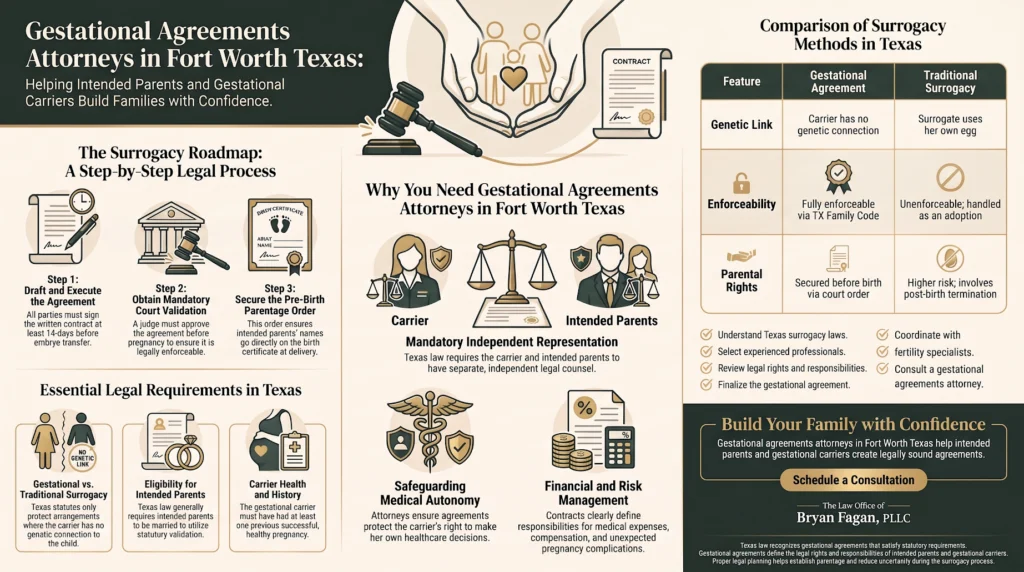
A gestational agreement is a written, court-validated contract between intended parents and a gestational carrier (surrogate) who agrees to carry a child conceived through assisted reproduction. Under Texas Family Code Chapter 160, a Fort Worth court must validate the agreement before the process begins, which establishes the intended parents as the child’s legal parents.
Key Takeaways
- · Surrogacy through a gestational agreement is legal in Texas, under Family Code Chapter 160, Subchapter I.
- · The agreement must be validated by a court before assisted reproduction begins (§160.756).
- · In a gestational arrangement, the carrier is not genetically related to the child — the eggs come from an intended parent or a donor (§160.754).
- · Under current Texas law, the intended parents must be married to each other.
- · Once validated, the agreement makes the intended parents the child’s legal parents at birth (§160.760).
- · An agreement that is never validated is not enforceable, and parentage is decided under the general rules (§160.762).
Our office is available 24/7. Do not hesitate to schedule your free case evaluation by calling 817-406-7230 or contacting us online today.
What a Gestational Agreement Is

A gestational agreement is a legally structured agreement that establishes the rights, responsibilities, and parentage expectations for intended parents, a gestational carrier, and any other required parties before assisted reproduction begins. Unlike a standard contract, a Texas gestational agreement generally must be reviewed and validated by a court under Texas Family Code Chapter 160, Subchapter I, helping ensure the intended parents are recognized as the child’s legal parents when the statutory requirements are met. The Gestational Agreements Attorneys in Fort Worth Texas at The Law Office of Bryan Fagan, PLLC help families navigate this process with clarity while protecting everyone involved.
A typical agreement identifies the intended parents, the gestational carrier, the carrier’s spouse if she is married, and any necessary egg or sperm donors. It outlines each party’s responsibilities, explains how IVF and embryo transfer will proceed, addresses medical decision-making, and establishes how legal parentage will be handled after birth. Rather than relying on a one-size-fits-all template, the agreement should reflect the family’s unique circumstances and comply with Texas law.
What makes Texas different is that a gestational agreement does not become enforceable simply because it has been signed. Before assisted reproduction begins, the parties generally petition the court for validation under Texas Family Code §160.756. This judicial review helps confirm that the agreement satisfies the statutory requirements, was entered into voluntarily, and provides the legal certainty families need before moving forward. You can also learn more about how this process works in other Texas communities by reading our guide to Gestational Agreements Attorneys in Bellaire, Texas.
In straightforward gestational arrangements, the validation process often proceeds smoothly when the required documentation is complete and the statutory requirements are met. In more complex situations—such as those involving donor embryos, out-of-state intended parents, or unique medical circumstances—additional planning may be necessary to coordinate the legal and medical timelines. Understanding these requirements early allows families to move forward with greater confidence, knowing they have built a strong legal foundation before their surrogacy journey begins.
Texas Surrogacy Laws: An Overview
Texas is one of the states with a clear statutory framework for surrogacy, which is part of why so many intended parents pursue it here. The law is found in the Uniform Parentage Act as adopted in Texas — specifically Chapter 160, Subchapter I, which governs gestational agreements. Rather than leaving surrogacy in a legal gray area, Texas sets out who may enter an agreement, what it must contain, and how a court validates it.
The framework recognizes only gestational surrogacy through this process — not traditional surrogacy (more on that distinction below). It requires a written agreement, court validation before the medical process begins, and a defined path to a parentage order once a child is born. For intended parents, the practical meaning is reassuring: follow the statute, and the law provides a clear route to being recognized as your child’s parents. The catch is that the requirements are specific, and missing them can leave an agreement unenforceable — which is why the process is one to handle carefully and with counsel.
Who Can Enter a Gestational Agreement in Texas
Not everyone is eligible to enter a gestational agreement under Texas law. Texas Family Code §160.754 identifies who must be included in the agreement and establishes the legal requirements that must be satisfied before a court may consider validating it. The Gestational Agreements Attorneys in Fort Worth Texas at The Law Office of Bryan Fagan, PLLC help intended parents understand these requirements early so the legal process stays aligned with their fertility treatment. For a broader overview of the legal process, visit our guide to Texas Gestational Agreements.
A Texas gestational agreement generally includes the intended parents, the prospective gestational carrier, the carrier’s spouse if she is married, and any necessary egg or sperm donors. Under the current statutory framework, the intended parents must be married to one another, and the agreement must provide that the pregnancy will occur through assisted reproduction. It must also state that the gestational carrier—and her spouse, if applicable—will relinquish parental rights, while the intended parents agree to become the child’s legal parents after the statutory requirements have been met.
One of the defining characteristics of a gestational agreement is that the gestational carrier cannot contribute her own eggs. Instead, the embryo must be created using the genetic material of an intended parent or a donor, ensuring the carrier has no genetic relationship to the child. This distinction separates gestational surrogacy from traditional surrogacy and plays an important role in determining legal parentage. If you’d like to explore this topic further, our resource on Texas gestational agreements explains how these statutory requirements work together to provide greater legal certainty.
In straightforward gestational arrangements where the required parties are properly identified and the statutory requirements are satisfied, preparing the agreement is often a smooth process. In more complex situations—such as those involving donor embryos, a married gestational carrier, or out-of-state intended parents—additional planning may be needed to ensure the agreement accurately reflects each party’s rights and responsibilities. Taking the time to prepare a complete agreement before seeking court validation helps protect everyone involved and supports a more secure path toward family formation.
Court Validation: The Step That Makes It Work (§160.756)

A Texas gestational agreement generally does not become legally enforceable simply because everyone signs it. Before IVF or any other assisted reproduction begins, the intended parents and the gestational carrier must petition a court to validate the agreement under Texas Family Code §160.756. The Gestational Agreements Attorneys in Fort Worth Texas at The Law Office of Bryan Fagan, PLLC guide families through this process because court validation is what provides the legal certainty that intended parents are seeking from the very beginning. For additional insight into how this process works in another Texas community, explore our guide to Gestational Agreements Attorneys in Dallas.
Before approving the agreement, the court reviews several statutory requirements designed to protect everyone involved. The judge must have jurisdiction over the parties, review medical evidence supporting the need for gestational surrogacy, determine that each party entered the agreement voluntarily and understands its terms, and confirm that the gestational carrier meets the qualifications established by Texas law. Unless waived by the court, a home study must also demonstrate that the intended parents satisfy the same fitness standards often applied in adoption proceedings.
These requirements are not obstacles—they are safeguards. The medical evidence requirement helps ensure gestational surrogacy is appropriate for the family’s circumstances, while the home study and voluntariness requirements promote informed decision-making and reduce the likelihood of future disputes. The requirement that a gestational carrier has previously experienced pregnancy and childbirth reflects the Legislature’s intent to protect both the carrier and the child by ensuring the carrier understands the physical and emotional realities of pregnancy.
In straightforward gestational agreements where the required documentation is complete and the statutory requirements are satisfied, court validation often proceeds efficiently. In more complex surrogacy arrangements—such as those involving donor embryos, out-of-state intended parents, or unique medical circumstances—additional preparation and coordination with fertility clinics, reproductive endocrinologists, and legal counsel may be necessary. Understanding these requirements before beginning assisted reproduction helps families move forward with greater confidence and a stronger legal foundation.
Validation is discretionary. Even when the requirements appear to be met, the statute says a court may validate the agreement — the decision rests within the court’s discretion and is reviewed only for abuse of that discretion. No attorney can promise a particular result. What good preparation does is make sure the petition squarely addresses each statutory finding, so the court has what it needs to make its decision.
Who the Legal Parents Are
Once a court validates the agreement and a child is born under it, the law is clear: the intended parents are the child’s parents. Under §160.760, on a showing that the validation order was properly rendered, the court orders that the intended parents are the parents and are financially responsible for the child. In practice this means the intended parents can be named on the birth certificate without a separate adoption — the parentage flows from the validated agreement itself.
This is the payoff of doing the process correctly, and it is worth contrasting with what happens if the step is skipped. Under §160.762, a gestational agreement that has not been validated by a court is not enforceable, and the parentage of any resulting child is decided under the ordinary parentage rules — which can mean the carrier (and her spouse) are treated as the legal parents. That gap between a validated and a non-validated agreement is the single biggest reason not to attempt surrogacy without careful legal guidance.
The consequences of that gap are not abstract. If a carrier is treated as the legal mother because the agreement was never validated, the intended parents may face an uncertain and contested path to establishing their own parentage — potentially including adoption or litigation — at exactly the moment they are welcoming a child. A validated agreement forecloses that uncertainty in advance. It is also why timing is so important: because validation must happen before assisted reproduction begins, there is no way to go back and cure a missed step after the fact. The order of operations is not a technicality; it is the whole design of the statute.
Gestational vs. Traditional Surrogacy
The two terms are often used loosely, but the legal difference is significant. In traditional surrogacy, the surrogate uses her own egg and is therefore the genetic mother of the child. In gestational surrogacy, the carrier is not genetically related to the child at all — the embryo is created through assisted reproduction using the intended parents’ or donors’ genetic material and then carried by the gestational mother.
This distinction matters because the Texas gestational-agreement statute is built around the gestational model. The requirement that the eggs come from an intended parent or donor — not the carrier — means the court-validation framework applies to gestational surrogacy, not traditional surrogacy. Couples considering traditional surrogacy face a very different and less certain legal landscape, which is one of the first things worth discussing with an attorney before choosing a path.
What a Gestational Agreement Typically Addresses

A well-drafted gestational agreement does more than satisfy the requirements of Texas Family Code Chapter 160—it creates a clear roadmap for everyone involved before the surrogacy journey begins. The Gestational Agreements Attorneys in Fort Worth Texas at The Law Office of Bryan Fagan, PLLC help intended parents and gestational carriers establish expectations regarding legal parentage, medical decision-making, financial responsibilities, communication, and other important issues that may arise throughout the pregnancy. For a broader overview of Texas surrogacy law, you can also read our guide to Gestational Agreements in Texas.
A comprehensive Texas gestational agreement typically addresses how health information will be shared, how medical decisions will be communicated, how pregnancy-related expenses and insurance responsibilities will be handled, and what procedures the parties will follow if unexpected circumstances arise. Texas Family Code §160.755 specifically requires the gestational carrier and intended parents to exchange relevant health information throughout the agreement, reinforcing the importance of transparency and informed decision-making. Rather than relying on standardized forms, the agreement should reflect the family’s unique medical, financial, and personal circumstances.
Equally important is understanding what a gestational agreement cannot accomplish. A gestational carrier cannot use her own eggs and remain within the statutory framework governing gestational agreements, and simply signing an agreement does not make it legally enforceable. Under Texas Family Code §160.756, court validation generally must occur before assisted reproduction begins, and no agreement can guarantee a particular ruling because approval ultimately rests with the court after reviewing the statutory requirements.
In straightforward gestational arrangements, these issues can often be addressed through careful planning before IVF and embryo transfer begin. In more complex surrogacy arrangements—such as those involving donor embryos, multiple intended parents, or out-of-state participants—additional provisions may be needed to address unique legal and practical concerns. Taking the time to build a thoughtful agreement at the beginning of the process helps reduce misunderstandings later and allows everyone to move forward with greater confidence and peace of mind.
Gestational Agreements in Fort Worth & Tarrant County
The statute is the same statewide, but the validation petition is filed and heard in court — and for Fort Worth families that means the Tarrant County courts. An attorney who practices in these courts and handles gestational agreements can prepare the petition to address each §160.756 finding and guide the parties through the hearing with far less uncertainty.
Our Fort Worth office helps intended parents and gestational carriers across Tarrant County and the surrounding region. We handle the agreement and the court-validation process together, and coordinate with the medical and agency professionals involved, so the legal side keeps pace with the rest of the journey. However you have arrived at surrogacy, our aim is to make the legal path clear and secure.
Surrogacy is rarely a purely legal undertaking — it usually involves a fertility clinic, sometimes an agency, and a medical timeline that does not wait. Part of an attorney’s job is to keep the legal steps synchronized with that timeline, so validation is completed before assisted reproduction rather than becoming a bottleneck. For Fort Worth families, having counsel who both practices in the Tarrant County courts and understands how the pieces fit together means fewer surprises and a process that moves in the right order. That coordination is quiet work, but it is often the difference between a journey that feels chaotic and one that feels handled.
Why Intended Parents Choose Texas
Not every state treats surrogacy the same way. Some prohibit or heavily restrict it, and others leave it in an uncertain legal space where enforceability is unclear. Texas took a different path by adopting a statutory framework that spells out how gestational agreements work and how they become enforceable. For intended parents, that clarity is valuable: it means the path to legal parentage is defined by statute rather than left to hope or to a patchwork of case law.
The court-validation requirement, which can first look like an obstacle, is actually part of what makes Texas attractive. Because a court reviews and validates the agreement before the process begins, the parties enter assisted reproduction with the parentage question already settled rather than looming over them. That front-loaded certainty is exactly what most intended parents and carriers want. It does come with a trade: the process is more formal and requires careful legal work up front. But for a decision as significant as building a family, most families find that rigor reassuring — provided they have counsel who handles these matters and can carry the legal side while they focus on the rest of the journey.
Listen to Our Texas Family Law Podcast
Prefer listening? In this episode, we explain gestational agreements and surrogacy law in Texas for Fort Worth families, including how these agreements work, what legal protections they provide, and how parental rights may be established.
How Our Firm Helps Fort Worth Families

Families pursuing surrogacy deserve more than legal paperwork—they deserve a clear plan that protects everyone involved from the very beginning. The Gestational Agreements Attorneys in Fort Worth Texas at The Law Office of Bryan Fagan, PLLC help intended parents and gestational carriers navigate every stage of the legal process, from preparing a gestational agreement that complies with Texas Family Code Chapter 160 to obtaining court validation and securing a parentage order after the child’s birth. To better understand the legal distinctions that shape these cases, we also encourage families to read our guide on Texas Gestational Surrogacy vs. Traditional Surrogacy: The Legal Differences That Decide Who the Parents Are.
Our team works closely with intended parents, gestational carriers, fertility clinics, reproductive endocrinologists, and other professionals to help keep the legal and medical timelines aligned. In straightforward gestational arrangements, this often means preparing the agreement, filing the petition for court validation, and guiding the parties through the statutory process before assisted reproduction begins. In more complex situations involving donor embryos, out-of-state intended parents, or unique family circumstances, we develop a legal strategy tailored to the family’s specific needs while helping them understand each step along the way.
Getting started is designed to be simple and informative. Our intake team gathers the information needed to understand your situation, and you’ll meet with an attorney during a Legal Strategy Session to discuss your goals, answer your questions, and develop a practical roadmap for the legal process ahead. By combining education, compassionate guidance, and experienced representation, our mission is to help Fort Worth families move forward with confidence as they build the future they’ve envisioned.
Our Fort Worth Office
The Law Office of Bryan Fagan, PLLC
204 W Central Ave, Fort Worth, TX 76164 · Tarrant County
Open 24 hours
Call 817-406-7230How a Gestational Agreement Works in Texas
Tap each stage to see how a Texas gestational agreement moves from drafting to a parentage order, and which part of the Family Code governs it. This is a general overview, not legal advice about any particular arrangement. One point runs through all of it: the court-validation step, done before the medical process begins, is what holds the whole framework together.
1 · Draft the agreement — §160.754
The parties — intended parents, the gestational carrier, her spouse if married, and any donors — enter a written agreement. It must provide that the carrier will carry a child by assisted reproduction, that she and her spouse relinquish parental rights, and that the intended parents will be the parents.
Statutory requirements shape this stage: the intended parents must be married to each other, and the eggs must come from an intended parent or a donor — not the carrier. Getting the terms right here is what makes the agreement eligible for validation.
2 · Petition the court to validate — §160.756
Before any assisted reproduction, the intended parents and carrier ask a court to validate the agreement. This is the step that separates a Texas gestational agreement from an ordinary contract, and it is filed in the county where the case belongs — for Fort Worth families, the Tarrant County courts.
The petition is prepared to address each finding the court must make, so the hearing has a clear, complete record to work from. Careful preparation here is where experienced counsel matters most.
3 · The validation hearing
At the hearing the court reviews the statutory findings: jurisdiction; medical evidence that the intended mother cannot safely carry a pregnancy; a home study (unless waived); that each party entered voluntarily and understands the terms; and that the carrier has had at least one prior pregnancy and delivery.
If satisfied, the court may validate the agreement and declare that the intended parents will be the child’s parents. Validation is discretionary, so the goal of good preparation is to give the court everything the statute asks for.
4 · Assisted reproduction and pregnancy
Only after the agreement is validated does the medical process proceed. The parties follow the agreement’s terms throughout the pregnancy, including the sharing of relevant health information that the statute requires.
Because the legal framework is already in place, everyone moves forward knowing how parentage will be handled — which is exactly the certainty the validation step is designed to provide.
5 · The parentage order — §160.760
After the child is born, on a showing that the validation order was properly rendered, the court orders that the intended parents are the child’s parents and are responsible for the child. This typically allows the intended parents to be named on the birth certificate without a separate adoption.
This final order is the payoff of the whole process — the point at which the legal recognition the family planned for becomes official.
Every family’s situation is different, and this overview is not legal advice about a specific arrangement. To understand how these steps apply to your journey, speak with a Fort Worth attorney who handles gestational agreements.
Starting your surrogacy journey?
A Legal Strategy Session is the place to map out the agreement and the court-validation process from the start.
Schedule a Legal Strategy Sessionor call 281-810-9760
Your Fort Worth Attorney
Bryan Bubis — Senior Attorney, Fort Worth
15+ Years Family Law · Tarrant, Johnson & Parker County Courts
Bryan Bubis brings more than 15 years of family law experience to parentage and family-formation matters, including gestational agreements and the court-validation process they require. Because his practice spans family law, criminal law, and probate, he brings a careful, well-rounded perspective to a process where the details and the statutory requirements truly matter. He earned his Bachelor’s in Business Management from Texas A&M University and his Juris Doctor from Texas A&M School of Law.
Bryan works with clients in the Tarrant, Johnson, and Parker county courts, and he can meet with you at the firm’s Fort Worth office. Read Bryan Bubis’s full profile.
What I Tell Every Family Starting This Journey
The first thing I tell every family is that Texas law is designed to create certainty, not confusion. The Gestational Agreements Attorneys in Fort Worth Texas at The Law Office of Bryan Fagan, PLLC help intended parents and gestational carriers understand that a properly prepared and court-validated agreement is one of the strongest legal protections available during the surrogacy process. Rather than viewing the legal requirements as obstacles, think of them as safeguards that help establish legal parentage and reduce uncertainty before your child is born. To learn more about the broader legal framework, visit our guide to Texas Gestational Agreements.
The second thing I emphasize is that timing matters. Under Texas Family Code §160.756, court validation generally must occur before assisted reproduction begins. In straightforward gestational arrangements, starting the legal process early helps keep the court, fertility clinic, and medical team working on the same timeline. In more complex situations involving donor embryos, out-of-state intended parents, or additional medical considerations, early planning becomes even more important.
Finally, I remind families that no two surrogacy journeys are alike. A gestational agreement should reflect your unique medical, personal, and legal circumstances rather than relying on a generic template. During a Legal Strategy Session, we take the time to understand your goals, answer your questions, and develop a legal roadmap that helps you move forward with confidence, clarity, and peace of mind as you build your family.
Conclusion
Building a family through surrogacy is one of life’s most meaningful journeys, and having the right legal foundation can make that journey far more predictable and secure. The Gestational Agreements Attorneys in Fort Worth Texas at The Law Office of Bryan Fagan, PLLC help intended parents and gestational carriers understand the legal requirements of Texas Family Code Chapter 160, navigate the court-validation process, and move toward parentage with greater confidence. If you’d like to learn more about how gestational agreements are handled elsewhere in Texas, explore our guide to Gestational Agreements in The Woodlands, Texas.
In straightforward gestational arrangements, where the statutory requirements are met and the medical and legal timelines are aligned, the process often moves efficiently from agreement to court validation and ultimately to a parentage order. In more complex situations involving donor embryos, out-of-state intended parents, international families, or unique medical considerations, thoughtful legal planning becomes even more important to protect everyone involved. Beginning the process early and working with experienced counsel helps reduce uncertainty, allowing you to focus on preparing for the newest member of your family.
At The Law Office of Bryan Fagan, PLLC, we believe families deserve more than legal documents—they deserve clarity, education, and peace of mind. Whether you are exploring surrogacy for the first time or preparing to move forward with a gestational agreement, our team is committed to helping you understand your options and build a secure legal foundation for the future you have envisioned.
About the Author
Bryan Fagan
Founder & Managing Attorney · Serving Texas families since 2012
I am Bryan Fagan, founder and managing attorney of The Law Office of Bryan Fagan, PLLC, one of the largest family law firms in Texas. I earned my Juris Doctor from South Texas College of Law, I am an elected member of the College of the State Bar of Texas, and I lead a team of more than 170 legal professionals with offices across the state.
I am also the author of The Texas Divorce Handbook, because I believe families make better decisions when they understand the law that affects them. Family formation through surrogacy is one of the most hopeful things our firm helps with, and also one of the most legally structured. Out of our Fort Worth office, our team guides intended parents and gestational carriers through gestational agreements and the court-validation process with care. If you have a question, we would like to help. Read more about Bryan Fagan.
Frequently Asked Questions
Yes. Texas has a statutory framework for gestational surrogacy under Family Code Chapter 160, Subchapter I. It allows gestational agreements that are validated by a court, which makes the arrangement enforceable and establishes the intended parents as the child’s legal parents.
It is a written contract among the intended parents, the gestational carrier, her spouse if married, and any donors, in which the carrier agrees to carry a child conceived through assisted reproduction and the intended parents agree to be the child’s legal parents. In Texas it must be validated by a court to be enforceable.
Yes. Under §160.756, the parties must petition a court to validate the agreement before assisted reproduction begins. The court validates it only if statutory findings are met, and validation is at the court’s discretion. An agreement that is never validated is not enforceable (§160.762).
The parties are the prospective gestational carrier, her spouse if she is married, each donor, and the intended parents. Under current Texas law the intended parents must be married to each other, and the eggs used must come from an intended parent or a donor — not the carrier.
In traditional surrogacy the surrogate uses her own egg and is genetically related to the child. In gestational surrogacy the carrier has no genetic connection — the embryo is created with the intended parents’ or donors’ genetic material. Texas’s court-validation framework is built for gestational surrogacy.
When the agreement has been validated by a court, the intended parents are the child’s legal parents, and the court will order parentage accordingly under §160.760 — usually without a separate adoption. If the agreement was never validated, parentage is decided under the ordinary rules.
Building your family through surrogacy?
Getting the agreement and the court validation right from the start protects everyone. Talk with our Fort Worth team.
Schedule a Legal Strategy Sessionor call 281-810-9760