
Medical Resources in Fort Worth, Texas: A New Resident’s Guide

One of the first things many parents do after unpacking the last moving box is ask, “Where’s the nearest doctor if one of the kids gets sick?” Finding Medical Resources in Fort Worth Texas quickly becomes more than another item on a moving checklist—it becomes part of creating a sense of security. Whether it’s locating a trusted pediatrician, transferring prescriptions, or knowing where the closest emergency room is, these everyday decisions help families regain confidence after a major life change.
Divorce often creates a season of uncertainty for both parents and children. New routines, two households, and unfamiliar schedules can feel overwhelming, especially when everyone is trying to establish a new normal. Texas courts recognize the importance of stability during these transitions. Under Texas Family Code § 153.002, every conservatorship decision is guided by the child’s best interest, and maintaining consistency in a child’s daily life—including healthcare, routines, and emotional support—can play an important role in helping children thrive.
At the Law Office of Bryan Fagan, PLLC, we believe families deserve more than legal answers—they deserve guidance that helps them move forward with confidence. Founded by Bryan Joseph Fagan, a graduate of South Texas College of Law and a recognized authority on Texas divorce and child custody law, our firm has helped thousands of Texas families navigate life’s most difficult transitions with compassion, clarity, and practical legal solutions. We understand that protecting a child’s future extends beyond courtroom proceedings. It means helping parents create thoughtful parenting arrangements that preserve stability, encourage healthy development, and reduce unnecessary conflict whenever possible.
In this guide, you’ll learn how healthcare continuity, thoughtful custody planning, and consistent parenting routines work together to support children’s emotional well-being and long-term success. We’ll explain how Texas courts evaluate issues affecting stability, offer practical guidance for co-parenting effectively, and share ways families can build a strong foundation that allows children to move forward with greater confidence and peace of mind.
Quick Answer
Fort Worth offers a full range of medical resources for new residents — major hospital systems, a dedicated medical district, urgent-care and walk-in clinics, community health centers, and pharmacies across the metro. New residents typically start by choosing a primary-care provider, confirming their insurance network, and locating the nearest emergency room and pharmacy to home.
Key Takeaways
- Fort Worth has multiple hospital systems and a recognized medical district, plus urgent care, community clinics, and pharmacies metro-wide.
- New residents should start with a primary-care provider and confirm which providers are in their insurance network.
- Know the difference between an emergency room and urgent care before you need one — it affects cost and wait time.
- Community health centers offer care on a sliding scale for those without insurance.
- Establish care before you need it: transfer records, refill prescriptions, and register with a pharmacy early.

Your Family’s Future Starts Here
Don’t navigate your legal journey alone. Schedule a consultation now and get the clarity and support you deserve.
Types of Medical Care in Fort Worth

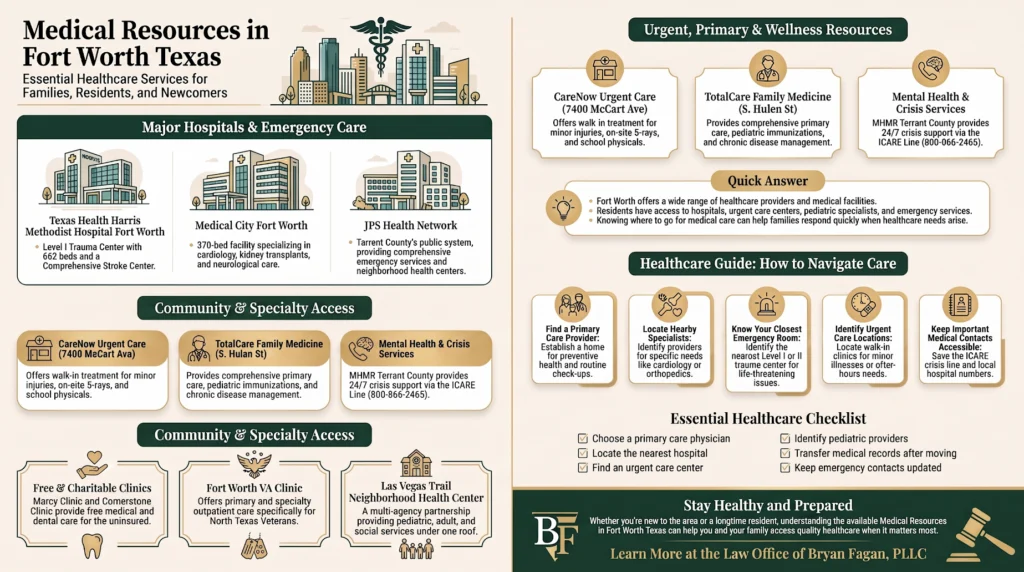
Medical Resources in Fort Worth Texas include hospitals, emergency rooms, urgent care clinics, primary care physicians, specialists, community health centers, and pharmacies that help families receive the right level of care when they need it. Understanding the purpose of each type of provider can save time, lower healthcare costs, and reduce stress—especially for families establishing new routines after a move or a family transition. If you’re relocating, our Moving to Fort Worth guide offers practical information to help you get settled while connecting with essential local services.
For serious illnesses, severe injuries, or life-threatening emergencies, Fort Worth is served by several leading healthcare systems, including Texas Health Harris Methodist Hospital Fort Worth, Baylor Scott & White All Saints Medical Center, Medical City Fort Worth, John Peter Smith (JPS) Health Network, and Cook Children’s Medical Center for pediatric care. For non-emergency concerns such as minor injuries, infections, or illnesses, urgent care and walk-in clinics typically provide faster, more affordable treatment than an emergency room. Knowing the location of both the nearest hospital and urgent care clinic before an emergency arises can help families respond with confidence.
A primary care physician serves as your family’s healthcare home base, providing preventive care, annual wellness exams, vaccinations, chronic disease management, referrals to specialists, and prescription management. When additional expertise is needed, specialists—including pediatricians, cardiologists, OB-GYNs, orthopedic physicians, psychologists, and psychiatrists—provide focused care for specific medical conditions. Establishing these relationships early creates continuity of care, particularly for children adjusting to a new home or parents coordinating healthcare across two households.
Community health centers and pharmacies round out Fort Worth’s healthcare network by offering preventive care, behavioral health services, prescription transfers, immunizations, medication counseling, and routine health support. In straightforward situations, selecting a primary care physician and identifying nearby healthcare facilities may be all your family needs. In more complex family transitions involving shared custody, relocation, or ongoing medical conditions, maintaining consistent healthcare providers and organized medical records can help create the stability that supports both your family’s health and your children’s long-term well-being.
Fort Worth’s Medical District
Fort Worth’s hospital core is the Medical Innovation District in the Near Southside, just west of Interstate 35W. It’s home to Tarrant County’s major hospitals and dozens of independent clinics, making it the regional hub for advanced and specialized care. Anchor facilities include Texas Health Harris Methodist Hospital Fort Worth, Baylor Scott & White All Saints Medical Center, Medical City Fort Worth, John Peter Smith (JPS) Hospital, and Cook Children’s Medical Center. For newcomers, it helps to know roughly where these campuses sit relative to your neighborhood — both for emergencies and for specialist appointments. Confirm current services and addresses directly with each facility before relying on them.
Major Hospitals in Fort Worth
A quick reference to the major hospitals among the medical resources in Fort Worth, Texas — what each is commonly known for and roughly where it sits. Map links open a Google Maps search so you can pick the campus nearest you (several systems have multiple locations).
This list is not a ranking, and “best known for” is a general orientation, not a limit on services — most systems offer a broad range of care. Confirm specialties and in-network status before booking.
| Hospital | Best Known For | Area | Map |
|---|---|---|---|
| Texas Health Harris Methodist | General & specialty medicine | Medical District | View on Google Maps |
| Baylor Scott & White All Saints | Surgery & women’s services | Near Southside | View on Google Maps |
| John Peter Smith (JPS) Hospital | Trauma & public health | Medical District | View on Google Maps |
| Cook Children’s Medical Center | Pediatrics | Medical District | View on Google Maps |
| Medical City Fort Worth | Emergency & specialty care | Medical District | View on Google Maps |
Emergency Room vs. Urgent Care: How to Choose

Medical Resources in Fort Worth Texas include both emergency rooms and urgent care clinics, and knowing when to use each can save time, reduce costs, and ensure your family receives the appropriate care. Emergency rooms are best for life-threatening conditions such as chest pain, stroke symptoms, severe injuries, difficulty breathing, or major trauma, while urgent care clinics typically treat non-emergency illnesses and injuries like sprains, ear infections, flu symptoms, cuts, and minor infections.
If your family is relocating or adjusting to new routines after divorce, identify the nearest emergency room and urgent care clinic near both parents’ homes before you need them. In straightforward situations, this simple step helps families respond quickly to unexpected illnesses. In more complex family transitions involving shared custody or ongoing medical conditions, both parents should know which healthcare providers and pharmacies are in-network and have access to the child’s medical records. When selecting a pharmacy, choose a trusted provider and stay informed about healthcare safety issues, including situations like the Main Avenue Pharmacy fraud case.
When in doubt about a life-threatening emergency, call 911 or go directly to the nearest emergency room—cost should never delay emergency treatment. Planning ahead by knowing where to find hospitals, urgent care centers, and reliable pharmacies provides peace of mind and helps your family respond confidently when unexpected medical situations arise.
| Situation | ER | Urgent Care |
|---|---|---|
| Chest pain, difficulty breathing, stroke signs, major trauma | Emergency Room | Urgent Care |
| Minor cuts, sprains, fever, infections, flu | ✓ | |
| Life-threatening or worsening-fast symptoms | ✓ | |
| Typical cost | Higher | Lower |
| Typical wait for minor issues | Longer | Shorter |
How to Choose a Provider After You Move
A short, repeatable process for setting up care in a new city:
- Check your insurance network first. Confirm which Fort Worth providers and hospitals are in-network before booking — out-of-network care costs dramatically more.
- Pick a primary-care provider. Choose one accepting new patients near home or work, and schedule an establishing visit.
- Transfer your records. Request medical records from your previous providers so your new PCP has your history.
- Locate your nearest ER and pharmacy. Know both before an emergency, not during one.
- Set up pediatric and specialty care as needed — ask your PCP for referrals to in-network specialists.
Insurance & Access
Healthcare access in Texas depends heavily on coverage. A few orientation points for newcomers:
- Employer plans — if your move involves a new job, confirm when coverage starts and which local networks it uses.
- Marketplace & public programs — coverage options exist for those between jobs or self-employed; eligibility and enrollment windows vary [VERIFY-LIVE: current enrollment details, with source].
- Community health centers — offer sliding-scale care regardless of insurance status, an important resource for the uninsured.
- Out-of-network costs — always verify network status before non-emergency care to avoid surprise bills.
New Resident Healthcare Checklist
The practical steps to get your family’s healthcare set up after the move:
- ☐Confirm your health-insurance network in the Fort Worth area
- ☐Choose a primary-care provider accepting new patients
- ☐Schedule an establishing visit
- ☐Request and transfer medical records from prior providers
- ☐Locate the nearest emergency room to your home
- ☐Register with a local pharmacy and transfer prescriptions
- ☐Set up pediatric care if you have children
- ☐Identify the nearest urgent-care clinic for non-emergencies
- ☐Note specialist needs and ask your PCP for in-network referrals
Relocating to Fort Worth with your family? Our family-law team put this guide together as part of helping families settle in. If your move also involves custody, divorce, or other family-law questions, you can schedule a consultation with our Fort Worth team whenever you’re ready.
Moving Because of Divorce or Child Custody?
If your move involves a court order, parenting plan, or relocation dispute, it’s important to understand how Texas family law may affect where you can move and what approvals you may need.
Schedule a Consultation Learn About Texas Relocation LawsCare for Specific Needs

Medical Resources in Fort Worth Texas include specialized healthcare for every stage of life, from pediatric and maternity care to senior services, behavioral health, and trauma care. Knowing where to find these services before you need them makes it easier to establish continuity of care after a move or during a family transition. If you’re relocating, our Transportation in Fort Worth guide can help you plan the best routes to hospitals, medical offices, and specialty care providers.
Families with children can establish care with pediatricians through Cook Children’s Health Care System, JPS clinics, and other major healthcare networks, while expectant mothers have access to maternity and women’s health services at hospitals such as Texas Health Harris Methodist Hospital Fort Worth and Baylor Scott & White All Saints Medical Center. Older adults can find geriatric medicine, cardiology, oncology, orthopedic care, and other specialty services throughout Fort Worth, typically through referrals from a primary care physician. If you’re moving with school-aged children, scheduling a pediatric visit early also helps ensure immunization records are ready for school enrollment.
Mental and behavioral health services are available through JPS Health Network, private providers, and many primary care practices, while John Peter Smith (JPS) Hospital serves as Tarrant County’s Level I Trauma Center for critical emergencies. In straightforward situations, establishing care with the right specialists may simply involve obtaining a referral from your family doctor. In more complex family transitions involving shared custody, chronic medical conditions, or ongoing treatment, coordinating specialty care and maintaining consistent medical records can provide the stability that helps both parents and children move forward with confidence.
Your First Weeks: A Simple Order of Operations
- Day one: locate the nearest emergency room and pharmacy to your new home — before you need either.
- First week: confirm your insurance network and transfer active prescriptions to a local pharmacy.
- First month: choose an in-network primary-care provider, schedule an establishing visit, and request your medical records from prior providers.
- As needed: set up pediatric, maternity, or specialty care through referrals, and note the nearest urgent-care clinic for non-emergencies.
How to Transfer Your Medical Records
Getting your history to your new Fort Worth providers is one of the easiest things to overlook and one of the most useful to do early. What to move:
- ›Sign a records-release (HIPAA) authorization with each prior provider so they can send your file to your new one.
- ›Request electronic records where possible — many systems use patient portals that make transfer faster.
- ›Prescription history — ask your prior pharmacy or provider for an active-medication list to give your new PCP.
- ›Imaging — X-rays, MRIs, and scans can usually be released on disc or electronically; request them rather than assuming they transfer automatically.
- ›Vaccination records — essential for school enrollment if you have children; request an official immunization history.
Telehealth Options

Medical Resources in Fort Worth Texas include telehealth services that make it easier to receive medical care without leaving home. Many primary care physicians, behavioral health providers, specialists, and urgent care clinics now offer secure video visits for routine illnesses, follow-up appointments, medication management, and mental health counseling. Virtual care can be especially helpful for families relocating to Fort Worth or balancing busy parenting schedules. For additional information about local services that support your transition, explore our Governmental Resources in Fort Worth guide.
Primary care telehealth appointments are ideal for common health concerns, while virtual behavioral health visits can provide continuity for counseling or psychiatric care during a move or family transition. Many healthcare systems also offer virtual urgent care for minor illnesses, often at a lower cost than visiting an urgent care clinic in person. In straightforward situations, telehealth offers a convenient way to establish care quickly. In more complex family transitions involving shared custody, chronic medical conditions, or ongoing treatment, virtual appointments can help parents coordinate care between households while maintaining consistency for their children.
Before scheduling a virtual visit, confirm whether your health insurance plan covers telehealth services and whether the provider is in your network. Coverage varies among PPO, HMO, Medicare, Medicaid, and Marketplace plans, so understanding your benefits ahead of time can help avoid unexpected costs while ensuring your family continues to receive the care it needs.
Don’t Forget Dental and Vision Care
Healthcare isn’t only hospitals and doctors. Rounding out your family’s care:
- ›Dentists — find an in-network general dentist accepting new patients; dental plans are often separate from medical insurance.
- ›Pediatric dentists — many families prefer a dedicated children’s dentist for younger kids.
- ›Optometrists & vision — line up eye care, especially if anyone in the family wears glasses or contacts.
- ›Vision plans — like dental, vision coverage is frequently a separate plan; check what your employer or marketplace plan includes.
Women’s Health
Beyond OB-GYN and maternity, women’s health spans care worth lining up with a provider after a move:
- ›Preventive screenings — well-woman visits and routine screenings; ask your PCP or OB-GYN what’s due.
- ›Mammography — imaging centers across the metro offer screening; your provider can refer you.
- ›Fertility & family planning — specialty care is available in the region; access is typically by referral.
- ›Menopause & midlife care — managed through primary care or a women’s-health specialist.
Several Fort Worth hospitals offer women’s and infant services, including Texas Health Harris Methodist and Baylor Scott & White All Saints; confirm which is in your network.
Senior Care

For older adults or parents you’re helping relocate, a few things to sort out:
- ›Medicare — confirm which Fort Worth providers accept your Medicare or Medicare Advantage plan; networks vary.
- ›Geriatric & specialty care — available across the major systems, usually by referral from a primary-care provider.
- ›Home health — in-home nursing and therapy services exist throughout the metro for those who qualify.
- ›Assisted living & long-term care — a range of options exists in and around Fort Worth; verify current availability and licensing directly.
Veterans’ Healthcare
Fort Worth and the wider North Texas region are served by VA healthcare facilities. If you or a family member is a veteran, confirm eligibility and current clinic locations directly with the VA (VA North Texas Health Care System serves the region). Enrollment and eligibility rules are specific, so check them against official VA sources rather than relying on a general guide.
Mental & Behavioral Health
Access to mental-health care matters as much as physical care, especially during the stress of a move. A safe starting point for new residents:
- Start with your primary-care provider — a PCP can assess needs and refer you to in-network therapists, psychologists, or psychiatrists.
- JPS Health Network — provides behavioral-health services and operates Tarrant County’s psychiatric emergency services.
- Telehealth therapy — virtual counseling can bridge care while you get established locally.
Setting Up Care: The Simple Path
If you remember nothing else, follow this order:
Living Near Fort Worth?

Many families settle in the communities around Fort Worth and still use the metro’s hospitals and clinics. If you’re in Benbrook, Keller, Saginaw, Burleson, White Settlement, Crowley, Haltom City, or North Richland Hills, the same guidance applies — confirm which Fort Worth-area providers and hospitals are closest and in your network, since some suburbs are nearer certain campuses than others.
Listen to Our Texas Family Law Podcast
Prefer listening? In this episode, we provide a healthcare guide for Fort Worth families, including local medical resources, important care considerations, and what families should know when making healthcare decisions.
Your Fort Worth Attorney
Bryan Bubis — Senior Attorney, Fort Worth
15+ Years of Experience · Tarrant, Johnson & Parker County Courts
Bryan Bubis is the Senior Attorney at the Law Office of Bryan Fagan’s Fort Worth office, bringing more than 15 years of family-law experience to divorce, child custody, and property-division cases in Tarrant County. His combination of legal training and a business education makes him especially effective in cases involving significant assets, business interests, or complex financial matters.
He earned his Bachelor of Business Administration from Texas A&M University and his Juris Doctor from Texas Wesleyan University School of Law (now Texas A&M University School of Law), and is admitted to the State Bar of Texas.
Read Bryan Bubis’s full profile · Plan your visit to the Fort Worth office.
Our Fort Worth Office
The Law Office of Bryan Fagan, PLLC
204 W Central Ave, Fort Worth, TX 76164 · Tarrant County
Open 24 hours
Call 817-406-7230 Map & DirectionsGetting Settled, One Step at a Time
You don’t have to sort out all of Fort Worth’s medical resources at once. The families who settle in most smoothly tend to do two things first: confirm their insurance network and establish a primary-care provider. Everything else — specialists, pediatric care, the right pharmacy — follows naturally from there.
Fort Worth’s healthcare landscape is deep, from the hospitals and clinics of the Near Southside Medical Innovation District to the county-wide safety net of JPS. The medical resources in Fort Worth, Texas are extensive, so take the setup one step at a time, keep this checklist handy, and you’ll have the essentials in place well before you need them. Welcome to Fort Worth.
Moving often involves more than healthcare. If your relocation is connected to divorce, custody, modification, or another family-law matter, our Fort Worth attorneys can help you navigate the legal side of your transition while you focus on settling into your new community. Schedule a consultation with our Fort Worth team when you’re ready.
Conclusion:
Finding the right Medical Resources in Fort Worth Texas is about more than knowing where to go when someone gets sick—it’s about creating the stability children need to grow, adapt, and thrive during times of change. When divorce or a custody dispute reshapes family life, thoughtful healthcare planning, consistent routines, and informed legal decisions can work together to protect your child’s emotional well-being and future. Understanding how Texas courts evaluate stability allows parents to make decisions today that can positively influence tomorrow.
Every family’s circumstances are different. In straightforward situations, parents may simply need guidance creating a parenting plan that supports consistent medical care and healthy routines. In more complex cases—such as disputes involving relocation, disagreements over medical decision-making, high-conflict custody issues, or a child with significant healthcare or special needs—developing a strategy tailored to your family’s unique circumstances becomes even more important. At the Law Office of Bryan Fagan, PLLC, we believe informed decisions lead to stronger outcomes. Our experienced Texas family law attorneys are committed to educating families, protecting what matters most, and providing compassionate, strategic guidance that helps parents move forward with greater confidence, clarity, and peace of mind.
People Also Ask
Fort Worth offers major hospital systems, a medical district anchored by advanced-care facilities, urgent-care and walk-in clinics, community health centers, and pharmacies throughout the metro.
Start by confirming your insurance network, then choose an in-network primary-care provider accepting new patients near home or work and schedule an establishing visit. Transfer your medical records so your new provider has your history.
Emergency rooms handle serious or life-threatening conditions and inpatient needs; urgent care handles non-emergencies that still need same-day attention, usually faster and at lower cost. For life-threatening symptoms, call 911 or go to the nearest ER.
Yes. Fort Worth has a concentrated medical district anchored by major hospitals and specialty facilities that serves as a regional hub for advanced and specialized care.
Community health centers provide primary and preventive care, often on a sliding fee scale based on income, regardless of insurance status.
Register with a local pharmacy and transfer your prescriptions early. Ask your prior provider or pharmacy to help move active prescriptions to a Fort Worth location.
Choose an in-network pediatrician or family provider accepting new patients, schedule an establishing visit, transfer your children’s records, and confirm any required immunization documentation for school enrollment.