
Domestic Violence in Richmond Texas: Legal Protections and Your Rights Under Texas Law

It often doesn’t start with something obvious. Maybe it’s the tension in the air when a door closes a little too hard, or the way conversations become shorter, sharper, and harder to navigate. You find yourself walking on eggshells, wondering how things changed so quickly—and what comes next. For many families, Domestic Violence in Richmond Texas becomes a reality not through one moment, but through a pattern that slowly reshapes daily life.
What many parents don’t realize is how deeply these experiences can affect everything around them—including their children’s emotional stability, routines, and ability to function day to day. Texas courts understand this connection. Under Texas Family Code §153.002, the focus is always on the best interest of the child, which includes not just physical safety, but consistency, structure, and emotional security.
At The Law Office of Bryan Fagan, PLLC, we have worked with families across Fort Bend County who are trying to make sense of these difficult situations. Led by Bryan Joseph Fagan, a South Texas College of Law graduate and a recognized authority on Texas divorce and custody law, our firm is grounded in one purpose: helping people reclaim peace of mind during life’s hardest transitions. Through clear guidance and compassionate counsel, we help parents understand their options and take meaningful steps forward.
In the sections that follow, you’ll learn how family violence can influence custody decisions, what Texas courts look for when evaluating stability, and how you can protect your child’s future—even in the middle of uncertainty.
Key Takeaways
- Domestic violence in Richmond Texas is referred to as “family violence” under Texas law, defined broadly under Texas Family Code §71.004 to include physical harm, threats, and dating violence.
- Texas law provides legal protections, including protective orders, for individuals facing family violence, and you can apply for emergency relief in Fort Bend County without paying filing fees.
- Family violence can significantly affect custody and visitation decisions in Texas, with courts required to consider credible evidence of abuse when determining what arrangement serves the child’s best interest.
- Both survivors and those accused have legal rights and obligations—understanding the court process in Fort Bend County helps you navigate the situation calmly and lawfully.
- Local resources like the Fort Bend Women’s Center offer crisis support, counseling, and advocacy alongside the legal protections available through the courts.

Your Family’s Future Starts Here
Don’t navigate your legal journey alone. Schedule a consultation now and get the clarity and support you deserve.
Listen to Our Texas Family Law Podcast
Prefer listening? In this episode, we discuss domestic violence in Richmond, Texas, including your legal rights, available protective measures, and the options you have to stay safe and take action.
The Law Office of Bryan Fagan, PLLC can represent clients in a variety of family law matters, such as the following:
As a family law firm, we recognize that clients entrust us with a deeply personal aspect of their lives. Respecting this responsibility, our firm operates with professionalism, diligence, and efficiency, while maintaining open lines of communication with our clients. Not only do we provide access to their attorney, but also a dedicated client support team capable of addressing any inquiries regarding the case, status updates, billing concerns, or any other matters that arise throughout the process. Please don’t hesitate to discover how we can be of service to you.
Contact the Law Office of Bryan Fagan, PLLC at 281-245-1907 or online.
Domestic Violence in Richmond Texas: The Short Answer
Domestic Violence in Richmond Texas is legally defined as “family violence” under Texas law, and understanding that definition is the first step toward protecting yourself and your family. Under Texas Family Code §71.004, family violence includes acts by a family member, household member, or dating partner that cause physical harm, bodily injury, assault, or sexual assault, as well as threats that place someone in reasonable fear of imminent harm. Importantly, the law does not require visible injuries—credible threats alone can qualify, reflecting Texas courts’ recognition that emotional and psychological harm are just as serious.
For families living in or relocating to Richmond, understanding the local legal landscape is critical. If you are new to the area or considering a move, resources like moving to Richmond TX can help you better understand the community and the legal systems that serve it. Fort Bend County courts regularly handle family violence cases and apply these statutes with a strong focus on safety and stability.
Texas law also provides meaningful protections for those facing family violence. Under Texas Family Code §85.001, courts may issue protective orders when family violence has occurred and is likely to occur again. These orders can prohibit contact, establish safe distances, and even address issues like firearm possession under both state and federal law. In emergency situations, courts may grant temporary ex parte protective orders quickly, often without requiring the other party to be present, ensuring immediate protection when it is needed most.
These protections apply regardless of marital status. Whether you are married, divorced, cohabiting, or in a dating relationship, Texas law extends safeguards to a broad range of individuals under Texas Family Code §§71.0021 and 71.005. This reflects the state’s evolving understanding of relationships and ensures that more people have access to legal remedies when facing dangerous situations.
If you are navigating these challenges, having clear, reliable information can make all the difference. Exploring resources like the firm’s Texas family law blog can provide additional guidance on protective orders, custody implications, and next steps. When you understand how the law works, you are better equipped to make informed decisions—whether you are seeking protection or responding to allegations—with confidence and peace of mind.

What Is Domestic Violence Under Texas Law?
Family violence under Texas Family Code §71.004 covers three main categories of conduct. First, it includes acts by a family or household member intended to cause physical harm, bodily injury, assault, sexual assault, or threats that reasonably place someone in fear of imminent harm. Second, it covers abuse toward a child as defined elsewhere in the Family Code. Third, it includes dating violence under §71.0021, which extends protections to romantic relationships even when the parties have never lived together.
The legal definition matters because it determines what protections you can access and what consequences may follow. Many people assume that family violence requires visible physical injury, but Texas law recognizes that threats alone—if they create reasonable fear of harm—qualify as family violence.
Understanding this definition also helps clarify who qualifies as a “family member” or “household member.” Under Texas Family Code §71.003 and §71.005, these terms include people related by blood or marriage, former spouses, parents of the same child (even if never married), current or former household members, and individuals in dating relationships. This broad definition ensures that intimate partner violence and domestic abuse are addressed regardless of formal relationship status.
Types of Domestic Violence Situations
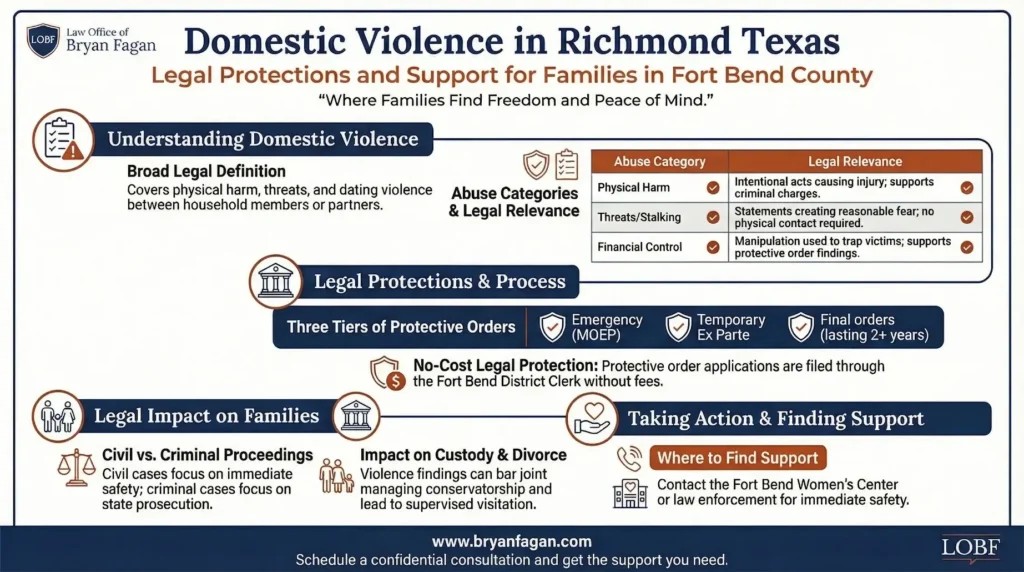
Texas courts recognize multiple forms of conduct that constitute family violence. Physical harm includes any intentional act causing bodily injury, but the law extends well beyond visible injuries. Threats that place someone in reasonable fear of harm also qualify, even without physical contact. Emotional abuse and control-related behaviors—while sometimes harder to document—can support protective orders when they involve threatening conduct.
The table below summarizes common types of domestic violence situations and their legal relevance:
| Type | Description | Legal Relevance |
|---|---|---|
| Physical Harm | Intentional acts causing bodily injury | Directly covered under §71.004; supports protective orders and criminal charges |
| Threats of Violence | Statements or actions creating reasonable fear of imminent harm | Qualifies as family violence under Texas law; no physical contact required |
| Sexual Assault | Non-consensual sexual contact or coercion | Covered under family violence definition; severe criminal and civil consequences |
| Stalking | Repeated conduct causing fear for safety | Protective orders may include anti-stalking provisions |
| Dating Violence | Violence by current or former dating partner | Covered under §71.0021; same protections as household family violence |
| Economic Control | Using financial control to trap or harm | May support protective orders when combined with threats or fear |
This framework helps courts evaluate whether conduct rises to the level of family violence, which then determines what legal remedies are available.
Legal Protections Available in Richmond Texas
Texas law provides legal protections, including protective orders, for individuals facing family violence. Under Texas Family Code §85.001, courts may issue protective orders when family violence has occurred and present danger exists. These orders can prohibit contact, require the respondent to stay away from certain locations, and may include provisions affecting firearm possession and license to carry.
In Richmond, applications for protective orders are filed through the Fort Bend County District Clerk at 1422 Eugene Heimann Circle, Richmond, Texas 77469. There are no filing fees for protective order applications, and the law allows flexible venue—you can file in the county where you live, where the respondent lives, or where the violence occurred.
Emergency relief is available through ex parte protective orders, which can be granted before a full hearing when there’s immediate danger. This means you can receive protection without waiting weeks for a court date. The temporary order remains in effect until a hearing is scheduled, at which point both parties can present evidence.
The Fort Bend County Constable’s Office, Precinct 1 Civil Division, handles service of protective orders in Richmond. Once served, the respondent must comply with all terms immediately.
How Domestic Violence Affects Child Custody
When it comes to Domestic Violence in Richmond Texas, the impact on child custody decisions can be significant and long-lasting. Texas courts are guided by one central principle: the best interest of the child. Under Texas Family Code §153.002, judges must evaluate what arrangement will provide the greatest level of safety, stability, and long-term well-being for the child. This includes looking closely at the home environment, each parent’s ability to provide consistency, and whether any history of family violence exists.
In cases involving allegations or findings of abuse, Texas Family Code §153.004 requires courts to carefully consider credible evidence of family violence that occurred within two years before the case was filed or during the litigation itself. If such evidence is established, courts are required to take protective measures. These may include denying or limiting joint managing conservatorship, restricting possession and access, ordering supervised visitation, or granting one parent the exclusive right to determine the child’s primary residence. These decisions are not made lightly—they reflect the court’s duty to prioritize a child’s physical safety and emotional security above all else.
At the same time, Texas courts do not rely on accusations alone. Judges evaluate the full picture, including documentation such as police reports, medical records, photographs, communications, and witness testimony. The goal is to determine credibility and identify patterns of behavior that may affect the child’s well-being. This balanced approach ensures that both protection and fairness remain central to the process.
For families in Fort Bend County, practical considerations like transportation, school access, and daily routines also play a role in custody arrangements. Understanding local factors—such as those outlined in transportation in Richmond TX—can help parents and courts create schedules that support a child’s stability. Thoughtful planning around logistics often reduces conflict and helps children maintain a sense of normalcy during difficult transitions.
Families facing these challenges often benefit from clear, reliable guidance. Resources like the firm’s child custody blog articles provide additional insight into how Texas courts approach conservatorship, visitation, and modifications. By understanding how the law applies to real-life situations, parents are better equipped to make informed decisions that protect their children and move forward with greater confidence and peace of mind.

What to Do If You Are Experiencing Domestic Violence
If you are facing Domestic Violence in Richmond Texas and believe you are in immediate danger, call 911 right away. Your safety is the top priority, and emergency responders in Fort Bend County are trained to act quickly to protect you and your family. In these moments, taking immediate action can make a critical difference.
Once you are safe, the next step is to create distance from the situation and begin protecting yourself both physically and legally. If possible, go to a trusted friend’s home, a family member, or a local shelter. Community resources play an important role during this time, and information found through government resources in Richmond TX can help you identify available support services, including emergency housing and advocacy programs.
Documenting what has occurred is also essential. When it is safe to do so, write down specific incidents with dates, times, and details. Save text messages, emails, and voicemails, and take photographs of any injuries. This type of documentation can serve as critical evidence if you seek a protective order under Texas Family Code §82.001 or if custody issues arise under §153.004, where courts evaluate credible evidence of family violence when determining what is in the best interest of a child.
Reaching out for support can help you navigate both the emotional and legal aspects of your situation. Local hotlines and advocacy organizations provide confidential guidance and can assist with safety planning. Medical attention is also important if you have been injured, both for your health and for creating records that may support your case.
You may also consider pursuing a protective order, which can be granted by a court under Texas Family Code §85.001 when family violence has occurred and is likely to occur again. These orders can provide immediate and enforceable protection, including restrictions on contact and provisions designed to keep you and your children safe.
Speaking with a knowledgeable attorney can help you understand your options and take the right steps forward. Whether you are seeking protection or preparing for custody proceedings, guidance from a legal professional can help you approach the situation with greater clarity and confidence. For additional insight into navigating these challenges, the firm’s family law resource blog offers practical information on protective orders, custody, and related issues.
It is important to remember that leaving an abusive situation can sometimes increase risk, which is why thoughtful safety planning is essential. Working with advocates and legal counsel can help you create a plan that prioritizes your well-being while positioning you for a safer, more stable future.
What to Do If You Have Been Accused
If you have been accused of family violence, take the situation seriously. Allegations of domestic abuse carry significant legal consequences, including potential criminal charges, protective orders, and effects on child custody.
Follow all court orders exactly. If a protective order has been issued—even a temporary ex parte order—comply with every term. Violating a protective order can result in criminal charges and will harm your credibility with the court.
Avoid contact with the protected person. Do not call, text, email, or communicate through third parties if a protective order prohibits contact. Even well-intentioned communication can be treated as a violation.
Preserve evidence. Gather any communications, witness information, photographs, or records that may be relevant to your defense. Keep your records organized and accessible.
Seek legal counsel immediately. An experienced family law attorney can help you understand the allegations, prepare for hearings, and protect your parental rights if children are involved.
Attend all court hearings. Failing to appear can result in default orders being entered against you. Courts take these matters seriously, and your presence shows you take them seriously too.
Remember that you have due process rights. Evidence matters in these proceedings, and having qualified legal guidance helps you present your case effectively.
Legal Options and Next Steps
The table below outlines common situations and the legal options available:
| Situation | Legal Option | What to Do |
|---|---|---|
| Experiencing ongoing family violence | Protective order | File application with Fort Bend County District Clerk; seek emergency relief if needed |
| Need immediate safety | Emergency shelter and crisis services | Contact Fort Bend Women’s Center hotline; call 911 if in danger |
| Facing custody concerns | Suit Affecting Parent-Child Relationship (SAPCR) | Document violence; consult family law attorney about custody modification |
| Accused of family violence | Legal defense | Comply with orders; preserve evidence; consult attorney immediately |
| Protective order violation | Criminal defense | Seek legal counsel; do not compound situation with further contact |
| Planning to leave abusive relationship | Safety planning and legal preparation | Work with advocate; consult attorney about protective orders and custody |
Each situation requires careful evaluation of your specific circumstances. A qualified attorney can help you understand which path serves your interests best.
What to Expect in Fort Bend County Courts
When dealing with Domestic Violence in Richmond Texas, understanding how Fort Bend County courts operate can bring a sense of clarity during an otherwise overwhelming time. Family violence cases are handled through established legal procedures designed to prioritize safety while ensuring fairness for both parties. Knowing what to expect at each stage can help you feel more prepared and in control of the process.
The process typically begins with filing an application for a protective order under Texas Family Code §82.001. This can be done through the Fort Bend County District Clerk’s office, whether electronically, in person, by mail, or by fax. In urgent situations, courts may issue a temporary ex parte protective order under Texas Family Code §83.001, often within days, to provide immediate protection before a full hearing is held.
After filing, the respondent must be formally served with notice of the application and any temporary orders. This step is handled by the Constable’s Civil Division. Proper service is essential because it ensures that both parties have the opportunity to participate in the legal process. Delays in service can impact scheduling, so it is an important part of the timeline to understand.
A full hearing is then scheduled, where both sides can present evidence and testimony. These hearings are guided by local court procedures, and judges carefully evaluate the information presented. Under Texas Family Code §153.004, credible evidence of family violence carries significant weight, especially when child custody is involved. Courts commonly review police reports, medical records, photographs, communications, and witness testimony to determine what occurred and what protections are necessary.
Judges in Fort Bend County have broad authority under Texas Family Code §85.021 to issue protective orders tailored to the situation. These orders may include stay-away provisions, restrictions on communication, limitations on firearm possession, and terms that affect child custody or visitation. The goal is always to create a safer and more stable environment while addressing the specific risks presented in each case.
Because many family violence cases overlap with criminal allegations, understanding how assault-related charges may intersect with family law proceedings is also important. Resources like Richmond assault legal guidance can provide additional context about how these issues may be handled locally. For broader insight into protective orders and custody considerations, the firm’s Texas family law blog offers helpful, up-to-date information.
Navigating the court system can feel intimidating, but with the right knowledge and support, you can approach each step with greater confidence. Whether you are seeking protection or responding to allegations, understanding how Fort Bend County courts handle Domestic Violence in Richmond Texas helps you make informed decisions and move forward with clarity.

Common Misconceptions About Domestic Violence Cases
Several myths create confusion about family violence cases in Texas. Let’s address them directly.
“Only physical injury counts.” This is false. Under Texas Family Code §71.004, family violence includes threats that reasonably place someone in fear of imminent harm. Physical contact is not required for protective orders or custody considerations.
“You need absolute proof to get a protective order.” Courts require evidence, but the standard is not “beyond reasonable doubt.” Credible evidence—which can include testimony, records, and documentation—supports protective orders when family violence has occurred and danger exists.
“Custody decisions automatically favor the victim.” Courts evaluate all factors under the best interest standard (§153.002). While credible evidence of family violence is considered, it doesn’t guarantee any particular outcome. Judges weigh multiple considerations in determining custody arrangements.
“Protective orders last forever.” Protective orders have specified durations and can be temporary, extended, or modified. The duration depends on the court’s findings and the level of risk involved.
“There are fees to file for protective orders.” There are no filing fees for protective order applications in Texas. Cost should not prevent someone from seeking legal protection.
How a Richmond Family Law Attorney Can Help
When facing Domestic Violence in Richmond Texas, the legal process can feel overwhelming, especially when your safety, your children, and your future are all at stake. Texas law provides strong protections, but navigating those protections effectively requires both knowledge and strategy. Working with a skilled family law attorney can bring clarity to a difficult situation and help you move forward with confidence.
Under Texas Family Code §82.002 and §85.001, individuals seeking protection from family violence can apply for protective orders, including emergency ex parte relief when immediate danger is present. An experienced attorney helps ensure that these applications are completed accurately, supported with the right evidence, and presented in a way that clearly demonstrates the need for protection. This can make a critical difference in how quickly and effectively the court responds.
Preparation is equally important. Family courts rely heavily on evidence, and under Texas Family Code §153.004, credible evidence of family violence plays a key role in decisions involving custody and visitation. A knowledgeable attorney will guide you in gathering documentation such as police reports, medical records, photographs, and communications, while also preparing you for what to expect during hearings. This preparation reduces uncertainty and strengthens your ability to present your case clearly and effectively.
During court proceedings, having legal representation ensures that your voice is heard and your rights are protected. Judges have broad discretion when issuing protective orders and determining conservatorship arrangements, and a well-prepared legal advocate can help ensure that the court fully understands your circumstances. This is especially important when children are involved, as custody decisions must align with the child’s best interest under Texas Family Code §153.002, including their safety, stability, and emotional well-being.
Beyond the courtroom, legal guidance also helps protect your parental rights and establish arrangements that support your family’s long-term stability. Whether you are seeking protection or responding to allegations, thoughtful legal strategy can help minimize disruption and create a clearer path forward. If you are preparing to meet with an attorney, resources like plan your visit to our Richmond office can help you take that first step with confidence.
For additional guidance, exploring resources such as the firm’s Texas family law blog can provide valuable insight into protective orders, custody issues, and navigating complex family law matters. With the right support, you can approach these challenges with clarity, strength, and a renewed sense of control over your future.

Actionable Checklist: Domestic Violence in Richmond Texas
Use this checklist to organize your next steps:
- [ ] If in immediate danger, call 911
- [ ] Reach a safe location or contact Fort Bend Women’s Center for shelter support
- [ ] Document incidents with dates, times, and descriptions
- [ ] Preserve text messages, emails, voicemails, and photographs
- [ ] Seek medical attention if injured
- [ ] Contact the domestic violence hotline for crisis support and advocacy
- [ ] Consider filing for a protective order through the Fort Bend County District Clerk
- [ ] Follow all court orders exactly if any have been issued
- [ ] Consult a qualified family law attorney in Richmond
- [ ] Create a safety plan with an advocate if planning to leave an abusive relationship
Conclusion
When everything feels uncertain at home, it’s easy to underestimate how far those ripples travel—especially into your child’s daily life and future. But the good news is this: stability can be rebuilt. With the right structure, support, and legal guidance, children are incredibly resilient. They don’t need perfection—they need consistency, safety, and parents who are willing to take thoughtful steps forward.
If you’re navigating a situation involving domestic violence, custody, or divorce, you don’t have to figure it out alone. Having an experienced Texas family law attorney by your side can help you make decisions that not only protect your rights, but also create a more stable path for your child. Sometimes the most important step isn’t having all the answers—it’s simply reaching out and starting the conversation.
At The Law Office of Bryan Fagan, PLLC, we believe families deserve clarity, compassion, and a plan they can trust. Whether you’re ready to take action or just need to better understand your options, we’re here to help you move forward with confidence. Because when you protect your peace, you’re also protecting your child’s future—and that’s a step worth taking.
Frequently Asked Questions
Domestic violence in Richmond Texas plays a significant role in custody decisions. Under Texas Family Code §153.004, courts must consider credible evidence of family violence when determining what arrangement is in the child’s best interest. This can lead to restricted visitation, supervised access, or one parent receiving primary custody to ensure the child’s safety and stability.
Yes, it often does. Children exposed to domestic conflict may struggle with focus, attendance, and emotional regulation. Texas courts recognize that a stable home environment supports academic success, which is why educational stability is often considered when making custody decisions.
Under Texas Family Code §71.004, domestic violence—referred to as family violence—includes physical harm, threats that create fear of imminent harm, sexual abuse, and certain forms of emotional abuse. It applies to family members, household members, and dating partners.
The “best interest of the child,” under Texas Family Code §153.002, includes factors like emotional and physical safety, stability of each home, parental involvement, and the child’s educational needs. Courts aim to create an environment where the child can thrive both emotionally and academically.
Courts may consider police reports, medical records, photographs, text messages, emails, witness testimony, and any documentation showing a pattern of abusive behavior. The standard of proof in these cases is typically a “preponderance of the evidence.”
Often, yes. Courts try to minimize disruption by allowing the child to stay in the same school whenever possible. Maintaining continuity in education is viewed as beneficial to the child’s overall well-being and stability.
Supervised visitation means a parent can only spend time with the child in the presence of an approved third party or at a designated facility. It is often required when there are safety concerns, including a history of domestic violence, to protect the child while maintaining some level of parent-child contact.
Parents can communicate regularly with teachers, establish consistent routines, monitor academic progress, and seek counseling or tutoring if needed. Creating a stable and predictable environment across both households is key to helping children succeed.
Violating a protective order is a criminal offense in Texas. It can result in arrest, additional charges, and serious consequences in both criminal and family court proceedings, including negative impacts on custody rights.
While not required, having an experienced Texas family law attorney is highly recommended. These cases involve complex legal and emotional issues, and an attorney can help you protect your rights, present evidence effectively, and advocate for your child’s best interests.