
Making Divorce Modifications in Richmond, Texas

Divorce Decree Modifications in Richmond Texas often begin not in a courtroom—but in an ordinary moment that suddenly doesn’t feel so ordinary anymore. Maybe it’s when your co-parent tells you they’re moving out of town. Maybe it’s a new job with hours that no longer match the current schedule. Or maybe it’s the quiet realization one evening that the agreement you once worked so hard to finalize just isn’t working for your life anymore.
Life after divorce has a way of shifting when you least expect it. What once felt stable and manageable can slowly become stressful, confusing, or even unworkable. Texas law understands this reality. Under Texas Family Code §153.002, courts are guided by what serves the best interest of the child, and that includes adapting when circumstances change in meaningful ways.
At The Law Office of Bryan Fagan, PLLC, we’ve helped families across Richmond and Fort Bend County navigate these turning points with clarity and confidence. Led by Bryan Joseph Fagan, a South Texas College of Law graduate and a recognized authority in Texas family law, our firm is built on the belief that legal guidance should do more than solve problems—it should restore peace of mind and provide a path forward.
The truth is, recognizing that something needs to change is not a failure. It’s a step toward creating a better, more workable future for you and your child. In this article, we’ll walk you through how divorce decree modifications work in Texas, what courts look for, and how you can take the next step with confidence and clarity.
Key Takeaways
- Divorce decree modifications in Richmond Texas allow certain court orders to be changed when circumstances significantly change. Texas Family Code Chapter 156 governs this legal process.
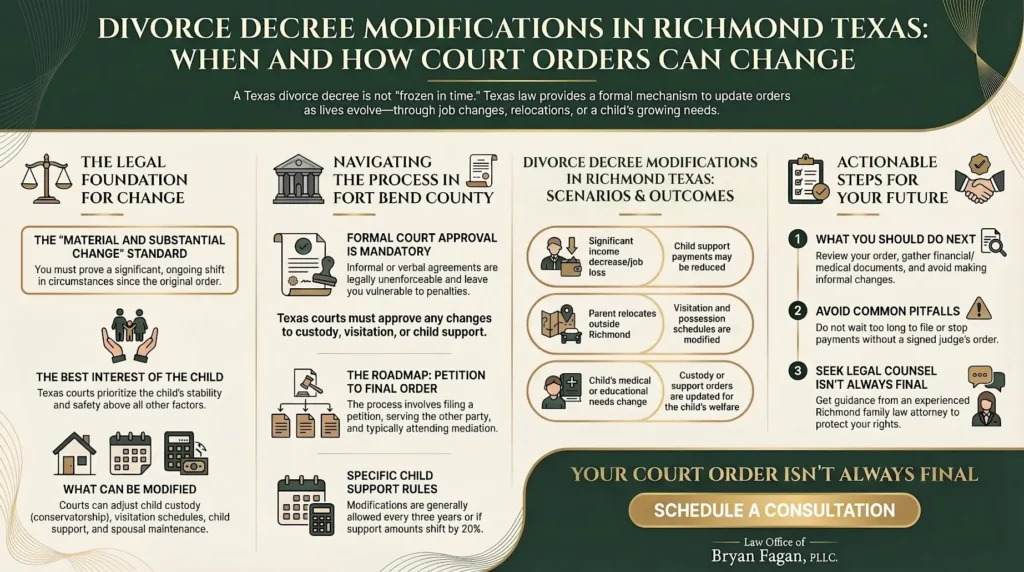
- Texas courts require a material and substantial change before modifying an existing order. This means proving that circumstances have genuinely shifted since the original decree was entered.
- Not all parts of a divorce decree can be modified. Child custody, visitation schedules, and child support can often be changed, but property division and final debt allocation are permanent.
- Fort Bend County district courts handle modification cases with specific local procedures. Understanding these procedures helps avoid delays and mistakes.
- Working with an experienced attorney familiar with Richmond Texas and Fort Bend County courts can significantly improve your chances of success.

Your Family’s Future Starts Here
Don’t navigate your legal journey alone. Schedule a consultation now and get the clarity and support you deserve.
Listen to Our Texas Family Law Podcast
Prefer listening? In this episode, we discuss modifying a divorce decree in Richmond, Texas, including when changes are allowed, what legal standards apply, and how to request a modification through the court.
The Law Office of Bryan Fagan, PLLC can represent clients in a variety of family law matters, such as the following:
As a family law firm, we recognize that clients entrust us with a deeply personal aspect of their lives. Respecting this responsibility, our firm operates with professionalism, diligence, and efficiency, while maintaining open lines of communication with our clients. Not only do we provide access to their attorney, but also a dedicated client support team capable of addressing any inquiries regarding the case, status updates, billing concerns, or any other matters that arise throughout the process. Please don’t hesitate to discover how we can be of service to you.
Contact the Law Office of Bryan Fagan, PLLC at 281-245-1907 or online.
Divorce Decree Modifications in Richmond Texas: The Short Answer
Divorce Decree Modifications in Richmond Texas allow parents and former spouses to formally request changes to existing court orders when real-life circumstances no longer match the terms set at the time of divorce. Texas courts require more than preference or convenience. Under Texas Family Code §153.002, any modification involving children must serve the child’s best interest, and the requesting party must typically show a material and substantial change in circumstances since the prior order was entered.
In straightforward situations—such as agreed changes to visitation schedules or adjustments based on clear financial updates—the process can move efficiently when handled correctly. Even in these cases, courts expect diligence and proper case progression. Missed deadlines, incomplete filings, or a lack of follow-through can slow your case down or raise concerns about credibility. Judges often look at how consistently a parent has acted, not just what they are requesting, when deciding whether to approve a modification.
In more complex cases—particularly those involving contested custody under §153.134, relocation issues, or concerns tied to child safety under Chapters 262 and 263—the court’s analysis becomes more detailed. Judges evaluate stability over time, each parent’s involvement, and whether the proposed changes create a more structured and reliable environment for the child. Where disputes are contested, the strength of your evidence and your ability to demonstrate consistency and long-term planning can significantly impact the outcome.
It is equally important to understand the limits of what can be modified. While custody, possession, and support may be adjusted under Chapter 156, property division and debt allocation are final under Texas law. Focusing your efforts on legally modifiable issues helps avoid unnecessary delays and keeps your case moving in the right direction.
For families considering relocation or lifestyle changes, practical factors—such as community, commute, and day-to-day structure—can influence how a judge evaluates stability. Learning more about moving to Richmond, TX can provide helpful context when these factors become part of your modification request.
If you are trying to determine the best path forward, reviewing information about child custody in Texas can help you better understand how courts approach these decisions and what evidence carries weight. In some situations, basic legal guidance may be enough to move forward with confidence. In others—especially where timelines begin to stall, disputes escalate, or the stakes involve long-term custody arrangements—a more structured, strategic approach becomes essential.
Taking action at the right time matters. Delays, missteps, or incomplete preparation can affect how your case is viewed and how quickly it progresses. Whether your situation is relatively simple or more complex, approaching it with clarity and the right level of legal support can help protect your case, your child’s stability, and your family’s future.

What Is a Divorce Decree Modification?
A divorce decree modification is a formal legal process through which a Texas court changes specific terms of an existing final divorce decree. This is not just a legal procedure for minor adjustments—it represents a significant court action that requires meeting strict legal standards.
Under Texas Family Code Chapter 156, modifications allow courts to revisit and alter orders related to conservatorship, possession and access, and child support. The court that issued your original divorce decree retains continuing, exclusive jurisdiction over these matters, meaning modifications must be filed in the same Fort Bend County district court that handled your divorce.
It is important to understand that modification differs from the initial divorce proceedings. During your original Texas divorce, the court established the terms of your decree based on circumstances at that time. A modification proceeding asks the court to acknowledge that those circumstances have changed enough to justify different terms going forward.
Modification also differs from enforcement actions. If your former spouse is simply not following the existing court order, you would pursue enforcement under Texas Family Code Chapter 157 rather than modification. Enforcement makes someone comply with what was already ordered. Modification changes what the order actually says.
What Parts of a Divorce Decree Can Be Modified
Texas law allows modification of several key provisions in a divorce decree, provided the requesting party can meet the legal standard.
Child custody arrangements are frequently subject to modification. This includes changes to conservatorship designations—whether one parent has sole managing conservatorship or both parents share joint managing conservatorship. Courts can also modify which parent has the exclusive right to determine the child’s primary residence.
Visitation schedules and possession orders can be changed when circumstances warrant. This includes standard possession schedules, holiday arrangements, summer schedules, and geographical restrictions on where the child can live.
Child support obligations are commonly modified. Under Texas Family Code §156.401, child support can be modified when there has been a material and substantial change in circumstances, or when the existing order has been in place for at least three years and the support amount differs by either 20% or $100 from what current guidelines would require.
Spousal support can be modified in limited situations under Texas Family Code Chapter 8, though the grounds are more restrictive than for child support modifications.
Table 1: What Can vs Cannot Be Modified
| Category | Modifiable | Not Modifiable |
|---|---|---|
| Custody / Conservatorship | Changing legal custody, managing conservator designation, decisions about child’s primary residence | N/A |
| Possession & Access | Parenting time schedules, holiday and summer arrangements, geographical restrictions | N/A |
| Child Support | Support amounts, medical and dental support, guideline conformance | N/A |
| Spousal Maintenance | Limited modifications when statutory criteria are met | N/A |
| Property Division | N/A | Final distribution of assets, real estate, retirement accounts |
| Debt Allocation | N/A | How debts acquired during marriage were assigned |
| Community Property Division | N/A | How marital property was divided |
What Cannot Be Modified
Texas courts treat certain aspects of your divorce decree as final and permanent. Understanding these limitations prevents wasted time and legal fees pursuing changes that simply are not available.
Property division cannot be modified. Once the court has entered a final decree dividing community property and separate property, that division is complete. Texas is a community property state, meaning marital assets acquired during the marriage are divided equitably at divorce. Once that division is final and any appeal period has passed, the court loses authority to revisit how marital property was allocated.
Final debt allocation is permanent. The way debts acquired during marriage were assigned between spouses in the original divorce decree cannot be changed through modification proceedings.
Division of retirement accounts and other assets is final. Once Qualified Domestic Relations Orders or similar instruments have been entered dividing retirement accounts, those divisions generally cannot be undone through modification.
The Texas Family Code grants courts continuing jurisdiction only over conservatorship, possession, access, and support matters—not over property division. This distinction is critical. If you believe the original property division was unfair, modification is not the remedy. You would have needed to address that through an appeal or other post-judgment motion shortly after the original decree was entered.
Legal Standard: Material and Substantial Change
Divorce Decree Modifications in Richmond Texas require more than simply wanting different terms. Texas courts apply a strict legal standard, meaning you must prove that circumstances have materially and substantially changed since the original order was entered. This requirement is not just procedural—it directly impacts whether your case moves forward or risks delay or denial.
Under Texas Family Code §156.101, a parent seeking to modify conservatorship, possession, or access must establish two key elements. First, the requested change must serve the child’s best interest under §153.002. Second, there must be a meaningful and ongoing change affecting the child or a parent. Courts are not focused on minor frustrations or temporary disruptions. Instead, judges evaluate whether the current order still provides stability—or whether it no longer reflects the reality of the child’s daily life.
In straightforward situations, such as documented schedule changes or agreed adjustments between parents, meeting this standard can be more direct. However, even in these cases, courts expect diligence. Delays in filing, incomplete evidence, or inconsistent follow-through can slow case progression and raise concerns about credibility. When a case appears inactive or unsupported, it can create unnecessary risk and make it harder to move forward efficiently.
In more complex cases—especially where disputes are contested, custody is challenged under §153.134, or concerns involve child safety under Chapters 262 and 263—the court’s analysis becomes much more detailed. Judges look closely at patterns over time, each parent’s involvement, and whether the proposed changes improve long-term stability. Everyday realities—like commute time, reliability, and consistency—can play a meaningful role in these decisions. Understanding factors such as transportation in Richmond, TX can help illustrate how logistical challenges affect a child’s routine and overall well-being.
For parents trying to determine what matters most in these cases, reviewing child custody in Texas can provide helpful insight into how courts weigh evidence and evaluate best interest factors. In some situations, basic legal guidance may be enough to present a clear and supported request. In others—particularly where facts are disputed, timelines are at risk, or the outcome could significantly impact custody—a more structured and strategic approach becomes essential.
Ultimately, timing and preparation matter. Waiting too long, failing to document changes, or approaching the process without a clear plan can weaken your position. Whether your situation is relatively simple or more complex, presenting a well-supported case that demonstrates both change and stability is what helps move your case forward—and protects your child’s future.

Common Reasons for Modification
Divorce Decree Modifications in Richmond Texas are often driven by real-life changes that make an existing court order no longer practical or aligned with a child’s best interest. Texas courts understand that circumstances evolve, but they expect those changes to be meaningful, well-documented, and tied to stability. Under Texas Family Code §153.002, the focus is always on what supports the child—not what is simply more convenient for a parent.
In straightforward situations, financial changes are one of the most common reasons families seek modification. A job loss, a significant increase or decrease in income, or unexpected medical expenses can affect child support obligations. When these changes are clear and supported by documentation, the process can move more efficiently. However, courts still expect diligence. Delays in addressing financial changes or inconsistent records can slow case progression and raise concerns about credibility.
Relocation is another frequent trigger. When a parent moves—whether within Fort Bend County or beyond—existing possession schedules may no longer function as intended. Under §156.103, relocation can significantly impact how courts evaluate a modification request. Judges look closely at how the move affects the child’s routine, school stability, and access to both parents. Even practical factors like commute time and daily logistics can influence whether a proposed change supports long-term consistency.
In more complex cases, changes in a child’s needs or safety concerns can carry significant weight. A child may develop medical or emotional needs that require a different level of care, or concerns may arise about their well-being in one household. Situations involving family violence or criminal allegations—such as those explored in Richmond assault cases—can directly impact custody decisions. Under Texas Family Code §156.1045 and related provisions in Chapters 262 and 263, courts take these matters seriously and evaluate whether a modification is necessary to protect the child. Where disputes are contested, judges focus heavily on patterns of behavior, supporting evidence, and each parent’s ability to provide a stable and safe environment.
Changes in parenting capacity can also justify modification. This may include substance abuse issues, extended absences, incarceration, or a shift in who is actually providing day-to-day care. In these situations, courts are not just looking at what has changed—they are evaluating consistency, reliability, and long-term stability under §153.134. A parent’s actions over time often carry more weight than isolated incidents.
For those trying to better understand how courts approach these decisions, reviewing child custody in Texas can provide helpful insight into how judges evaluate best interest factors and weigh competing claims. In some situations, basic legal guidance may be enough to move forward. In others—especially where safety concerns, contested facts, or significant life changes are involved—a more structured and strategic approach becomes essential.
Recognizing when a change rises to the level of a legal modification is critical. Acting too late, failing to document issues, or approaching the process without a clear plan can create unnecessary risk. Whether your situation is relatively simple or more complex, understanding these common triggers—and how courts evaluate them—can help you take the right next step with clarity, confidence, and control.

The Legal Process in Fort Bend County
Pursuing a divorce decree modification in Fort Bend County involves several distinct steps.
Filing the petition initiates the legal process. You must file a Petition to Modify in the same Fort Bend County district court that issued your original divorce decree. The petition must clearly identify the existing order, specify what changes you are requesting, and state facts supporting a material and substantial change in circumstances. For custody modifications, an affidavit may be required under §156.101(c).
Proper service is essential. The other party must receive formal legal notice of your modification petition. Texas Rules of Civil Procedure govern service requirements, and failure to properly serve your former spouse can delay your case significantly.
Discovery and evidence gathering follow in contested cases. Both parties can request documents, take depositions, and gather financial records, school records, medical records, and other evidence supporting their positions.
Court hearings and mediation provide opportunities to resolve the case. Fort Bend County courts may require mediation or alternative dispute resolution before a final hearing. If parties reach agreement, the modification can proceed more quickly. If the case remains contested, a final hearing before the judge will be scheduled.
Entry of the final modified order concludes the process. If the court finds the statutory standards are met and the modification serves the child’s best interest, it will issue a new order that becomes enforceable immediately.
Fort Bend County Local Rules set specific time standards: contested family law cases should reach final disposition within six months of the appearance date, while uncontested cases should be completed within three months.
Modification vs Enforcement: Understanding the Difference
Understanding when you need modification versus enforcement is critical to pursuing the right legal remedy.
Table 2: Modification vs Enforcement
| Issue | Modification | Enforcement |
|---|---|---|
| Purpose | Change the terms of the existing court order | Make someone comply with the existing order |
| Legal Authority | Texas Family Code Chapter 156 | Texas Family Code Chapter 157 |
| Required Showing | Material and substantial change plus best interest | Proof that the other party violated the order |
| Typical Remedies | Changed custody, modified support, new possession schedules | Contempt findings, wage garnishment, arrearages judgment |
| When to Use | Circumstances have genuinely changed | Other party is simply not following current orders |
If your former spouse is refusing to pay court-ordered child support or denying your possession time, enforcement—not modification—is likely the appropriate remedy. Enforcement proceedings under Chapter 157 can result in contempt findings, financial penalties, and wage withholding.
However, sometimes the same facts may support both actions. For example, if your former spouse’s failure to exercise possession time reflects a genuine change in their circumstances and parenting involvement, that might justify both enforcement of the current order and modification of future custody arrangements.
Evidence Needed for a Modification Case
Divorce Decree Modifications in Richmond Texas depend heavily on the quality and organization of your evidence. Texas courts do not make decisions based on assumptions or general claims. Judges expect clear, credible proof that circumstances have materially and substantially changed, and that the requested modification supports the child’s best interest under §153.002.
In straightforward situations—such as income adjustments or agreed changes between parents—basic documentation may be enough to support your case. Financial records play a critical role here. Pay stubs, tax returns, and proof of income changes help demonstrate whether child support should be modified under Texas guidelines. However, even in these cases, courts expect diligence. Incomplete or inconsistent financial records can delay your case or raise concerns about credibility.
In more complex cases—especially those involving contested custody under §153.134 or concerns related to a child’s safety—evidence becomes even more important. Parenting schedules, communication logs, and detailed records of exchanges help show how the current arrangement is actually functioning. Courts look closely at patterns over time, not just isolated incidents. Where disputes are contested, your ability to present consistent, well-documented evidence can directly impact how the court evaluates stability and each parent’s involvement.
School records, medical documentation, and reports from counselors or therapists can also carry significant weight. These records help establish how changes in circumstances are affecting the child’s day-to-day life. In cases where safety concerns are raised—such as issues involving substance use or criminal allegations, including those related to Richmond DWI/DUI cases—courts will examine evidence carefully to determine whether a modification is necessary to protect the child under Chapters 262 and 263.
For parents seeking a clearer understanding of how courts evaluate these factors, reviewing child custody in Texas can provide helpful insight into what judges prioritize and how evidence is weighed. In some situations, organizing basic documentation and presenting a clear timeline may be sufficient. In others—particularly where facts are disputed or the stakes involve long-term custody outcomes—a more structured and strategic approach is essential.
Ultimately, documentation is the foundation of your case. Acting early, keeping thorough records, and presenting evidence in a clear and organized way can help move your case forward and avoid unnecessary delays. Whether your situation is relatively simple or involves more complex challenges, strong evidence is what turns a request into a compelling case—and positions you for a more stable outcome.
Timeline Expectations and Challenges
Modification cases in Fort Bend County vary significantly in duration depending on whether they are contested or uncontested.
Uncontested modifications—where both parties agree to the changes—can often be completed in two to three months. When there is no dispute over the facts or the relief requested, courts can enter modified orders relatively quickly.
Contested modifications typically take longer, often four to six months or more. Discovery disputes, the need for expert witnesses or evaluations, and crowded court calendars all contribute to delays.
Fort Bend County Local Rules aim for contested family law cases to reach disposition within six months, but actual timelines depend on case complexity and court availability. Be prepared for the process to take time, and avoid making unilateral decisions while your case is pending.

Common Mistakes to Avoid
Several common divorce mistakes can derail modification cases.
Filing without sufficient evidence is perhaps the most frequent error. Vague allegations without supporting documentation will not satisfy the material and substantial change standard. Courts will dismiss or deny petitions that lack proper evidentiary support.
Ignoring existing court orders while your case is pending creates serious problems. Until a court enters a modified order, the original order remains in full effect. Violating those legal obligations can result in enforcement actions against you and damage your credibility with the court.
Confusing enforcement issues with modification needs wastes time and resources. If your problem is that your former spouse is not following the current order, enforcement—not modification—is the proper remedy.
Delaying action when circumstances change can hurt your case. Courts may question why you waited months or years to seek modification if the change was truly significant.
Making verbal agreements without court approval leaves you vulnerable. Informal agreements between former spouses carry no legal weight unless approved by the court through proper modification proceedings.
How a Richmond Family Law Attorney Can Help
Divorce Decree Modifications in Richmond Texas often seem straightforward at first—but even small mistakes can delay progress or weaken your position. The right legal guidance helps ensure your case is built on a solid foundation, with proper documentation, accurate filings, and a strategy that aligns with how Texas courts actually evaluate these cases.
In straightforward situations—such as agreed modifications or clearly documented life changes—basic legal guidance may be enough to help you move efficiently while avoiding procedural errors. Courts still expect diligence. Missed deadlines, incomplete pleadings, or inconsistent follow-through can raise concerns about credibility and slow your case down. Judges in Fort Bend County often look at how actively a case is being pursued, not just the request itself, when evaluating whether it should move forward.
In more complex cases—particularly those involving contested custody under §153.134, safety concerns under Chapters 262 and 263, or disputes over primary residence—the need for a structured legal strategy becomes much more important. Courts evaluate long-term stability, each parent’s involvement, and whether the proposed modification truly supports the child’s best interest under §153.002. Where disputes are contested, the strength of your evidence, your consistency, and your ability to present a clear and credible case can directly influence the outcome.
Legal guidance also plays a critical role in preparing evidence and keeping your case on track. From organizing financial records to documenting parenting patterns, every detail matters. Small procedural missteps—such as filing incomplete paperwork or failing to properly support your claims—can create unnecessary delays or weaken your position at critical stages of the case.
For those trying to better understand how courts approach these decisions, reviewing child custody in Texas can provide valuable insight into how judges evaluate best interest factors and long-term stability. If your situation involves relocation, ongoing disputes, or significant life changes, connecting with a local resource like the Richmond family law office can also help you better understand how these cases are handled at the local level.
Ultimately, the level of legal support you need depends on the complexity of your situation. Some cases can be handled with clear documentation and proper filing. Others—especially where conflict, risk, or long-term custody outcomes are involved—require a more strategic, litigation-aware approach. Recognizing that difference early can help you avoid delays, protect your case, and move forward with confidence toward a more stable future for your family.

Actionable Checklist: Divorce Decree Modifications in Richmond Texas
- [ ] Review your current court order thoroughly and identify exactly what you need changed
- [ ] Document the specific changes in circumstances that have occurred since the last order
- [ ] Gather supporting evidence: income documents, medical records, school records, communication logs
- [ ] Determine if statutory thresholds apply (three years plus guideline difference for support modifications)
- [ ] Avoid making unilateral decisions that violate your current order
- [ ] Track any compliance issues with the current order separately from modification needs
- [ ] File proper paperwork in the Fort Bend County district court that issued your original decree
- [ ] Ensure proper service on your former spouse
- [ ] Prepare for discovery if your case is contested
- [ ] Seek legal counsel from a divorce modification lawyer familiar with Fort Bend County procedures
Conclusion
At the end of the day, Divorce Decree Modifications in Richmond Texas are not just about changing legal terms—they are about realigning your life with what actually works today. When circumstances shift, Texas law provides a path forward, but courts expect more than intent. Under §153.002, the focus remains on the child’s best interest, and judges look closely at stability, consistency, and whether the proposed changes create a better long-term structure. Taking action at the right time—and with the right preparation—can be the difference between moving your case forward or facing delays that affect both your timeline and your outcome.
In straightforward situations, where both parents agree and the facts are clear, the process can be relatively smooth with proper guidance and attention to detail. However, even simple cases require diligence. Missed steps, incomplete filings, or delays in case progression can raise concerns about credibility. In more complex cases—especially those involving contested custody under §153.134, relocation challenges, or concerns tied to safety under Chapters 262 and 263—the stakes are significantly higher. Where disputes are contested, courts evaluate not only what has changed, but how each parent has demonstrated reliability, involvement, and the ability to provide a stable environment over time.
For parents trying to better understand how these factors are evaluated, reviewing child custody in Texas can provide helpful clarity on what courts prioritize and how decisions are made. If you are preparing to take the next step—whether that involves filing, responding, or attending a hearing—planning ahead can reduce uncertainty. Resources like the Richmond office visit guide can help you feel more prepared and confident as you move forward.
Ultimately, the right approach depends on your situation. Some families can move forward with clear communication and proper filings, while others require a more structured, strategic approach to address contested issues or protect long-term outcomes. Recognizing that difference early allows you to avoid unnecessary setbacks, stay on track, and make informed decisions that protect your child’s stability and your family’s future.
Frequently Asked Questions
A divorce decree modification is a legal process under Texas Family Code Chapter 156 that allows certain provisions of a final divorce decree to be changed by the court. Modifications can address child custody, visitation schedules, and child support when circumstances have significantly changed since the original order was entered.
Texas law requires showing that circumstances have genuinely and significantly changed since the original order. Common examples include major income changes, relocation, changes in a child’s medical or educational needs, safety concerns, or a parent’s incarceration. Temporary or minor changes typically do not meet this standard.
Yes, child support can be modified when there has been a material and substantial change in circumstances, or when the order has been in place at least three years and the current amount differs by 20% or $100 from what guidelines would require based on current income.
Property division and final asset distribution cannot be modified after a Texas divorce is final. How community property and marital assets were divided, and how debts were allocated, are considered permanent under Texas law.
Uncontested modifications where both parties agree typically take two to three months. Contested modifications often take four to six months or longer, depending on discovery needs, court availability, and case complexity.
While legal representation is not required, working with an experienced attorney significantly improves your chances of success, especially in contested cases. An attorney ensures proper procedures are followed and helps present your case effectively to the court.
Potentially yes, if the relocation constitutes a material and substantial change that affects custody arrangements. However, relocations also raise jurisdiction questions about which state’s courts have authority over custody matters going forward.
If your former spouse is not following existing court orders, you would pursue enforcement under Texas Family Code Chapter 157 rather than modification. Enforcement remedies include contempt findings, wage garnishment, and arrearages judgments. This is different from seeking to change what the order actually requires.