
Child Support Lawyers in Dallas Texas: Your Complete Guide to Texas Family Law

You just received papers in the mail about child support, and your stomach dropped. Maybe you’re wondering whether the amount listed is fair, or you’re worried about how you’ll manage payments alongside your other bills. Perhaps you’re on the other side—waiting for financial support that never seems to arrive, wondering how you’ll cover your child’s needs this month.
If you’re searching for child support lawyers in Dallas Texas, you’re likely dealing with uncertainty, stress, and a lot of questions about what comes next. Child support is both a financial and emotional matter. It affects your daily life, your relationship with your children, and your long-term financial stability. Mistakes in how support is calculated, documented, or enforced can be costly and long-lasting. The purpose of child support is to ensure your child’s basic needs—such as housing, food, clothing, education, and medical care—are met consistently and reliably.
This guide will walk you through how child support works under Texas law, what to expect in Dallas County courts, and what steps you can take to protect your rights and your child’s welfare. Board certified family law attorneys bring advanced expertise to child support cases in Dallas, offering specialized guidance for your unique situation. Whether you need to establish a new order, modify an existing one, or enforce payments that haven’t been made, understanding the process puts you in control.
Free or low-cost legal aid is available to low-income residents through organizations like Legal Aid of NorthWest Texas and public services such as the Dallas County Child Support Office.
Key Takeaways
- Texas state guidelines determine child support calculations, but courts may adjust amounts based on unique family circumstances and the child’s best interests
- Child support in Texas follows guideline formulas, but Texas courts can adjust amounts based on real-life circumstances and your child’s needs
- Dallas County courts have specific procedures through programs like C.A.R.E. that can impact timelines and outcomes
- Income is broader than just salary, including bonuses, self-employment earnings, investments, and rental income
- Support orders can be modified when circumstances change significantly under Texas Family Code Chapter 156
- Enforcement actions can be serious, including wage garnishment, license suspension, and contempt of court
- Working with a child support lawyer in Dallas Texas helps ensure accuracy, strategy, and protection of your parental rights

Your Family’s Future Starts Here
Don’t navigate your legal journey alone. Schedule a consultation now and get the clarity and support you deserve.
Speak With a Child Support lawyers in Dallas Texas
A contested divorce can affect your finances, your family, and your future. Having a skilled Child Support lawyers in Dallas Texas on your side can help protect your interests and give you peace of mind during a challenging time.
To learn more about how the Law Office of Bryan Fagan, PLLC can help with your contested divorce case, call 469-972-8473 today to schedule a confidential consultation.
Child Support Lawyers in Dallas Texas: The Short Answer
Child support lawyers in Dallas Texas help parents establish, modify, and enforce child support orders under Texas law — but what that means in practice goes well beyond filing paperwork. Every child support case that moves through Dallas County’s family district courts requires accurate income documentation, a clear understanding of how Texas calculates support, and the ability to present your situation effectively to a judge who sees dozens of these cases every week. Without that foundation, even a parent with a legitimate claim can walk out of court with an order that doesn’t reflect reality.
Under Texas Family Code §154.125, child support is calculated as a percentage of the paying parent’s net resources — the income actually available after specific deductions like federal taxes and Social Security. That percentage starts at 20% for one child and increases from there. What sounds straightforward becomes contested the moment income is disputed, inconsistently documented, or drawn from sources beyond a regular paycheck. Texas Family Code §154.062 defines net resources broadly, capturing wages, self-employment income, rental income, bonuses, and more. Dallas County judges expect both parties to arrive with organized, verifiable financial records. Parents who don’t are at an immediate disadvantage, regardless of which side of the support equation they’re on.
In straightforward situations where income is clearly documented and both parents agree on a support amount, working through the Dallas County process with basic legal guidance may be sufficient to establish a fair order. In more complex situations — particularly those involving self-employment income, disputed earnings, interstate enforcement, or a co-parent who is not complying with an existing order — the quality of legal representation becomes the determining factor in the outcome. Where cases involve custody determinations governed by Texas Family Code §153.002, which requires every decision to serve the best interest of the child, the consequences of inadequate representation extend well beyond a single court date. When circumstances change and an existing order no longer reflects your financial reality, understanding your options for modification is equally important — and equally time-sensitive.
What separates experienced Dallas child support attorneys from general practitioners is local knowledge that cannot be found in a statute. Dallas County’s family district courts have specific procedural expectations, and familiarity with how individual courts approach income disputes, temporary orders, and enforcement motions shapes how a case is prepared and presented. Board-certified family law attorneys — those who have met the Texas Board of Legal Specialization’s rigorous courtroom and examination requirements — bring an additional level of verified expertise to complex matters where the financial stakes are highest.
Delay in these cases carries real financial consequences. Arrears accumulate under existing orders regardless of changed circumstances. Modifications are not retroactive. Every month without the right order in place is a month that cannot be recovered. In situations where both parties are cooperative and the facts are simple, a parent can reasonably navigate the process with limited assistance. But when the facts are disputed, the income is complex, or the other parent is not acting in good faith, working with experienced child support lawyers in Dallas Texas is not a luxury — it is the most direct path to an outcome that actually protects your child and your financial future. The Law Office of Bryan Fagan, PLLC exists to make that path as clear and manageable as possible, from the first consultation through the final order.

Listen to Our Texas Family Law Podcast
Prefer listening? In this episode, we discuss child support in Dallas, Texas, including how payments are calculated, what factors courts consider, and what parents can expect throughout the process.
Start Here: What Situation Are You In?
If you are facing a child support issue such as needing to establish support, modify an existing order, enforce missed payments, or clarify your obligations, it’s crucial to have knowledgeable legal representation to protect your rights and your child’s best interests within the Dallas County court system.
I need to establish child support You’re going through a divorce, separation, or custody situation and need a formal support order. A Dallas child support lawyer can help you file the appropriate petitions, gather financial documentation, and ensure support is calculated correctly from the start.
I need to modify an existing order Your circumstances have changed—maybe you lost a job, received a significant raise, or your child’s needs have shifted. Texas law allows modifications when there’s a material and substantial change. An attorney can evaluate whether modification makes sense and guide you through the Dallas County filing process.
I’m dealing with missed payments Child support payments aren’t arriving as ordered, creating financial hardship for your family. Enforcing child support payments requires specific legal action. A lawyer can file enforcement motions and pursue remedies including wage garnishment and contempt proceedings.
I’m not sure what I should be paying or receiving You’re uncertain whether current support amounts align with Texas guidelines or reflect your actual financial situation. A child support attorney can calculate what support should be based on net income and identify whether adjustments are warranted.
If any of these situations describe you, talking with a Dallas child support lawyer about your options is an important first step.
How Child Support Works in Texas
Child support in Texas is typically calculated using guidelines based on a parent’s net income and the number of children requiring support. The purpose is straightforward: ensuring that payments cover a child’s basic needs—including housing, food, clothing, education, and medical care—so that children receive adequate financial support regardless of which parent they live with.
The Texas Family Code provides the legal framework governing all child support matters. Texas Family Code §153.002 establishes that the “best interest of the child” is the primary consideration in all custody, visitation, and support decisions. This standard guides judges in Dallas County district courts when making support determinations.
Dallas County handles child support cases through its seven Family District Courts, with court locations at the George L. Allen, Sr. Courts Building in Dallas, TX. Understanding these court locations is important for navigating local procedures and requirements in Dallas, TX child support cases. The county also operates the Domestic Relations Office (DRO), which administers the C.A.R.E. program—a monitoring and enforcement system that automatically tracks payments and takes action when support goes unpaid. Additionally, the Texas Attorney General’s Child Support Division is the state’s official enforcement agency for child support, assisting in establishing or enforcing orders, though it does not provide personal legal representation.
Support orders are created through court proceedings that examine both parents’ financial resources and the children’s needs. Once established, these orders remain in effect until modified by the court or until the child reaches adulthood.
How Child Support Is Calculated in Dallas
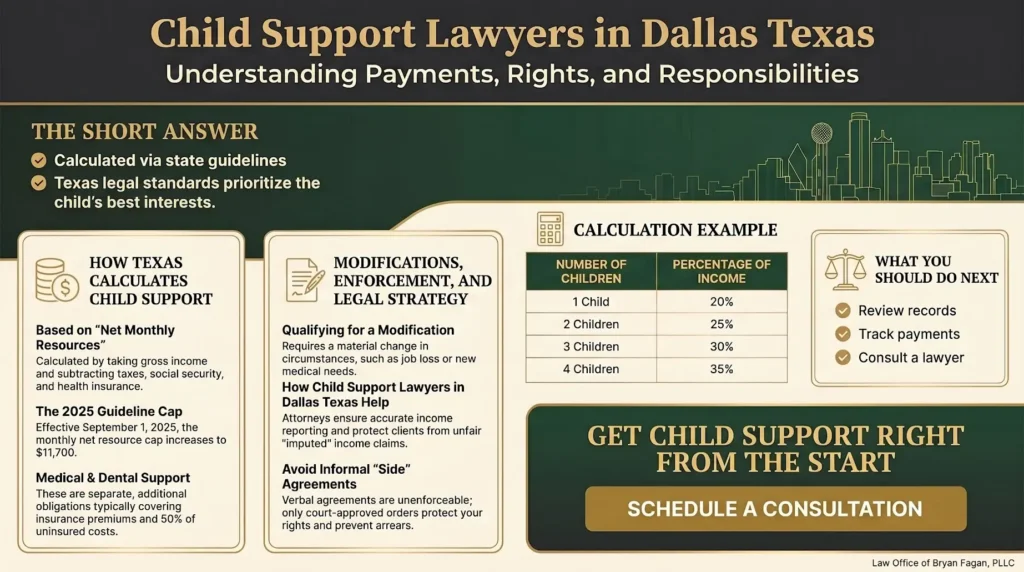
Under Texas law, child support is calculated based on percentage guidelines applied to the paying parent’s “net resources.” The amount is calculated based on net resources and state guidelines to ensure fairness and consistency. Texas Family Code §154.062 defines net resources as all income minus specific allowable deductions—essentially your income after certain taxes and required expenses.
Net resources in plain English: Take your gross income from all sources, subtract Social Security taxes, federal income taxes (using standard allowances), union dues if applicable, and health insurance costs for the children. Texas has no state income tax, so that’s not a factor. What remains is your net resources for child support calculations. Attorneys calculate net resources, secure payment compliance, handle paternity issues, and represent clients in Dallas County courts to ensure fair support payments in accordance with the Texas Family Code.
Texas Family Code §154.125 establishes the percentage guidelines applied to net resources. Dallas County courts may also consider other factors, such as unique family circumstances or special needs, when determining the final support amount.
Table 1: Texas Child Support Guidelines
| Number of Children | Percentage of Net Resources | Notes |
|---|---|---|
| 1 child | 20% | Baseline guideline amount |
| 2 children | 25% | Applied to first two children |
| 3 children | 30% | Increases with additional children |
| 4 children | 35% | Continues progressive scale |
| 5 or more children | 40% | Maximum percentage under guidelines |
As of September 1, 2025, Texas caps the net resources considered for guideline calculations at $11,700 per month. Support is calculated up to this cap. For income above that amount, additional support may be ordered only if proven necessary for the child’s needs under Texas Family Code §154.126.
Dallas County courts apply these guidelines consistently, though judges consider individual circumstances when determining final amounts.
What Counts as Income for Child Support
Texas courts consider a broad range of income sources when calculating child support — and the definition goes well beyond what shows up on a regular paycheck. Under Texas Family Code §154.062, net resources include wages, salary, bonuses, commissions, overtime pay, self-employment income, business profits, rental property income, investment returns, retirement and pension payments, and royalties or trust distributions. In plain terms, if money is coming in and increasing what a parent has available to spend, Texas courts generally want to know about it. The court also weighs the child’s financial needs alongside that income picture, ensuring that any support order meets the standard established under Texas Family Code §153.002 — that every decision serves the best interest of the child.
Not everything counts. Returns of principal or capital, accounts receivable that haven’t been collected, and benefits paid specifically because of a child’s disability are excluded from the net resources calculation. These exclusions exist for specific legal and policy reasons, and understanding where they apply — and where they don’t — requires more than a surface reading of the statute. Dallas County judges expect both parties to arrive at hearings with organized, verifiable financial documentation. A parent who cannot clearly account for their income sources, or who presents records that don’t align with their lifestyle or prior tax filings, loses credibility in a courtroom where judges make these determinations regularly.
The most contested income disputes in Dallas County child support cases involve hidden or underreported income, irregular self-employment earnings that fluctuate significantly year to year, business owners who reduce their reportable income through aggressive expense deductions, and parents with multiple income streams that aren’t immediately apparent from a single document. When income is genuinely disputed, Dallas courts examine tax returns, bank statements, profit and loss statements, and in some cases, business records going back several years. In situations where a parent appears to be earning less than they reasonably could — whether by working reduced hours, leaving a higher-paying position without clear justification, or structuring a business to minimize visible income — courts can impute income, meaning they assign an income figure based on what that parent is capable of earning rather than what they currently report.
In straightforward situations where income is clearly documented and both parties agree on the numbers, the court process in Dallas County is manageable with basic legal guidance. In more complex situations — particularly those involving self-employment, disputed earnings, or a co-parent who is concealing income — the outcome depends heavily on how the evidence is gathered, organized, and presented. For parents who have recently relocated to the Dallas area, understanding how a change in circumstances affects an existing support order is an important early step, since modifications are not retroactive and delays in filing can result in continued obligations that no longer reflect current financial reality.
Waiting to address an income dispute or an inaccurate support calculation carries real financial consequences. Every month under the wrong order is a month that cannot be recovered. In cases where the facts are simple and cooperative, a parent can navigate this process with limited assistance. Where income is complex, documentation is incomplete, or the other parent is not acting transparently, experienced child support lawyers in Dallas Texas provide the legal framework, local court knowledge, and advocacy that turns a complicated evidentiary challenge into a clear, well-supported case. The Law Office of Bryan Fagan, PLLC is here to help you understand exactly where your situation falls — and what the right next step looks like.

When Courts Deviate from Guidelines
While Texas state guidelines provide the baseline for calculating child support, courts may consider other factors when determining the final amount. Courts may adjust child support when circumstances change or when guideline amounts would be unjust. The Texas Family Code §154.123 allows deviation from standard percentages when evidence shows the guideline amount doesn’t serve the child’s best interests, taking into account both state guidelines and other factors unique to each family.
Common reasons for deviation include:
- Child’s extraordinary needs: Significant medical care requirements, special education costs, or therapeutic services
- Special talents or activities: Costs for competitive sports, arts training, or other development opportunities
- Parent’s financial hardship: Situations where paying guideline support would create genuine hardship
- High-income households: When income exceeds the statutory cap and children have demonstrated needs
- Extended possession time: When the non-custodial parent has the child significantly more than standard visitation
- Other factors: Unique family circumstances, the child’s special needs, or major life changes that might influence support calculations or modifications
Dallas County judges evaluate deviation requests carefully. Any deviation must be justified in writing with specific findings pointing to the child’s best interests and the statutory factors. Simply wanting to pay less or receive more isn’t sufficient—concrete evidence of why guidelines don’t fit your situation is essential.
How Custody Affects Child Support
In Texas, custody is called “conservatorship.” The managing conservator makes major decisions about the child’s life, while the possessory conservator typically has visitation rights and pays child support.
How conservatorship affects support:
- The parent with primary residence usually receives support from the other parent
- Possession schedules and overnight calculations can influence deviation arguments
- Joint managing conservatorship doesn’t automatically mean no support—one parent typically still pays based on income differences
Common misconceptions: Texas law does not automatically reduce child support when parents share time equally. Any reduction must be justified under §154.123 deviation factors. Simply having 50/50 custody doesn’t eliminate support obligations if there’s significant income disparity between parents.
The court examines living arrangements, each parent’s financial resources, and the child’s actual needs when determining how custody affects support amounts.
Establishing Child Support in Dallas County
Establishing child support in Dallas requires filing a petition in Dallas County district court and providing comprehensive financial documentation.
Table 2: Child Support Process in Dallas
| Step | What Happens | What You Need |
|---|---|---|
| 1. File petition | Submit suit for child support or divorce petition including support | Completed petition, filing fee, proof of residency |
| 2. Complete blue form | Dallas County requires the “blue form” to set up a support account | Blue form, signed court order, photo ID |
| 3. Financial disclosure | Provide income documentation to the court | Pay stubs, tax returns (2-3 years), bank statements |
| 4. Temporary orders | Court may set interim support while case is pending | Evidence of urgent need, current expenses |
| 5. Final hearing | Present evidence; judge issues final support order | Full income evidence, child’s needs documentation |
| 6. Account setup | DRO establishes payment registry through C.A.R.E. program | Court order, blue form completion |
Temporary vs. final orders: Temporary orders provide immediate support while your case proceeds. Final orders are issued after a full hearing with evidence and testimony.
Timeline expectations: Dallas County cases vary based on complexity and court schedules. Simple cases may resolve within a few months; contested matters involving income disputes or complex child support cases can take longer.
Modifying Child Support Orders
Life changes, and Texas law recognizes that a child support order that made sense two years ago may no longer reflect the financial reality of either parent today. Under Texas Family Code Chapter 156, a court can modify an existing support order when there has been a material and substantial change in circumstances — meaning a significant shift in income, employment, the child’s needs, or the custody arrangement since the last order was entered. Common triggers include job loss, a meaningful increase or decrease in either parent’s earnings, changes in the child’s medical or educational needs, and shifts in how much time each parent spends with the child. Texas law also provides a practical alternative: if three years have passed since the last order and the current guideline amount under Texas Family Code §154.125 differs from the existing order by either $100 or 20% or more, that gap alone is sufficient grounds to request a modification — no additional proof of changed circumstances required.
The modification process in Dallas County follows a structured path. A petition must be filed in the court that issued the original order, the other parent must be properly served, and updated financial documentation must be prepared and submitted. Dallas County courts typically require mediation before a contested modification reaches a final hearing, which means both parties have an opportunity to negotiate a revised amount before a judge decides. If urgent circumstances exist — a sudden job loss, a medical emergency affecting the child, or a significant income change that makes the current order immediately unworkable — a temporary hearing can be requested to address the situation while the full modification proceeds. For parents navigating these changes while also managing the practical demands of daily life in Dallas, understanding the local resources and support systems available to families can make the process feel significantly less isolating.
Timing is one of the most consequential decisions in any modification case. Modifications under Texas law are not retroactive — they take effect from the date the petition is filed, not from the date your circumstances actually changed. Every month you delay filing is a month the existing order continues to accrue, including any gap between what is ordered and what you can realistically pay. Arrears do not disappear when a modification is eventually granted. In straightforward situations where both parents agree that a modification is warranted and the financial documentation is clear, the process can move relatively quickly and without significant legal complexity. In more complex situations — where one parent contests the modification, income is disputed, or the change involves a custody adjustment with financial implications under Texas Family Code §153.002 — the outcome depends on how effectively each side presents their case to a Dallas County judge.
Waiting too long to act on a modification that is clearly warranted is one of the most common and costly mistakes parents make in child support cases. Experienced child support lawyers in Dallas Texas understand both the legal standards and the local procedural landscape well enough to move efficiently, build a strong evidentiary record, and avoid the delays that allow avoidable arrears to accumulate. The Law Office of Bryan Fagan, PLLC is here to help you assess whether your circumstances meet the modification standard, what documentation you need, and what a realistic timeline looks like — so you can make a confident, informed decision rather than one driven by frustration or uncertainty.

Enforcing Child Support Orders
What happens when payments are missed? Texas Family Code Chapter 157 provides multiple enforcement remedies, and Dallas County’s C.A.R.E. program actively monitors compliance. In Texas, failure to pay child support can result in wage garnishment, loss of driver’s license, and even jail time, underscoring the serious legal consequences for those who do not fulfill their obligation to pay child support.
Enforcement tools include:
- Wage garnishment and income withholding: Payments taken directly from paychecks
- Bank levies: Seizure of funds from bank accounts
- Property liens: Claims against real estate and other assets
- License suspension: Driver’s license, professional licenses, and recreational licenses
- Contempt of court: Court finding of willful violation, potentially including jail time
How Dallas County handles enforcement: The C.A.R.E. program automatically initiates income withholding and notifies parties when delinquencies occur. If payments remain unpaid, the custodial parent or attorney can file a motion for enforcement under §157.001, specifying the violation and relief sought.
Arrearages accrue interest under Texas law. In fiscal year 2023, Texas parents owed roughly $19 billion in unpaid child support statewide—enforcement is a serious matter with significant consequences.
Common Child Support Issues in Dallas
Self-employment and income disputes: Business owners and self-employed parents often present challenges in calculating child support accurately. Courts may examine business bank statements, client records, and expense claims.
Health care expenses and insurance disputes: Disagreements frequently arise over who pays for a child’s health care, including medical costs, health insurance premiums, and out-of-pocket medical needs. Under Texas law, child support calculations must include provisions for health care expenses to ensure the child’s medical needs are met.
Non-payment and enforcement challenges: Despite enforcement tools, collecting from parents who move frequently, work cash jobs, or hide assets requires persistent legal action.
Informal agreements that aren’t enforceable: Parents sometimes agree to different amounts outside court orders. These informal arrangements aren’t legally binding—if disputes arise, only the court order controls.
Interstate enforcement: When one parent lives outside Texas, enforcement involves additional procedures under interstate family law compacts.
High net worth cases: Complex financial structures, business interests, and substantial assets require careful attention to ensure accurate calculations and appropriate support levels.
These issues are common not only in Dallas, TX but also in nearby areas like Fort Worth, where families face similar child support challenges and require experienced legal guidanceCommon Mistakes Parents Make in Child Support Cases
- Agreeing to support outside a court order: Informal arrangements leave both parties vulnerable
- Failing to document income properly: Incomplete records lead to inaccurate calculations
- Waiting too long to modify an order: Arrears accumulate while circumstances have changed
- Falling behind without taking action: Enforcement penalties compound over time
- Assuming equal custody eliminates support: It doesn’t—income differences still matter
What a Dallas Child Support Lawyer Actually Does for You
If you think support is too high or too low: Dallas child support attorneys, especially those who are board certified and have legal specialization in family law, calculate what support should be under Texas guidelines, identify whether deviation factors apply, and present evidence supporting adjustment.
If the other parent is hiding income: Dallas child support lawyers can subpoena financial records, examine tax returns, and present evidence of unreported income to ensure accurate calculations.
If you are behind on payments: A Dallas child support attorney can negotiate payment arrangements, present hardship evidence, and help you avoid the most severe enforcement consequences.
If you need to modify an order: A Dallas child support lawyer handles the petition, gathers documentation, guides you through mediation, and represents you at hearings.
Without legal help, parents often accept unfair calculations, miss filing deadlines, or fail to present evidence effectively. Dallas child support lawyers, particularly those with board certification and legal specialization in family law, ensure your case is handled correctly from the start.
Real Example: How Child Support Cases Play Out
Understanding child support law in the abstract is one thing. Seeing how it applies to a real situation is where the stakes become clear. Consider a parent who owns a small business with income that fluctuates month to month — some months revenue is strong, others are slow, and expenses can temporarily exceed income depending on the season or the project cycle. If a Dallas County court calculated support based on a single strong month, the obligation could be set far higher than what the business actually sustains. If it calculated based on a difficult month, the child’s financial needs would go unmet. Neither outcome serves the standard established under Texas Family Code §153.002, which requires every support decision to reflect the best interest of the child — and that standard demands accuracy, not convenience.
An experienced Dallas child support attorney approaches this situation methodically. Multiple years of tax returns are gathered to establish a reliable income pattern rather than a misleading snapshot. Bank statements, profit and loss statements, and business records are reviewed to separate genuine operating expenses from deductions that inflate costs on paper without reflecting real financial constraint. The attorney presents evidence that explains the business cycle to the court — why income varies, what the realistic average looks like, and what net resources are actually available to the paying parent under Texas Family Code §154.062. At the same time, questionable deductions claimed by the other party are examined and, where appropriate, challenged. For families navigating child support disputes that also involve a child’s ongoing health needs, understanding the medical resources available in Dallas can be an important part of documenting the child’s financial needs accurately for the court.
The result of this kind of preparation is a support order calculated on a fair representation of earning capacity — not an artificially high number that strains the business generating the income, and not an artificially low number that leaves the child without adequate support. Dallas County judges see complex income cases regularly and respond to well-organized, credible financial presentations. They also notice when documentation is incomplete, inconsistent, or appears designed to obscure rather than inform. The difference between those two presentations is almost always the difference between an order that works and one that becomes the subject of enforcement proceedings or modification litigation within a year.
In straightforward situations where income is stable and both parties are transparent, the path through Dallas County courts is manageable with basic guidance. In more complex situations — self-employment, disputed income, forensic-level financial review, or a co-parent who is not acting in good faith — strategy and documentation are not optional. They are the case. Delay in addressing an inaccurate or unworkable support order creates financial consequences that compound over time, since Texas modifications do not apply retroactively. Experienced child support lawyers in Dallas Texas bring the local court knowledge, evidentiary preparation, and legal strategy that complex cases require. The Law Office of Bryan Fagan, PLLC is here to help you understand exactly what your situation demands — and to make sure you walk into Dallas County court prepared for the outcome your child deserves.

Checklist: Child Support Lawyers in Dallas Texas
- [ ] Gather all income records and recent tax returns
- [ ] Estimate support obligations using Texas guidelines
- [ ] Track all support payments made and received
- [ ] Document any significant financial changes promptly
- [ ] Avoid making informal support agreements outside court orders
- [ ] Follow all court orders exactly as written
- [ ] Prepare documentation for potential modifications
- [ ] Consult with an experienced Dallas child support attorney
- [ ] Understand Dallas County court procedures and requirements
- [ ] Keep detailed records of all child-related expenses
Conclusion: Moving Forward with Clarity
Child support cases in Texas are rarely as simple as a percentage and a payment date. The details — how income is calculated, how custody arrangements affect the numbers, whether an existing order still reflects your reality — are where outcomes are actually decided. In straightforward situations, knowing the guidelines and following the process carefully is often enough to reach a fair result. In more complex cases, particularly those involving self-employment income, disputed earnings, interstate enforcement, or a co-parent who isn’t complying with a court order, the quality of your legal representation becomes the difference between an order that works for your family and one that doesn’t.
That’s where the right child support lawyers in Dallas Texas make a tangible difference. At The Law Office of Bryan Fagan, PLLC, we don’t believe families should have to figure this out alone. Whether you’re establishing a first order, revisiting one that no longer fits your circumstances, or enforcing an agreement that’s being ignored, our team brings the legal knowledge and practical experience to handle your case with both precision and care. If your situation involves high-asset income, business ownership, military service, or an out-of-state parent, those complexities require attorneys who handle them regularly — not occasionally.
Your next step doesn’t have to feel overwhelming. A straightforward conversation with our team can clarify where you stand, what your options are, and what a realistic path forward looks like for your family. That clarity is something every parent in this situation deserves, and it’s exactly what we’re here to provide.
Frequently Asked Questions
Child support in Dallas, TX is calculated based on state guidelines set forth in the Texas Family Code. Under Texas Family Code §154.125, support for one child is 20% of the paying parent’s net resources, increasing to 25% for two children, 30% for three, 35% for four, and 40% for five or more. Net resources are defined under §154.062 as income minus specific deductions including federal taxes and Social Security. Courts in Dallas, TX strictly follow these state guidelines to ensure fair and consistent child support orders.
Yes. Texas Family Code Chapter 156 allows modification when there’s a material and substantial change in circumstances since the last order. Additionally, if three years have passed and the current guideline amount differs by $100 or 20% or more from the existing order, modification is available. Common triggers include job loss, significant income changes, or changes in the child’s needs.
If you fail to pay child support in Texas, there are serious legal consequences. Texas courts have multiple enforcement remedies under Chapter 157, including wage garnishment, bank levies, property liens, license suspension, and contempt of court proceedings. Arrearages accrue interest, and Dallas County’s C.A.R.E. program actively monitors compliance and initiates enforcement when payments are missed. Not paying child support can also negatively impact your credit and result in jail time.
The parent with primary residence typically receives support from the non-custodial parent. Possession schedules and overnight calculations can influence deviation arguments under §154.123. However, Texas law does not automatically reduce support for equal time-sharing—any reduction must be specifically justified.
Child support in Texas typically continues until the child turns 18 or graduates from high school, whichever occurs later. If the child is still enrolled in high school at 18, support continues until graduation or the end of the school year following the child’s 18th birthday. Support may continue indefinitely for children with disabilities.
While not legally required, working with a Dallas child support lawyer—especially one who is board certified in family law—significantly improves outcomes in complex cases. Board certified attorneys have advanced expertise recognized by the Texas Board of Legal Specialization. Additionally, free or low-cost legal aid is available to low-income residents through organizations like Legal Aid of NorthWest Texas and public services such as the Dallas County Child Support Office.
The Texas Attorney General’s Child Support Division is the state’s official enforcement agency for child support orders. They assist in establishing, enforcing, and modifying child support orders, but do not provide personal legal representation. Local offices, such as the Dallas County Child Support Office, also provide support and resources for enforcement.
Texas considers wages, salary, bonuses, commissions, overtime, self-employment income, rental property income, investment returns, and retirement payments. The court looks at all income sources, not just regular paychecks. Deductions are limited to Social Security taxes, federal income tax, union dues, and children’s health insurance.
Timeline varies based on case complexity and court schedules. Simple, uncontested cases may resolve within a few months. Contested matters involving income disputes, complex financial structures, or disagreements over deviation factors can take significantly longer. Temporary orders may provide interim support while the case proceeds.
Local expertise matters because Dallas, TX courts may have unique procedures, and local attorneys are familiar with the judges, court staff, and resources available in the area. Working with a child support lawyer who understands Dallas, TX family law ensures your case is handled efficiently and in accordance with local practices.